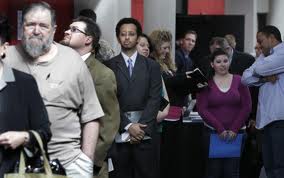
Election 2012: Forget the Gays! Let’s Kill the Middle-Class!

SCENE:

A mob of men and women sporting haute couture ensembles are followed by domestic staff brandishing fiery torches, weed-wackers, and gilded “breaking ground” shovels move at an accelerated pace (note: they are not running; they never run; they simply walk with tremendous determination) between the craggy, overhanging cliffs somewhere near Malibu or the tall, dense sand dunes near the Hampton’s.  They scream hateful epithets like “And you thought Polo was just an after-shave,” or “Only a monster prepares his own taxes,” or “Even a hunchback is beholden to religion for its servile and miserable life.”

CUT TO:

A group of men and women run up narrow, rocky paths or stumble through swallowing, deep sand.  They’re absolutely terrified, and yet they clutch one or two possessions (laptop, picture frames, deed to a house) even though their requires two hands.  You get the sense that they’re clutching all that remains of their life.  Suddenly a heavyset, winded man loses his balance and though others try to grab his free hand, they yell things like, “Let go of the picture,” or “It’s only a college degree!”

But suddenly he holds the framed diploma tightly against his chest as he teeters over the edge and everyone watches as he falls into the abyss tightly holding his most precious possession.

Welcome to December, 2012 if the Republican machine takes hold of the White House.

I think that it’s perfectly normal to ignore distracting noise, especially campaign noise, when 120% of your attention to personal-matters-at-hand is parsed and you’re really not interested in cockfighting.

That is until your private AGI (adjusted gross income) permits political campaigns to assign you a specific economic class moniker. The herding of same AGI’s should get your attention.  Once you’ve been economically branded you begin to recognize topics related to your self-proclaimed monikers (or, sub-classifications) which label behaviors and values, your distinguishing parts, (which you once defended, affirmed, and proudly paraded). These distinguishing parts have been diminished by time into a complex, amalgamated you much less the “youthfully combative sum of your parts” and much more like your mother or father (with very distinctive differences).

Until the amalgamated you becomes campaign fodder, a cadaver dissected in public by wielding derisive displays of contempt and hatred resurrecting foregone battles to right history’s wrongs and to spread fear like an airborne toxin.  How on earth, you think to yourself, have I been put on the ballot?

Because the run for leader of the free world has nothing to do with leading.  It’s become a referendum prosecuting or defending the future of the middle-class.  The American middle-class: devoted family, work ethics, values, respect, you get what you can afford, hard-working, proud, stable, honest, neighborly, caught. . .in the middle. . .of change.

But greed changed all that.  First bankers got greedy, then brokers got greedy, the home owners got greedy, and then. . .lower to lower-middle class were qualified for mortgages on real estate which was falsely inflated to satisfy everyone’s greed.  Families that simply couldn’t afford to buy a home found themselves underwater (owing more that the home is really worth.  In other words sellers, brokers and lenders all told varying degrees of lies and the poor schmuck wanting his piece of the American Dream ended up being the real sucker in the scheme.  But not one banking executive has gone to jail or forced to pay for those lousy mortgages out of their skyrocketing profits.

“Go Ahead,” they urged, “See If It Fits.”

According to results recently delivered to scientists at an annual meeting of the Categorize, Classify, and Typify Society that more than 92% of the American workforce can be identified as bearing the common traits associated with one of only two populations: unaffectedly round or affectedly round.  Of the 92% of American workers, 97.639% fall into the unaffectedly round while the remaining 2.361% not only self-identify with the characteristics associated with affectedly roundism, but maintain those characteristics no matter the consequence or makeover.  But the most surprising statistic was satisfaction: Nearly 100% of both populations felt little job satisfaction.  And as an addendum, most professionals believe that the hole which they currently occupy doesn’t accurately represent them,

It had been six months since the crash and like so many accidents turned a normal life into a new normal life; I’m not saying that the normal was better than the new normal; I’m simply using pre-crash as a point of reference of which to compare. My normal life had all the normal things: A life partner of 23 years named Nick, a beautiful Victorian home, a cute little MINI convertible, lovely gardens, custom clothing, Rolex watch, retirement accounts, money in the bank; all the trappings. But as the old adage goes “nothing in life is free” and I never knew the cost of having all the normal things until June 28, 2008 when I was not one of the normal things; as a matter of fact, I was one of those new normalists substituting for the normal team.

How many of us continue to force a round peg into a square hole only to find it frustrating, angering and eventually impossible? Some of us can manage to get a corner in, some of us trim the excess by dummying down or taking jobs beneath of us, some of us simply place the round peg atop of the square hole hoping one day one of them will change enough to fit.

On June 28, 2008 I finally realized that I would never fit into one of their holes. My roundness wouldn’t even fit into their round hole because much like metric versus english, a wrench which looks like a close fit isn’t a fit at all and simply won’t work.

Whew! 15 Minutes Is A Long Time!

Being the subject in a feature article which appeared in the first section of the Sunday edition of a US major newspaper like the Chicago Tribune was wholly a great experience, but also one in which I am relieved is diminishing in attention.  Like a child standing abreast the Sundae Buffet Bar at a local eatery piling one bizarre topping atop the last, the news cycle here in Chicago has a short attention span, especially when the subject (me) is an unknown (me).

It was the condition (bipolar); its manifestations before diagnosis; the odd behaviors preceding a mental breakdown; the swath of tawdry details, hateful accusations, and trust-damaging honesty laid bare which piqued their interest. The reporter who, with an eye focused on sensitivity, remained intent to anatomize sequential events like they were the identifiable behavioral ingredients required to produce a blue-ribbon breakdown pie.  She often returned to the timeline which, like a mooring buoy, guides a diver safely to the wreck.  However, my timeline represented a fall from grace, a clawing desperation numbed by opiates, acts of treason undermining my relationships; and finally, any semblance of sanity or allegiance to life was pitched like an unwanted circular.  The drilling for details only struck bedrock when trivial yet salacious activities, freely offered as context, had to be included in the article to highlight the stakes of my all in bet.

Absolutely not!  I would not be drawn-and-quartered on page 8, section 1, the entrails of my privacy displayed like human anomalies hawked at second-class side-shows!

I made it very clear: I’m not ashamed nor am I proud of my behavior, the pain it caused others, my professional devastation, the annihilation of trust, or the surrender of an identity.  But there’s a difference between honesty and privacy when it involves my life and the lives of those dearest to me.  I have been candid and explicit and straightforward.  But if your newspaper can’t respect what I say is private, then they must not respect what I’ve determined to be public.  In which case they can’t have any of it!

And that stand on my own behalf was my take-away.  Before 2008 I always felt like I had too keep going, had to get promoted, had to make six figures, because there was always somewhere to go, a place just beyond my reach that would be better, easier, calmer.  And on I went, like so many of my friends, pursuing. . .something. . .

After 2008 that place which had been so important to get to disappeared along with the constant gnawing I heard, and the “coveted by others” baubles bought to fill an expanding void where truth-to-self and character once resided, and year after year after year of acrimonious evaluations designed to hobble my self-worth.

I find great joy and comfort and silence knowing there really is nowhere else than right where I am.


Chicago Tribune Feature – Published Sun., Aug. 26

No rhetoric; no sublime style; no lexicons or etymology.  Pure and simple disclosure of disquieting issues.

Please, REPOST THIS ON YOUR BLOG.  Personally, I prefer privacy over publicity; I exposed my life in the hope that the stigmas of mental illness, obesity, and homosexuality might be reconsidered to be human conditions worthy of respect and empathy.

http://www.chicagotribune.com/health/ct-met-bipolar-20120824,0,3948031.story

Bipolar II disorder: Another Chicagoan’s story

Like Jesse Jackson Jr., Harlan Didrickson has the illness and has had weight-loss surgery

 Harlan Didrickson poses outside his Rogers Park home. (Chris Walker, Tribune photo / August 17, 2012)
By Barbara Brotman, Chicago Tribune reporter, August 26, 2012
Harlan Didrickson was a model of middle-class stability.He lived with his partner of more than two decades in a handsome Victorian on a leafy North Side street. He worked as manager of executive and administrative services for a high-powered architectural firm, where he made hospitality and travel arrangements for large meetings and oversaw budgets that ran into millions of dollars.He was not the kind of person who would go to lunch with friends and come home having spent $4,500 on a puppy and a month of obedience training.

Or who would get up at 2 a.m., go to Dunkin’ Donuts, then drive to Indiana and back, snacking on Munchkins.

But that’s who he became.

Four years ago, his life was upended by bipolar II disorder, the same illness recently diagnosed in U.S. Rep. Jesse Jackson Jr.

This is not Jackson’s story. People with the disorder — nearly 6 million in the U.S. — have unique experiences with the illness, which cycles between moods of manic energy and deep depression.

“The symptoms of bipolar disorder can be very different from one person compared to another,” said Dr. John Zajecka, a psychiatrist with Rush University Medical Center who specializes in mood disorders.

Manic states leave some people euphoric, others irritable. “There are people who can function their whole lives in these hypomanic states,” though they may lose marriages, jobs and money, Zajecka said.

Depression, too, can appear in a variety of ways. Some sufferers stay in either mania or depression for decades; others cycle between them many times a day. And people respond differently to treatment.

But Didrickson’s struggle provides one look at how bipolar II disorder and its treatment can affect a life.

And he does have one key factor in common with Jackson. Like the congressman, Didrickson, 54, had weight-loss surgery before being diagnosed with bipolar. He had a gastric bypass procedure; Jackson had a duodenal switch.

It became a serious complication in his treatment. The weight-loss procedure, which causes the body to absorb fewer calories, prevented him from absorbing the full dose of his antidepressant medication.

Didrickson’s illness began when he started feeling extremely stressed at work. He considered himself skilled at his job but felt beleaguered by office politics.

“I felt as though I was fighting a lot of fights on different fronts in my life, and that I didn’t have the wherewithal, the energy,” he said. “I was profoundly unhappy.”

He changed jobs, twice. He still felt miserable. And he also felt trapped, having to do work he now found unbearably stressful.

More than 60 percent of people with bipolar engage in substance abuse as they try to self-medicate their inner pain. Didrickson was among them. At night he would wash down some hydrocodone, an opiate he had been prescribed for a back injury, with beer. He would stay up till 4 a.m. watching TV, then take Ambien to fall asleep.

“At 6 o’clock I woke up, got dressed and went to work. I was probably still high,” he said. “Then somewhere around noon, I would crash. I would go to the men’s bathroom, go sit on the toilet and fall asleep.”

His partner, Nick Harkin, a publicist with an entertainment and lifestyle marketing firm, had no idea how deeply troubled Didrickson had become.

But then Didrickson didn’t show up on time for a planned out-of-town getaway. When he arrived the next day, he was morose, secretive and exhausted. “It was a very abrupt shift,” Harkin said. “It was quite obvious that something was very seriously wrong.”

Didrickson was thinking of ending their relationship, he told Harkin. And he wanted to move to California’s Death Valley. He wanted to start a new life.

“I was falling apart,” Didrickson said. “It was this desperate: I will do anything to get out from under this pressure.’ It was like having a heart attack, and if you don’t get out from under it, it will kill you.”

Back home, he called a friend who had once been his therapist. She asked if he was suicidal.

“I was, like, ‘Of course I am. I think about it all the time,'” he said. “‘It’s the only comfort I have.'”

She told him to see a psychiatrist. He did, and was told he had depression — a common initial diagnosis for people with bipolar, who generally seek treatment during a depressed phase of the illness.

The antidepressant the doctor prescribed didn’t work. Didrickson developed memory problems, to the point where he forgot how to do simple tasks like using a phone.

“I could not take a shower, because I couldn’t recall the sequence of activities … turning on the water, stepping into the spray, getting wet, washing,” he said.

He lost 40 pounds and neglected bathing and grooming. And yet there were also times when Didrickson felt powerful, energetic, nearly like a superhero. He could do anything he wanted, no matter how dangerous or destructive, with no consequences.

He ran red lights. He drove the wrong way down one-way streets. “I felt like I was back to being in charge, like I was back to saying, ‘It’s going to go like this because I said so,'” Didrickson said. “I felt kind of emancipated.

“I thought, Wow, this (antidepressant) Paxil is really working.'”

But it wasn’t. A psychopharmacologist gave him a new diagnosis: bipolar II disorder, a form of bipolar disorder with less extreme mood swings.

His new doctor told him to stop self-medicating — Didrickson said he hasn’t had a drink or abused a drug since — and put him on a mood stabilizer. And then began the painstaking process of trying to find the right antidepressant: six weeks getting to a therapeutic amount of a drug, then six weeks being weaned off when it didn’t work, again and again.

“My symptoms came back. I just felt terrible,” he said.

He was still manic, once getting up at 4 a.m. to drive to Lake Shore Drive to look at newly fixed potholes. He spent money recklessly. He spent hours obsessing over the paper stock to use for custom stationery.

The manic states always turned dark, ending with him lashing out at people — usually Harkin.

“When I begin my mania, it’s a great party,” he said. “But when it gets to be months into it, it gets uglier and uglier and uglier, to the point where you really are a monster.

“Mania isn’t happy; mania is crazy,” he said.

No antidepressant worked. Then a friend with bipolar recommended Adderall, the stimulant often prescribed for attention deficit disorder.

His doctor prescribed a standard amount. It did nothing.

So Didrickson took another dose. And he felt a little better.

“I started to feel buoyant,” he said. “I always talk about feeling underwater. I felt like I was finally breaking the surface.”

He didn’t know why he needed a higher dose. But then he came upon online message board postings by people who had undergone gastric bypass surgery and then found that their antidepressant medicines stopped working.

The gastric bypass surgery he had undergone years earlier to lose weight, he concluded, was keeping his body from absorbing the medicine.

Indeed, Zajecka said, gastric bypass surgery can change how people absorb medicines given for bipolar disorder.

The Mayo Clinic statement announcing Jackson’s diagnosis also noted that the weight-loss surgery he had “can change how the body absorbs food, liquids, vitamins, nutrients and medications.”

Didrickson’s doctor would only marginally increase his dosage of the notoriously abused amphetamine. It wasn’t until he switched doctors because of a change in his health care coverage that he got what he found to be an effective dose.

His longtime internist, Dr. Eric Christoff, assistant professor of clinical medicine at Northwestern University’s Feinberg School of Medicine, gradually increased Didrickson’s dosage, with weekly appointments to check his blood pressure.

The depression lifted. He has been on the higher dosage for a year and a half.

“We have never seen any evidence of drug toxicity or high blood pressure,” Christoff said. “He’s really not absorbing much of any dose he’s taking.”

Many people with bipolar disorder are able to resume their previous lives.

“It’s one of the most treatable illnesses we have in medicine,” Zajecka said. “If it’s diagnosed properly and treated appropriately, there’s no reason they can’t get back to resuming a normal lifestyle and their normal goals in life.”

But Didrickson has been unable to go back to work and still has periods of depression and mania, though much milder ones. He manages the house, cooks and has taken up woodworking.

“Going out in the evening can be very, very, challenging for him,” Harkin said. “If we go to a concert or a dance performance and it’s too noisy, he’ll have to leave. If … there’s someone in a film who’s violent or cruel, that’s very upsetting to him too.”

“It’s nothing like I thought my life would be,” Didrickson said.

“The good thing, I guess, is that I don’t hold on to yesterdays,” he said. “That’s a blessing, I think, frankly. But I also don’t have tomorrow. My life isn’t about tomorrow.”

He has gone back to writing, which he did in college. He writes a blog about his experiences with bipolar, under the name T.M. Mulligan. The moniker stands for “Taking My Mulligan.”

“I’m having my do-over,” he said. “I’m taking the second chance.”

Copyright © 2012, Chicago Tribune

My One and Only Rolex

Fifteen years ago I developed an obsession for Rolex watches which eclipsed practically every other interest or desire.  Its greatest impact was felt by my spouse: He was hostage to my unyielding resistance to any gift that wasn’t a Rolex.

Eventually Nick’s patience and resolve buckled beneath the burden of my expectation.  One Christmas he handed me an easily overlooked brown paper bag.  As I took it from him I felt a significant heft; I heard a steel bracelet shift at the bottom; I spied a bezel and Oyster case peeking out from an afterthought of concealment.  I slowly lifted the folds of vaguely familiar tissue paper which revealed the indubitable shape and renowned style of the classic stainless steel Rolex.  He said he’d been looking for one (for almost a year) when the week before a dealer called to say that a customer recently presented a used (and much older) Rolex as a trade-in and it’s “as-is” retail price is with-in Nick’s price range.  He purchased a Rolex manufactured in 1958 (the year of my birth) and it wasn’t until this year did I learn the historical significance of this watch.

A month later I found myself overheating in a Puerto Vallarta hot tub.  I dragged my lobster-red body to the swimming pool and jumped in.  Upon surfacing I heard Nick ask for time. While wiping away the stinging chlorinated water I noticed that there was moisture condensing on the inside surface of the watch crystal.

The Rolex watch is often perceived as an extravagant luxury and status symbol outshining its fundamental purpose: telling time.  But Rolex, SA (manufacturer) has played a significant role in the history of the wristwatch.  Rolex, SA can lay claim to being first at: automatically changing date on face; show two time zones at the same time (GMT Master (designed by request of Pan Am pilots); automatically changing day-and-date on face; earning “chronometer” designation (meaning that it’s mechanical movement is extremely accurate and consistent that it can be used to navigate ships.  But the fundamental and most notable characteristic (which it achieved first in 1926 and again in 1953) is being waterproof (1926); not water resistant; waterproof to a depth of 330 feet BSL (1953).

Obviously Nick’s gift had forfeited that foremost characteristic.

I was greatly disappointed that the Rolex Nick had worked so diligently to uncover had been compromised by irony: its fundamental purpose (time keeping) was also its assassin (time passing, i.e. years of use).   I took the infirm watch to the only certified Rolex repair center in North America (at the time) and was saddened by their conclusion: it would cost more to rebuild than the price Nick paid.  A friend gave me the phone number of a reseller in Georgia that represented Rolex watches on consignment.  Overnight I received three brand new stainless steel Rolexes from which to choose.

When I slid on the first, then the second, and finally the third I had exactly the same reaction: These Rolexes had lost their mystique, their meaning, their value; these were simply very expensive watches.  (And frankly, my time isn’t that valuable!) 

The watch given to me by Nick was, in my opinion, the only true Rolex because it was the one he generously gave me.  I wanted that Rolex; and I wanted that Rolex to function like any other Rolex.  So I returned to the Rolex repair center and placed it in their expert hands.  Six months later it was returned to me in pristine condition.  It is now thoroughly serviced every three years to keep it in working order.

So why did I share this with you?

You may get what you ask for in life, and while it may not be exactly what you wanted, you were very fortunate to have received it.  It may be imperfect, or damaged, or used.  But it is less about what you’ve been given, and much more about how you hold it, what it means to you, and how you care for it.