One Step Forward, Two Steps Back

adepressedgal

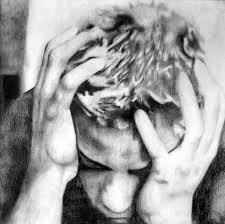
A few weeks ago I was incapable of simply managing daily routines such as bathing; I couldn’t process dual stimuli so if I was brushing my teeth and a faucet was turned on my attention went to the running water and my brushing slowed to a stop as though someone had killed the power. There was no conscious thought besides a gnawing, chewing darkness as though black velvet curtains had been suddenly drawn, shutting out the noonday sun. If I was present I was only present to the fact that I had, almost immediately fallen down a deep tunnel of which there was no light and no escape and no orientation. Or better, as though I had been swallowed by the immediate mud-slide of my life and in complete darkness and suffocation I simply held on to the one hope that maybe my prescription would act as a breathing tube offering me much needed oxygen as Nick, my psychiatrist and friends and family kept begging for me to hold on as help was on the way.

Two days ago I traveled north to Milwaukee to spend a couple of days with my older brother. We sat for nine hours the first day and six hours the next simply talking. Well, I talked and in a profound gesture of brotherhood generosity he listened interjecting sparingly opinions. It was an exhaasadguyusting experience met with fatigue, resistance and weeping, but I plowed through years of illumination, insights and epiphanies. It was the first time that I was able to track the experiences as they evolved much like tracking a lion or bear by using their footprints in a densely green forest. It was the first time that I was able to collect and sort, catch and dissect, speak and understand a monumental array of thoughts, failed expectations, compromises, distance and pain. My life for the past three years had been laid out before me like a table at Thanksgiving; every piece in its place awaiting their purpose.
Each day my energy has slowly begun to return and I grow stronger. I am still wobbly and use the assistance of a cane to walk; my gait is slow as I amble to the post-box or to the doctor; I often lean upon it when I tire or grab a hold of a fence or the arm of Nick.

But the most important, painful, and fool hardy admission was that I had erected my life cantilevered and precipitously atop a ravine simply adepressedman1for the view.  Then one evening a mud-slide swallowed me, my partner and his family, my career and others at work, my family and friends.   And now, standing at the base of change, the annihilation of my overlooked life, I now stand alone before this devastation, try to catch a glimpse of any familiar object in order to delay the inevitable: to once again try to salvage any pain my uncaged manic self inflicted

When “Whom” Lost Majority To “What”

Bertolt Brecht (1898-1956) called it Estrangement;
Luigi Pirandello, Nobel Laureate ( 1867-1936)
is often quoted as saying,
“. . . it is only a mask that man unconsciously assumes
in order to adapt himself to the social context in which he finds himself . . .”

abrecht2What was it that playwright and director Bertolt Brecht and Nobel Laureate and playwright Luigi Pirandello explored and recreated in the 1930’s?  Brecht called it Estrangement; Pirandello’s later works were framed self liberation by Disconnection. Both Brecht and Pirandello explored similar ideas through their plays and novels; and both arrived at the same intersection with theories and one fundamental question for audiences:  What condition or cause affords us to be estranged or disconnected, i.e. emancipated from a predictable life?  Both writers agreed:  We (representing humanity) wear various masks, depending on who we’re with, where we are going, for influence, or lust, or determination.  They challenged critics and writers alike by writing/directing that actor’s portray a character by imitation, impersonation, and isolation.  While they both wrote some of the greatest plays of the modern age, it was Brecht who pursued his theory of Verfremdung(They both wrote plays which explored their hypothesis:  but it was Brecht that had the advantage by writing and directing his plays).  Being both playwright and director he had the good fortune to write; test it on stage; rewrite . . . and so on, amalgamating ideas and discarding all but what worked within the Estrangement Movement: the actor isn’t the actual character, but a surreal representation of a character inside the play.  

Does that sound, in any way, familiar to you?  You’re not really crazy, you’re simply acting out; You’re not really crazy, you’re just vying for attention; you’re not the type, you’re just saying suicide to make me feel guilty.  So maybe you’re the shy but lethal type?  You stay in your room or apartment or Malibu Beach bungalow.  Maybe you have these conversations with . . . the character you play in your melodrama. It doesn’t matter which target you’re aiming your epithets.  Most of them don’t make sense any way.  In your gut you know you would never say or do any of the hollow threats or cynical promises.  Those things belong to the character you’re playing.  But the redemption you sought and were politely given isn’t yours to keep.  It belongs to that character you play (“a very convincing performance,” someone had said to you).

Your illness, it’s debilitating effects, duration, severity, and recovery provides a pension of patience and politeness.  But you’ve become conscious of a hushed and tiny change like a slow drip that floods a basement if ignored long enough.  This change, odd enough, isn’t about gettingappirandello smaller.  Indeed!  This change or sense of change remains like an irritating allergy.  And then, one day, one fine day, one more fine day, not another one fine day . . . you awaken to a certain degree of disorientation; you check your watch for the day of the week; the house has an eerily empty air; as though time simply passed by leaving you undisturbed.  You walk to the kitchen and see that the mundane morning rituals were indeed completed and one set of car keys was missing from the hook.

A magnificent change occurred during the night.  Quite similar to the fate of Kafka’s Gregor Samsa without all the bugginess.  The world stopped interacting with me as a lover,  friend, colleague, church member, brother and began to interact with me as an illness.  It’s as though a giant magnet simply plucked me out of my life, then delicately placed Mr. Mental Illness, a clone of me with one obvious exception:  it lacked me .  But this likeness, it was showered with change; attention when I spoke, belief when I discussed my illness, even slowing our pace to a speed I could manage.  A World of Magnificent Changes!

But it wasn’t quite the nirvana I’d thought.  In this World of Magnificent Changes it was expected that I would welcome the absence of all those akafkadecisions I had to make, like going to parties, movies, late dinners (“oh no, he won’t come, he has trouble with evening events,”); brunches, art museums, and botanical gardens (“Yep, both of us.  He likes daytime things,”) meeting friends for dinner, spontaneous day trips, “grab your-jacket-we’re-going-to-see-a-show-with-Richard (“He can’t do it, was all he said, he simply couldn’t do it.”)  All that life lost because of my illness has been changed to “What life lost; it’s who he is now.”

Like characters that Brecht, Pirandello, and Kafka created in an attempt to understand their cultures, I too, had been hard at work creating mine, and then training those around me, and then Opening Night/Opening Day when I was no  longer a guy with mental illness. Instead the world sees and interacts with my mental illness.  The old me’s been retired.


Mr. Buchanan’s Peach Orchard

apeach1

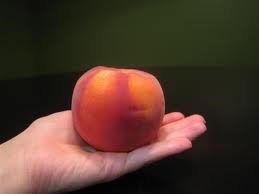
Today I feel like that carefully selected peach.  The one picked for its promise, for its intention, for its springtime when its dense pulp prediction comes of age.  Hands coddle, gently squeeze, study its color palette, infer its density.  This is the One; I can hardly wait for its cotillion; the fuzzy skin taught like an umbrella tested by exuberant winds; at long last its flesh liquefies into sweet extract; itself a parity of perfection.  

Arriving at its destination, it is cautiously extracted from the tote and collides with a biting downpour, where it’s tossed from hand to hand like packing the first snowfall’s first snowball.  Flour-sacks turned drying-towels swaddled the tender pelt, familiar with its shallow depth and bias favoring lacerations, the freshly showered peach sustains a dozen instinctive pats then takes its place among the others.  And waits.  And waits.  And waits . . .

Some are gone, snatched like field mice from above.  Others suffered dismemberment; a knife tilled dry mortality then quit, flushing succulent hope into the dust bin.  The remainders eroded to the Italian-painted bottom and waited.  While waiting each of us, privately, felt the shock when its flesh gave-way; and the longer our wait the greater our deterioration.

Where did they go, we thought collapsing, the intoxicating eyes that radiated suggestive, wanton, and greedy fortunes?  Where are those fussy hands that arranged us in the Italian-painted bowl like fowl on a nest?  It was upon the scavenger fruit-flies arrival did we sense movement then the iciness of steel pushing us closer, some clinging then scraping then tumbling, airborne, as though I were that one fortunate seed that landed on that one fortunate acre that grew into one of many fortunate peach trees in Mr. Buchanan’s orchard.

apeach4


“First Door On The Right! And Be Careful . . . !”

“Awe, crap . . . !”


a-crapper1

Those were the final FCC approved two words which fell from my mouth in his parent’s first floor powder room (which remains a gallery for the family’s monogrammed and sun-bleached bathroom set) a nano-second after I recognized a rising water level in the bowl.  Debris would leisurely bob and dunk as an improbable fresh water toilet tank tsunami added gallon upon gallon upon gallon of fresh water that was uplifting the residual debris which were bushwhacked by the unexpected gridlock, and now cascades down the cold, white porcelain moving across the floor like urban crawl, defiling everything in its path.

At which time I foolhardy reached for the precious, handed down through generations, hand woven and monogrammed bathroom set

a-plunger1(upon which not a single drop of moisture touched it’s surface) but has hastily been inducted into the Le Grand Corps de Craps, an esteemed pile of rags: been somethings, used to be used for, or, it had wiped his bouncy little bottom well past ten.  Now retired and living out their days as “first responders” should absorption or heat require instantaneous dispatch, each of them, whether flannel, Egyptian Cotton, or terry cloth are proud to arrive at the incident first and they all know that this or the next alarm might be their last.  But every single member of the Le Grand Corps de Craps hopes and prays that their final call isn’t a clogged toilet.  After all, who wants their coup de grace to be wiping up someone else’s crap.

a-hellokitty

Simple Square Box and Coasters

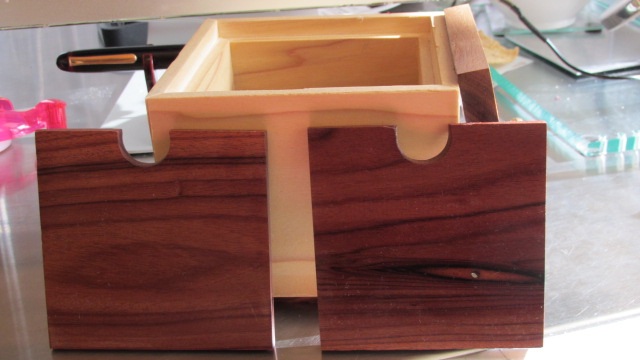
image I’m pleased to share my latest woodworking project, aptly named Simple Square Box and Coasters.  The commission originally asked for a simple slap-together wooden box in which he could place a necklace he purchased for his niece as a Christmas present.  So the slap-together wooden box would be tossed into the same heap of recently bloomed ribbons of nylon and a pile-up of ripped and twisted wrapping paper resembling a fog-induced tangle of abstract alloy.  Really, who remembers the wrapping paper of a long-forgotten gift they received at an indiscriminate holiday, the exception being gifts which modify destiny such as an engagement ring, new car, or divorce papers.  But I couldn’t imageshake the thought; an insignificant wooden coffer hand-crafted to exact dimensions whose sole purpose rose no higher than the oft ignored cardboard box, one of millions prefabricated generic boxes produced by manufacturers. Yet this box really should´ve been seen as the first part of her gift, but instead was just another obstacle to obliterate in a doggedly pursuit of the delightful bauble inside.  And after a few perfunctory refined and delightful “thank you’s,” the delicate bauble was distractedly deposited into her motherCoasters on Display´s cupped hands.  Her mother  placed the bauble (whose importance continued to nose-dive like the stock exchange in 1929) among other gifts.  And the slap-together box had been exiled to the paper mountain, and eventually would be crushed by the insensitive jaws of an indiscriminate refuse collector. Had I blithely reached into my pile of left-over lumber and found a throw-away board I suppose the box would experience a fate very similar to the one above.  However, a particular piece of Poplar caught my eye because of its deliciously creamy base color and like a dried riverbed, a thick, malted-milk brown ran the length of the board which was absent of blemishes, gouges, chips, and knots, a cappuccino’s foam decorated by a creative barista; or, the faintly dusting of heat transforming the peaks of whipped meringue from snow-covered to densely charred remnants of a serial forestimage fire.  I held the six-foot board respectfully in my hands, looked for cupping or warping at its ends like a sharpshooter whose focus remained on his target.  I found the board to be true then placed it on the workbench to calculate the cuts. That’s when it began. I can’t find words to describe it, but it was like balance on a bicycle: no one handed you a ball of balance, you simply had balance.  My experience with that board couldn’t be taught or handed down.  It wasn’t an indicator of mania.  It was simply, to respect the trees life in the differing colors of its rings.  Those rings identified that tree like fingerprints identify people.  And yet it was more:  I felt a growing sensitivity and responsibility to work with the lumber to create an object of beauty.  The longer I listened to the sensitivity of the wood, the greater my awareness of the woods signature became.  It was then that I worked with the wood, and so did the wood with me.