
What It’s Like


Upon awakening I remember that today is just one more day in a long line of days and while I know there’s an end to the string I can’t yet see it.  Still under the weight of Clonazepam I haven’t heard Jenni bounding down the stairs ready for a romp.  This hour or two is what I call my lay-over: I’m between medications neither of which are therapeutic; both of which masquerade symptoms of my mental illness.  Heavy and lethargic I pause a moment bedside to take a 30 second assessment of mood, same as last time, whenever last time was.  My memory of yesterday is monochromatic: I’m aware that things happened, but their details blend into the blizzard; yesterday and yesterday’s yesterday and all their predecessors simply disappear during the night.  Even painful arguments, bad news, anger and disappointments flee and aren’t carried forward, but get stopped at the border; most get turned away; a handful are waved through, arbitrarily, and sit idly, stuck, their reason or purpose kept by officials at the border; memories without purpose are like pieces of truck tire littering the highway; of no use.

My medicine awaits: nine orange pills like little life preservers, taken at three different times throughout the day.  The Teva variety lift you quickly, like a propulsion ride at a theme park, but their half-life is only a few motivated, buoyant hours until the bridge disintegrates beneath your feet and down you go, debris tumbling to the bottom; the lethargy is impossible to escape, like a tar pit or a muddy slope, incapacitated you reach for your next dose.  My goal every day is simply to be productive and purposeful.  Incomprehensible on my own.  I hate the fact that my daily life couldn’t produce if not for these nine orange pills.  But without them depression causes my torso to ache, it demands darkness and silence, it prohibits hope, it sleeps.

As usual, at this hour I’m so tired I struggle to fix dinner, to talk to my partner; watching TV, if I wasn’t eating I’d be asleep.

This is what it’s like.  Probably a good thing I won’t remember this tomorrow.

Pages From The Past (Journal Entries, 2010)

The vestiges of my past hang at the back of my closet: Suits, shirts and ties organized by color and pattern; shoes and belts; whimsical cufflinks rest in velvet-covered nests in a wooden box; kaleidoscope silk kerchiefs lay folded in a drawer next to ironed linen hankies.  These things wait, set aside or put-away once the armistice had been agreed.  But these armaments which were once crucial to my survival now gather dust in a similar fashion to the life which wore them.   Like a warrior returning from a campaign, I now stand in unfamiliar territory: what once was my life is now my past.  I wish my reinvention were as simple as a down-sizing or relocation or economical result; but mine occurs as the result of a collapse of comprehensive proportion; I simply went mad.

My madness manifested itself in a broad incapacity to hold things together:  think Pandora’s box unhinged, and all of life’s graces emancipated from the mind which held them captive; a purging, or emptying of clutter; raging torrents of once-organized-now-disassembled debris of thoughts; memories like photographs tossed to the winds; a palette of emotion falling face down, once true colors now soiled creating strange and unpredictable influences; flair, forte, savvy and knack bundles ripped open, their dusts snaking across the ground or swirling in the air; fresh conversations gushing at first but slowing to the trickling of archaic chitchat; a tool shed of implements strewn across the prairie; and an inky sense of dispassion swabbed across its interior.

Blindness eventually annexed madness: an incapacity to witness authenticity:

June 26, 2010

 Yesterday turned into one of the worst days I have had in a very long time.  My niece is visiting us and I guess I was a little edgy about that: she’s a precious yet precocious girl; but having someone new in the house, especially one with such unbridalled passion for life is, well, overwhelming.  And the places that I normally go to enjoy quiet time, the lakefront for an early morning walk with Jenni, was filled FILLED with people in various colors of spandex and rubber all waiting for the start and/or finish of some race or another.  Therefore, the cadence of steps while walking a dog was intermittently interrupted by throngs of sweaty people moving in packs like gazelles down the savannah.  It just didn’t turn about the way I had expected, and change is incomprehensible.  My partner of 25 years is such an incredible sport through all this: so supportive and understanding.  And while I like the euphoria and focus the Adderall does provide, it also gives me a sense of urgency about things which I am am uncomfortable wth and unfamiliar.

By the time my group support meeting rolled about I was already feeling very irritiable, and had it not for my niece’s preference to remain sequestered in our Edgewater home as opposed to an adventure amidst world-class art and history museums, my other choices were a room full of depressed or manic middle-aged gay men (where are all the young and beautiful depressed or manic gay men I’ve often wondered) or the crippling jaws of a ravenous city whose downtown was infested by oblivious and awed visitors, unaware that the city is our home, not some ruin on the mediterranean; given those bleak options I may have opted to simply stay in the relative safety of my backyard and enjoy its serenity.  Perhaps there’s nothing I really want besides not having this mental illness, as it wreaked havoc on my yesterday.

The breakdown which occurred emptied out the contents of my mind; in the past two years I haven’t so much as been piecing them back together as much as letting old things back in if needed.  There are some memories best forgotten; there are some experiences best left in pieces; regrets seem to have their own distinct pile; I do feel somewhat hobbled together, as though the first me, the pre-breakdown me accumulated things like an attic; and for the most part many of these things, while important at the time, ceased in their importance, and therefore were forgotten.  There are piles and piles of those things; there are sharp pieces of glass and mirror strewn everywhere, memories of moments when my appearance seemed important: but more that anything, there is an emptiness I feel, as though I were walking about an outdoor market an smelling and squeezing and weighing items which might make their way into my mind: the harbor this morning; Jenni in a puddle; Nick’s smile after his first mouthful of a warm dinner on a cold night; winning at cards; I want to learn to be okay with less.  Less is lighter and mobile.

June 28, 2010

The Adderall seems to make me very anxious and quick to draw conclusions.  I find myself to have a very short fuse.  Without the Adderall I felt that the world was moving slowly. That my mind wasn’t filled with this scratching sound, as though the inside of my skull was being scratched by long fingernails; or white noise which fills my head with noise.  I find I am soothed when I am surrounded by quiet and calm; I find that when I ride my bicycle I am surrounded by quiet and calm and the errant tinkle of a passer-bys bell.  I haven’t felt euphoric since the first dose of Adderall a week ago.  What I do feel is a need to move.  To be doing something.

I’ve been waking earlier than normal these past recent weeks.  Because of that I have been taking Jenni out for her walk.  When I was struggling with my sleep meds for the past year, Nick has been kind enough to get dressed, even in the harshest of conditions, and take Jenni for a walk.  She doesn’t seem to mind the weather, though.  There were days upon days when I literally couldn’t pull myself out of bed in the morning.  And on quite a few of them I’d find myself sleeping past the time Nick would leave for work.  It was all a very difficult time, and not one in which one learns very much; I was dealing with all the symptoms of mania or depression that I never really spent much time on me, or what I would do.  One of my biggest losses is my lack of desire.  There’s nothing propelling me towards anything.  It’s not that I feel adrift.  It’s that I don’t really feel anything.

In these past two years I have surrounded myself with an environment in which I feel safe.  It is quiet when I need it to be quiet; there are guests when I know there should be guests; I can nap when I feel tired (which is still daily); it’s as though I’ve created this little world in which I live.  And I’m very comfortable here.  It’s when I venture outside of the environment that I feel most terrified; crowds; noise; hostility; aggression; these are the things which unnerve me.

The coffee is set to brew at 6:00 a.m.  We’ll load into the car after that and go to the lakefront for a walk.  I hope that this too doesn’t become common place.  I just wish I knew what was normal from what has been reengineered.  I yearn for the mental march of my first fifty years; these past two year of reconstruction have been uncomfortable and confronting.  Much like, I assume, the construction of an adolescent.  Except that society accepts the adolescent, where society shuns us.

 July 7, 2010

The anniversary of my breakdown was met with a variety of emotions: On Sunday, 4 July my partner and I were on a bike ride from Winnetka to the Botanic Gardens.  It was a warm and muggy morning and we had already logged a 1.5 hour walk with Jenni earlier that morning.  But there were a number of bicyclists already on the narrow trail and often they would pass us at a high rate of speed or say “on your left” to alert us that they were passing.  All these things seems normal enough, but for me they were very stressful.  Eventually I couldn’t even achieve the Botanic Gardens and had to stop by a lake and under some crab apple trees for a rest.  More than physically tired, I was emotionally tired and felt myself on the verge of tears.  I was deeply saddened by the reflection of my former self, my post two-year self and his physical and mental strength to ride a bike in a crowd, and this present timid, cautious, and moody bicyclist rattled by the velocity by which he was being passed.  After some time had passed Nick graciously offered to ride back alone to the car and return, but I idiotically and stolidly mounted my bicycle for the return trip to Winnetka.  Once back on the trail, again we were passed by menacing and reckless cyclists which aggravated my sense of diminished capacity, and which catapulted to the present my mentally weakened state.  This sadness disintegrated into an overflowing of tears and weeping which sidelined our forward progress towards Winnetka.

July 10, 2010

It feels as though I’m sinking into a lower depression.  The days seems harder to muddle through, and without the Adderall, I’m afraid I wouldn’t be of much use.  Nick being on vacation is making me a little nervous as I know that he likes to be busy, and frankly, though I provide a lot of the housework around here, I’m afraid that he’s going to want to do more than I’m used to doing.  So I will try to keep up.

The crying spells from last weekend alarmed both Marge and I and it’s something I should start to talk to Corey about.  Perhaps we should start experimenting with anti-depressants again.  I’m not too concerned that they will trigger mania; mania would be a relief from this constant, senseless existence.

By-(pass) & Bi-(polar)

Please note:  If you know of someone who has had gastric by-pass surgery and is having similar experiences as I’ve described, please share this post with them.  They can send a note to: questions@bypassandbipolar.info.

Fact:  We cannot predict the future.  Fact:  Life has no guarantees.  Fact:  New ideas can be both liberating and debilitating.  Fact:  Those offering a service resulting in permanent physical modification should fully understand the immediate impact as well as future consequences.

Myth:  The Medical Community at-large fully understands the alternative treatment options researched and developed by medical professionals specializing in gastric by-pass surgery due to the post-gastric by-pass patients insufficient absorption of oral medications.

It’s been ten years since I elected to undergo the radical Roux-en-Y gastric by-pass surgery and permanently remove most of my stomach and a length of my small intestine.  The alienation of these two components produces significant weight-loss because: 1) You can’t eat much; and, 2) You can’t absorb much.  Yes, there is a fair amount of adjustment, but the weight literally falls off and stays off with an average regain of ten percent.

Remnants of the “old you” are carted to resale shops or, in my case, high-end tent and boat sail manufacturers.  Everything is absolutely wonderful until you hit a bump in the road say, like a complete mental breakdown. Psychiatrist’s whip out the antipsychotics and antidepressants like they were six-shooters; their effects are hardly immediate; many take as long as six weeks to burrow into your blood stream; still crazy?  No problem, the psychiatrist’s reach for the tommy-gun and another six-weeks pass; nothing.  Up and up and up we go until finally the two of us are sitting in a missile silo and his finger hovers above the launch button.  Dabbing his ever-perspiring brow with a cotton kerchief he mutters repeatedly, “this is unnatural, this is unnatural. . .”

It is unnatural!  Post-gastric by-pass patients have been modified, re-engineered; fundamental human mechanics, basic organ responsibilities, broad physical and chemical hypothesis tested and tried and approved by the FDA have little (if any) effect; we’re the svelte yet queer abomination of opportunistic, profit seeking surgeons that prey on the desperate obese willing to do anything to permanently lose weight.  Malabsorption is the snake oil the surgeons are hawking.

If I sound particularly harsh toward the bariatric profession it’s because I firmly believe that they have abdicated a large chunk of their responsibility not only to their patients, but to their fellow medical colleagues as well.  In  the ten years since I had gastric by-pass surgery, I have learned from a very reputable source, a doctor of some notoriety in the field of obesity, that to his knowledge, no one is, nor anyone has bothered to explore and/or discover and educate the medical community as to an alternative method of transporting medications into the body when oral absorption is impossible or only 25% effective (as is my case).  Or perhaps they could propose a mathematical equation which other medical colleagues could use to increase a gastric by-pass patient’s daily dosing.

The only medication that provides any relief from my mental illness is dextroamphetamine salt prescribed in a volume that aroused the suspicion of local pharmacists who publicly (in the presence of their staff and other customers) strongly suggested that I was either A) An addict or B) A pusher, then flatly refused to honor my doctor’s authorized prescription.

I suffer from a mental illness that kills 40% of those diagnosed by suicide; the commonly practiced treatment of prescribing oral antipsychotics and/or antidepressants is impossible because I elected to undergo gastric by-pass surgery ten years ago; if I become one of those 40% because the doctor’s that promote, promise, and perform these procedures have abdicated their responsibility to provide an effective treatment alternative in ten years, do me a favor: file a class-action lawsuit against every last one of them for their gross negligence!

And Yet She Cried The Day He Died

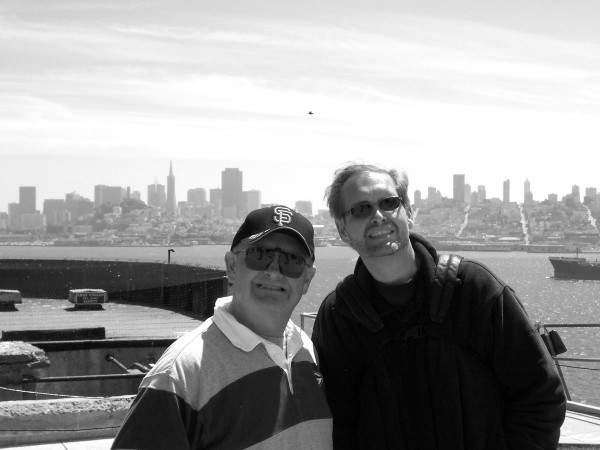
IMG_0838My earliest recollection of my dad came when I was four or five and he had come home from working as a second shift foas foreman at a drop forge plant.  He was sitting at the kitchen table eating poached eggs and dry toast, washing it down with a boiler maker.  “The Twins” as he would refer to them with great affection were my dad’s undoing; he would drink when manic, especially near the end of an episode, when his aching bitterness and resigned sarcasm hinted at a common premonition: he would soon retreat to his basement work shop for days on end tortured by his emotional evolution, and his inescapable march down the steep stairs of depression.  He must’ve been in the throes of mania  when convention insisted they marry upon discovery that his rakish bullying on the back seat of his Packard on a rural road outside Thorp not only massacred her wide-eyed naiveté but abolished any hope of extricating herself from beneath the clammy, sour-smelling, incoherent beast.  Her surrender of modesty produced more than forty-five minutes of vintage 1955 passion.
They found themselves in a stone-cold courthouse in Green Bay with a couple of bar friends to witness.  My mother clutched a small handful of wildflowers they bought from a farmer’s road stand that morning.  My mother was a beauty queen back in 1955, with full, red lips, wavy, blond hair that fell over her shoulders, and bright, anxious blue eyes.  She stood looking at my father, the barrel-chested, dark-haired, first-generation Norwegian she met less than one month before.  I’m certain that neither one of them intended for the wedding to be the result of a quickie in the back of a sedan on a country road, but in 1955 it was more important to uphold convention than it was to be in love.  No one ever questioned their motives in getting married, instead hoping and wishing them the best of luck in the new life together. They never won the prize of a 1960’s nuclear family, a foursome driving a new sedan, owning a new house in a new sub-division, boys going to the standard public school, belonging to a crisp, new Catholic church, it just never happened.  It never worked out and eventually corroded beyond what was once recognizable as a relationship, and turned physical, my father opting for punches and slaps instead of hugs and kisses. I want to believe that it was hard for both of them, especially my mom, of course, but also my dad, landing punches onto the delicate face; the face of a woman that once he had found so attractive that he invited her to share his rumble seat.  I want to believe that neither of them was a monster, that neither of them hated the other, that maybe, in the beginning they held the same blind, young hope that life would work itself out.

It started with a cymbal crash, or it might’ve been a car accident, or even the frying pan falling out of my mother’s hand as she scrubbed the caked egg.  But it struck with velocity, as though it had been tossed, no, more like it had been thrown, aimed at the floor, or better, the cupboard, for it never made its mark, instead falling short and striking the edge of the table and finally the floor.  My eyes shot open and I listened only to hear the sirens race toward the accident, but the suburb was four-thirty quiet, and the only sharp wheeze I heard bumped first against my door, then slid slowly down to the floor, her form eclipsing the bright kitchen light. As though the car she was driving careened out of control and struck some child in a cross walk I heard her whisper some apology and asked him to think about me.  I slipped out from my bed and crawled over to the rag rug, and put my face to the door.  His voice was a distant gush of slurs and profanity, italicized by the growling.  She stayed there, mashed against my door, her long, painted fingers clutching the same rag rug on which I sat and which had slid half-under the door, clutching, as though her whole life was that simple rag rug.

Suddenly the door thumped with a low, heavy sound, like dropping a melon on the table.  I dropped to the floor and pressed my face into the colorful coils, and saw his black, steel-toed Oxford’s sparkle in the bright overhead light.  I saw the swift shadow, perhaps a bird and heard that same heavy thud, and watched as crimson rain sprinkled the linoleum.  The color spotted the vinyl floor slowly, as though it were being restrained somehow, pulled in, withheld, and swallowed. It was quiet for a moment, the shiny black Oxford’s rolling as though they were standing on the deck of a heaving ship, the scarlet rain drops preceded by a sniffle.  Through the whole time I had held my breath until I exhaled with a small sob.  My mother’s face grew enormous as I saw her eyes and bloodied nose drop to the floor, pressing herself to the door.  Her hand waved him off saying, “Ssh, he’s awake, he’s been listening. . .”  Her bright blue eyes caught mine and we looked at each other for a moment.  As I began to move towards her, to . . . I don’t know what, help her . . . again I saw that fluttering shadow, except this time it was no shadow, but a black, heavy steel-toed Oxford, and it landed its iron nose at the back of her head and crushed her face into the crack at the bottom of the door.  Her eyes didn’t close, but opened further as though she were releasing any blind hope and I moved quickly away from the door and crawled under the bed.  I heard his heavy steps move off and watched as the kitchen light was turned out.

It was months before I could sleep in my bed, often crawling under it once she turned out the lamp and closed the door.  I suppose the worst part though was for her: For me to see her like that, in a position of no hope, no dreams, just the flat end of a hand or the blunt toe of a shoe.


Has Been’s, Could’ve Been’s, Once Was’s, and Children

My brother got my dad’s physique; I got his mental illness.

Once I assumed the role of cook a couple of years ago, I planned my menu so that every other day I’d prepare a new meal.  The only cookbook I owned was a 1960’s copy of Betty Crocker’s Cookbook.  This cookbook was my mother’s, and if you saw it, you’d think Betty Crocker herself passed it along to my mother.  It was a solid first-step for me, my hesitation quieted by my mother’s obvious use of the cookbook, evidenced by the incredible number of batter-splattered pages; missing pages; half-pages; and an index at the rear which resembled the color palette of Crayola’s 64-Color box of crayons.  There were highlighted recipes; notations at the margins; and just a few, but oddly significant in an extreme way, an ad infinitum decree by way of thick, heavy lines, one or two eliminated altogether by a formidable, dense marker, applied as determined and repeated coats, forbidding any chance that these recipes might appear on our kitchen table.

My father was already a train wreck when my brain began recording his presence.  Failing at life (mainly due to his undiagnosed mental illness, bipolar), his appearance was infrequent: his social mask was one of humor: albeit acidic sarcasm and shearing, pointed wit composed in the key of tease and enacted before an unending column of untried yet promising second-shift ladies.  His role as a bullying, boorish big shot, whose sole domestic purpose was to reprise the 1963 verbal variety of water boarding. His peacocking drove us  closer and closer to suffocation, as though with each matinée he pressed another thick pillow of despair onto our faces and then, just when our desperation went quiet and we felt that first, foamy wave of disappearance, back we’d go into his second act and the shrill, ingenuous cackle of his subordinate’s callow laughter warned us that he was gaining adoration.  And the louder the laughter, the more lewd, raunchy, and viscous his anecdotes became, and our mention increased proportionally until, by the end, the three of us, his family, descended well past indecency, a good way beyond degenerate, and somewhere between contemptible and worthless.

And as the ladies stood and he, broadcasting his manners, helped them with their coats, those ladies whose saturating attention fueled my father’s mania sending him further and further afield, looked at the three of us, fodder of my father’s insanity, and delicately lifted the corners of their mouths in an effort to produce a symbol of empathy that my father couldn’t decode.

But what those lips produced was that sneer tossed at has been’s, could’ve beens, once was’s, and children who repeatedly witness their father falling apart.