THERE’S COLD . . .
 Cold cream, the cold shoulder, cold as ice, having a cold, Cold War, stone-cold dead, cold sores, knocked-out cold, cold (sexual disinterest), cold feet, cold turkey, cold water man (a Scot that doesn’t drink alcohol), cold cuts, cold storage, catch a cold, “…has a cold…” (politician, diplomat, or executive is fired), cold air, quit cold (die suddenly), cold fish, cold snap, cold as a cucumber, “blood runs cold” (profound apathy for others), cold blood, cold storage, cold cereal, cold sweat, cold front, cold comfort, “cold hands, warm heart” (lovey-dovey idiom), “cold, hard cash” (nothing’ but greenbacks
 (US currency printed in green on one side starting in 1862; aka “Legal Tender”)), “feed a cold and starve a fever” (axiom first used in 1574 as a remedy for fever), “a cold one” (euphemism describing an ice-cold beer), “… she’s a cold one (or, cold tart)”, (disparaging expression used by a refuted suitor when describing a woman disinterested in his unmannerly advances), “cold as a witches bosom [sic]” (vague expression of “cold” in varying contexts), cold, hard facts (1. Empirical Data generally used in the sciences for unquestionable facts; 2. My mother’s off-handed remark whenever I
  was dumped by a girl (implying “. . . silly boy, you’ll never get a girl so face the facts . . .”)), cold case (police investigation which remains unsolvable after exhausting every lead), cold plate (recipes served cold), cold duck (originally invented in Detroit in 1937 and was based on a German legend. The recipe calls for one part Mosel wine, one part Rhine wine with one part of Champagne,
 seasoned with lemons and balm mint.), knocked cold, leave out in the cold, out cold (unconscious, intoxicated, sound asleep), stop cold, take a cold shower (an often futile attempt to quell the hormones associated with lust).
AND THEN THERE’S COLD . . .
 “Cold enough for you?” I kept an eye on my thermometer all yesterday. The temperature remained steady at -13º F which coincidently is the precise temperature of ice cream. I’ve lived in the Northern Hemisphere all my life, so I’m very familiar with the winter season: days are shorter, sun remains low on the horizon, a cloudy and snowy day is likely to be warmer than a clear day (clouds capture heat and the sun’s too low on the horizon to radiate warmth added by clear skies which allows ground heat to rise upwards), all dogs love snow, we all wish for a “White Christmas.”
 “If you don’t cover your ears and nose they’ll be the first to freeze, next will be your fingers and your toes,” At -13º F frostbite can begin immediately to susceptible parts of the body such as: tip or whole nose, ear lobes, fingers, and toes. Common warning signs include: progressing numbness and a loss of sensitivity to touch. The affected area will also tingle or feel as if it is burning. As the condition worsens, the pain begins to fade or eventually disappear. Frostnip (which I experienced only yesterday on my right hand)) is a superficial freezing of the outer layer of the skin which turns white as blood circulation decreases, then stings, and becomes quite painful. Frostnip can occur during vigorous outdoor activity and you may not be aware of it until you stop exercising.
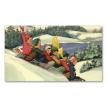 “Come in from the cold!” was a chorus sung ritually during winter by my aunt that babysat for us. She knew what was coming when I refused to wear the childish, insulated, and nylon snow pants. So she kept vigil at the window which overlooked the school yard for that first warning sign of a child wearing cotton pants and sliding and falling into drifts of snow. I never noticed that my wet pants quickly yielded to the cold. Suddenly my bottom half was encased in ice which would stick to my legs. Every step home felt like pen knives were being poked into my legs, my bottom, and my feet. When I stepped into the house and started to undress my aunt hurried to stop me, then quickly placed me right in front of the heat register and turned up the heat. Then she handed me a cup of hot cocoa saying, “Drink that cocoa slowly because as those pants begin to melt, so will you. And honey, you ain’t felt anything that hurts like that!” Then over her shoulder as she walked away, “And tomorrow those snow pants won’t look so childish!”
 “It’ll be a cold day in hell!” before I cross the street to schmooze. The other night I saw a leggy woman walking an equally leggy dog wearing a unitard (the long-legged dog was wearing it not the leggy walker, who’d resemble an Olympic swimmer languidly strolling down a snowy sidewalk on a blustery eve). I and my dog crossed the street beneath the guise of doggy introductions. After they’d had their bouts of butt-ery I finally asked the woman, “what on earth is your dog wearing?” Her Tsk, followed by the 180 degree hair toss followed by a voluminous, lung-filling sigh told me that our humorous repartee was chilly when her answer was dipped in the patronizing tone fondue, “Why, it’s a Unitard, of course; cold dogs are a reality. They’re all wearing them in Lincoln Park. But I suppose way up here in . . . in Roger’s Park . . . “ to which I interjected, “Lady, are you lost? This is Edgewater where, believe it or not, our dogs wear fur coats in winter and in summer we relish our hot dogs!”
 of cold places where
 of gray Merino wool.

 The penance in 1928 for this path of omission would be swift, impudent, and ruinous to his sixteen year old daughter’s
  It would appear that Conventional Wisdom adamantly insisted that: 1) any scandalous; 2) censurable; or 3) malevolent activity and its vicarious, foreseeable, or misbegotten side-effect i.e. bastard, crime, or hardship be: 1) blueprints; 2) engineered; and 3) dispatched clandestinely as to: 1) disquiet suspicion; 2) stave off defamation; and 3) avoid malice. Conventional Wisdom’s golden era must’ve been a time when the world loomed large. An age when


 , strike out, airline, stitches, lipstick, heartbreak, failure, beer, hangover, diamond ring,
 house, flat tire,
  HARLAN DIDRICKSON