Back Then, Ignorance Was De Rigueur

At the end of the 60’s and carrying into the 70’s there still seemed a deep-rooted sentiment: if it’s none of your business, then keep your nose out of it.  Which seemed to work fine for most people.  Of course every neighborhood had its busybody, just as it had its grouchy-keep-off-my-grass-senior-citizen, and bubble-gum-snapping-younger-than-her-bosom-suggests-daughter-of-a-longshoreman.  But by-and-large, if it didn’t directly involve you then you were commanded to stay-out-of-it.  And woe be the kids with clumsy feet: too inattentive or naive to jump when they spot trouble; or those nearest the melee when it explodes, or the small-fry-wanna-be whose taunts often ignite newly produced testosterone because they all will be hauled to the principal’s office for punishment followed by the famous litany of idiotic parental rhetoric: “. . .well, if he jumped off. . .;” “If I’ve told you once. . .;” and the classic “I  could see those <insert surname  here> boys were trouble. . .”   But the message was always the same: mind your own business.
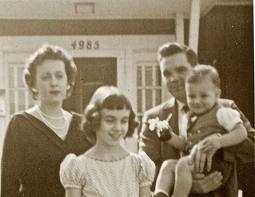
Now, that’s not to say there was a lack of dinner-table rumor-mongering, my mother usually updating us on the goings-on of the neighborhood.  But, if the rumor was rated PG-13 and above, we were given the briefest synopsis, censored beyond recognition, devoid of any example of debauchery, infidelity, or any despicable acts whether or not the “I’m-not-naming-names-neighbor-three-doors-down” was perpetrator or victim.  My mother’s talent for omission was legendary, but her dinner-table-abridging offered very little by way of a storyline, but witnessing her agility at avoiding incriminating details while maintaining a conversational tone was so entertaining that my older brother wanted to call the Watergate crew and offer them her secret of how-to skirt the truth and avoid prison for perjury.  He said he tried but was told they don’t take messages for inmates.

But even spreading gossip was considered a breach of social convention and was practiced with the highest degree of discretion.  I overheard my mother talking on the phone about Mrs. Bowers and her recent loose-lipped huddle at Kroger’s with Mrs. Hanson about boys, booze, broads and a bathtub: to Mrs. Bowers chagrin the broad and bathtub belonged to Mrs. Hanson.  Right there in aisle 5-A Mrs. Hanson’s strong upper lip began to quiver and like a mudslide, her conviction simply gave-way taking her sand-bagged courage with it and Mrs. Hanson dropped to the floor as if someone had cut her marionette strings.

Back then the message was loud and clear: keep your mouth shut! 

And I suppose it was that exact 1960’s deflection of responsibility, respect for authority, and absolute ignorance of any activity which happened outside the euphemistic “four walls” of our family (and home) that created a vacuum of moral accountability.  This social ignorance was the fertile ground from which victims sprouted already marinated in the tenets of civic propriety: keep your mouth shut and mind your own business.  Now add a new genus of Catholic leadership: an indubitable, irrefutable and influential priest whose intentions, if questioned, are defended rigorously by the diocesan hierarchy.  These two social renunciations: bewilderment on the part of the parents and blindness on the part of the Catholic Church created the perfect playground for sexual predators that mocked piety and disgraced through indignity and malice, the Christian image of the protector of children.

We had a predatory priest back in Catholic grade school.  As a pedophile he’d developed quite a reputation and a skillful set of traps which left little, if any scars, except those which appeared years later.  He developed a certain degree of notoriety: A staggering example of the decades-long failure of the Church’s treatment (reflection and counseling) resulting in reassignment or perhaps the estimated number of casualties he produced (across generations in one family).  His ecclesiastic devotion was a stark contrast to his budding reputation as “overly affectionate” or “physical with boys beyond acceptable behavior” so the Arch Diocese of Milwaukee continued to pry his paws away from parishioners at one church (akin to “running him out of town”).

He was hurried over to a safe house for an overhaul: counseling, hand-slapping, celibate reminders, penitence, forgiveness, and then off to some R & R (restoration & repair), placed back into the deck, reshuffled, and dealt to an ignorant congregation of affable and duteous parents who’d bred reverent and obedient children.  Some devote parishioners believed that the affection of a doting priest was reserved for the innocent of the innocents, were venerated by God and anointed (via the local messenger, i.e. priest) with an extra helping of divinity.  I remember hearing that some devoted parents would volunteer their children’s time to vocational pursuits i.e. ironing vestments, vacuuming sacristies, opening the weekly offering envelopes, in order to maintain proximity to the priest should a divine message be received.  But back then, back in 1969, that’s how Catholics behaved because they were taught that a priest was called by God to act as emissary here on earth; and the most important (mysterious, and grossly misunderstood) tenet of a priest’s appointment was his unconditional vow of celibacy (the state of being unmarried and, therefore, sexually abstinent).

And that presumption, that priest’s were not sexual, was the perfect degree of insulation these priest’s and their superiors needed to stave off accusations of impropriety brought to the diocese.  And here’s the revelation:  No matter how impassioned, no matter how unthinkable the alleged violations seemed, no matter that these abominations were reruns from previous parishes, the victim, a child, with nothing to gain (and so much to lose) were often suspect!  First by the parents, then the parish leaders, then when facing the priest in his rectory, and then, if pursued, again face-off with highly respected and very suspicious diocesan officials and the priest (whose interest and adorations became manipulative, threatening, painful episodes and were so outrageous and impossible to prove, that the only logical and least damaging conclusion anyone with any sense could draw:  the child is  exaggerating, misconstruing, or unintentionally and without malice positioned themselves near the priest and misunderstood their physical contact as egregious.

And frankly I don’t know which buckled first: The highly improbable assertion that a child repeatedly seduced a religious official vowed to celibacy or the unquestionable devotion of generations to the Catholic Church (the age-old collapse of a faith in God and a faith in the Godliness of men ordained by Him).  But what it took to shift the burden of proof from the victim (child) to the perpetrator (priest) was a departure from isolation and silence to community and conversation.  When adults decided that blind allegiance to any organization purely based on what that organization tells you to believe is, in and of itself, questionable, was when the fortified walls of some of the world’s oldest and most revered organizations began to weaken.

It’s not what we’re told by leaders (whether religious, political, corporate) that has the capacity to tear this world apart.  It’s what we believe that we’re told.  It’s not the children’s fault that the Catholic Church protected and permitted decades of sexual abuse.  It’s the adult’s fault (whether or not your the priest or the parent or the pope).  It’s an adult’s responsibility to question authority each and every time it violates freedom!

There isn’t one person on this planet that stands above repute.  Except, that is, perhaps the children.
Loosing Elasticity

It seems that my mind is like a farmer’s field: memories, like field stones continue to break ground.  And like the farmer, which stones I remove and which stones remain is largely one of effort: some stones rise wholly like a new moon; others merely crack the surface, their real mass remains solidly rooted; these unearthed boulders are marked like land mines.  But unlike the farmer who can adapt to the obstacle, I am intrigued by the coincidence of its appearance.  So I am willing, on occasion, to recall an incomplete memory: as a writer of a particular age I no longer rely on the creative end of creative writing.  Instead I dip my hand into the cold creek of memory where most recollections lay scattered, scoop up what my numb fingers can manage, and attempt to detail, at best a mosaic of my memory.  For instance:

Not yet school age, one early afternoon I watched my mother organize her ironing station in front of the television in anticipation of the daily broadcasts of her favorite soap opera’s  No more than three minutes into the first program the telephone rang.  My mother, hypnotized by her program, allowed the  phone to ring six times before answering.  I vaguely recall the immediate change in my mother’s telephone voice (from pleasant to pointed) she confirmed leaving a message, and agreed to hold for that department.  Moments later she was complaining to a sales clerk in the lingerie department at Gimpel’s that the bra she’d purchased three months earlier had lost its elasticity, which without, failed to uphold its purpose.

The clerk understood my mother’s tone immediately and transferred the call to a junior manager who was, I gathered, an obstinate, pushy and unapologetic salesman who strongly suggested that my mother purchased the wrong size.  Speechless, my mother put the phone down and stormed to her bedroom.  I picked up the receiver just in time to hear the insolent salesman male suggest to one of his minions that my mother might wish to engage my father’s help in gauging her size, as he (the salesman) was quite certain your husband (my father) was absolutely certain as to the size of her breasts.  At that moment my mother yanked the phone from me: I repeated the salesman’s suggestion: pause: slam!

Ten minutes later my mother was dragging me in one hand and her bra in the other uptown to Gimpel’s.  Never before and never since have I heard my mother use so many words in such a short period of time in such a loud voice which naturally attracted female shoppers, then clerks from other departments, department managers, and finally three men in dark suits that parted the crowd like royalty, and in a vain attempt tried to interject while my mother’s consternation whirred on like the blades of a window fan.

We rode home in the back seat of a large black sedan, just my mother (who actually radiated a self-confidence and fragrance (thanks in-part to a gift from Chanel), and I.  And at our feet were bags and bags and bags of bra’s compliments of the three dark suits; Executive’s, my mother said proudly; Chief Executive’s, the chauffeur added with a little laugh.

Talk In A Quiet Place

(to the Scarecrow & Tin Man)

One night after clouds
sprinkled the fire leaves
making them smolder
I and two shadows,
(friends then. . .now poorly written
letters posted too late to be news),
walked through a white cemetery.
Homes

Were clean there; twilight
showers often bathed
names on granite-storybooks.
Whispering

So that bats that hung low
from winged-trees wouldn’t know
which way to swoop,
we chatted about tomorrow’s
Tomorrow.

Restless birds kept tossing and
turning, recalling triumphs over
worms and bugs — wings aloft —
we ran beneath the blackened
Avalanche

Rippling overhead to the clearing,
its eternity absorbing
the deluge.  Hands still protecting
hair, laughing at our
Superstition

We walked across the forgotten
as fire leaves danced to the harmony
of my harmonica and the two
shadows singing Christmas
Carols.

The neighborhood echoed our songs.
Tomorrow’s tomorrow is today and my
long-ago-lost harmonica and poorly
posted letters echo a haunted portent:
Silence.

Two Equal Boys (excerpt from “On the Periphery”)

A few months after I turned twelve I recall a banal moment (whose date is wholly forgotten like a New Year’s resolution) when the shiny gleam of my childhood curiosities began to tarnish, to take on a darker patina, to age.  While still filed under curiosity this newly discovered interest and its mysterious appearance led to strange and eager investigations of objects which, until recently, ceased to exist as anything more than minutia painted onto the backdrop of my life.  This sub-category of curiosity I was to learn later that year or earlier the next was known as lust.  I found lust to be an odd emotion, dormant until mixed with the inaugural yield of testosterone.  Its arrival was both odd and enchanting; I often found myself adrift in a boat without a rudder (the consequence of idle thoughts and deficient attention), but now, now lust was the captain and I’d been demoted to deck hand, essentially parasitic lust’s adolescent host.

It crept up slowly, like an itch that can’t be reached; brought on by a passing boy, or a sound, perhaps the tenor of someone’s voice; or a smell, reminiscent of a piece of clothing someone wore and that I inhaled briefly or deeply; an odor so distinctive that I’d soldered it to my cortex.  But it never attacked, it charmed, yearned for freedom at night and returned as a daybreak half-dream like our cat’s nightly routine.  It was fun at first, a distraction to science class, a daydream to wile away minutes in the school bus; fantasies with neighbor boys who are skinned of their shirts and jeans.  What I hadn’t known was that lust wasn’t idle entertainment.  Lust required expression and freedom; lust could be caged but also required parole.  I barely noticed at first when lust was an intermission, but soon it was everywhere like crawling ivy; it edged out innocence and substituted indecency.  At first lust glowed like a nightlight but now its brightness was blinding like the spotlight of the police car behind you.  My lust became carnivorous:  Like a beast it hunted when hungry and will, if forced, scrounge or take riskier chances.  I discovered that lust could be sated quickly and privately.  Or it would wander off to hunt, rupturing trust, morality, and safety.  But once lust loses its grip, sensibility takes control like a police riot line and estimates the damage: silly actions, minimal integrity, lack of conviction paid with excuses, confessions, apologies, or a fake phone number.

One of my earliest fascinations was Robbie, a boy my age who wore a pea coat in the fall that smelled like the inside of his house.  He rarely wore jeans vying instead for plain-front khaki chinos made popular by Wally Cleaver and dark colored Ban-Lon polo’s.   Thoroughbred-brown, straight-edged hair crowned an otherwise waspy face, but he had those dreamy bedroom eyes, the kind that coax you, like quiet hand pats on cushions, to take a seat next to him on the sagging basement sofa from which extrication was impossible once it snapped shut like a Venus Fly Trap.  He was the brain behind  many mischievous pranks at St. Joe’s (our Catholic grade school).  Of course he never moved a muscle and wisely kept a safe distance from the exploding toilet, ruptured water fountain, or the infamous girl’s locker room mouse-capades.  Instead he’d delegate the execution to some of the bigger and dumber kids like Jim or Billy.  And like the suspicious neighborhood dog that discovers a chunk of meat abandoned just beyond the stoop where boys that torture cats live, I tried to imagine what might happen if I. . .and there it was!  Hidden behind those dreamy eyes like cops at-the-ready behind the billboard, were cold eyes, calculating eyes, entrapping eyes.  I grabbed my parka, tripped going up the stairs, and rushed out the door all the while hearing his cynical and cold-hearted catcalls echoing from the basement.

But the real deal, the apple of my eye was Jeff.  He was as beautiful as a boy could be and not be a girl.  He had that soft, ivory colored skin, baby-fine blond hair, cool blue eyes, and eyelashes that were the envy of all the girls.   But his smile, ah  — the smile was warm and crooked and always made one wonder what was hidden behind the grin; it was the kind one would have if he already knew the punchline.  Jeff was seduction.  Boys and girls alike were willing to cast aside moral convention just to please him.  Reciprocity was of no concern; just the opportunity to be close, to listen to his whispers, to see him waiting for you, to be his was all anyone wanted.

My chance happened  in the alley behind my house at dusk on a summer week night.  Jeff and I and a few of our friends were involved in some kind of pursuit game when suddenly both Jeff and I realized we’d been hoodwinked. The sun had just set behind a row of bungalows and an iron husk of a retired steel plant carved the last bit of sun into the crooked and bony fingers of old women.  Jeff stood on the rise of a hill, and I at the bottom in the alley. Cupping his hands around his mouth he said, “Looks as though they’ve left us.”

Taking a quick survey I finally looked up at him, “Seems like they have. What now?”

“How the hell should I know,” he snapped.

Walking up the hill to face him I said, “because they’re in your freakin’ club, is why!  Brotherhood, ain’t that your motto?”

He turned quickly and after a long moments pause said, “Hey, blow me!”

And without hesitation I blurted out the dare of all dares, “Whip it out!”

I watched his face as I heard that familiar pop of a brass snap at the top of his jeans, that notorious crawl of teeth as they fanned out from each other, and that silent stop, knowing that his jeans were now thrown open like the agitated jaws of a dog, the white of his underwear exposed  like the sharp teeth. “Stop there”  I muttered to myself, “Don’t  go any further” I wished under my breath.

I knew that no matter how often I’d drifted off to sleep thinking of him, no matter how often I had glanced quickly as he ran down the gym floor to the other basket and scored; no matter how often I risked my own humiliation to stay in the shower five questionable minutes longer to perhaps catch a brief glance at his naked body; no  matter that I tried out for wrestling just to have an opportunity to hold him once in an embrace that no one would suspect; I nearly turned and ran as fast and as far as I could. But for those thirty seconds as Jeff stared at me and as I struggled to lock my eyes on his; and to not, no matter what happened, to not look down at the front of his jeans, to keep my eyes focused like a bird dog pointing at a grouse; in those brief thirty seconds my silly little life flashed before me and although what I had wished for all those erotic, half-asleep, fully aroused nights, all those embarrassed, wall-hugging gym classes in the pool as he swam laps and sideswiped me with every turn, he was now presented to me and if I were to act I would certainly be condemned to a life I abhorred, even before I was completely aware of the consequence. One that I was certain held only loneliness and abandonment, a life of damnation, accusation and reproach.  A life of darkness.  A life of listening over your shoulder  for the snickers; of always wearing up-turned collars; nocturnal; predatory.  And I suppose as I reflect on that  incident,  the confusion that  had  really gripped  me wasn’t so much my desire versus my identity, but rather my longing versus my dream.

I so wanted him.  But not presented in that grotesque, obvious manner.   I noticed then that although my body enjoyed the sensations that another boys’ body could provide (and it was clear that there were other boys’ bodies available), there was an intricate piece missing, a small one, down in the corner somewhere, it would’ve been easily masked, an ornate frame or wide mat, or even some other piece forced to fit, but it was that piece that I searched Jeff’s eyes for:  It was in his eyes that  I saw  a  reflection  of  my own desperation:  And it was then, at that very moment that I crawled out from under his spell and separated lust and love, and realized that boys weren’t interested in matters of the heart, but instead were only interested in lusty bravado, and that any method was as good as the last or the next so long as the method wasn’t self-inflicted.

It was  then,  right  then,  that  I decided  that  although I imagined I’d enjoy all the activities associated with a sissy, I was not going to be a pansy, and if Jeff wanted me to blow him, then he was going to show me how!

I backed away from him, unzipped my jeans, yanked down my shorts, walked back over to him and stood, half-naked and double-daring. He was dumb-struck.  And then, as if the whole incident never happened, he turned around quickly and closed his pants.  “Come on,” he said, “let’s go find the other guys before they think we’re queer or something.

He started down the hill as I stood there in the deep dusk, arranging myself in my jeans, and finally running after him.  I lowered my shoulder and bumped him in the kidneys.  He hesitated for a moment, then threw himself at me and wrestled me to the ground as only two equal boys could.

Airborne (from “Tree’s: Collected Poems”)


Past barbed wire infantry,
Maple battalions
send paratroopers
leading.
Prop-toppers spin round and
round and
land like lace handkerchiefs.
Amazed
I watch this off-spring
float to the target —
(a yellowed matchbook cover).
I feel like a string

from a lost kite, too heavy
to float.
I will lie here and
watch them
spin.