After 50 Years, I Can Speak My Father’s Language

I became Harold’s (my father’s name) youngest son when he was forty-nine years old.  Forty-nine today isn’t what it was in 1958, especially when you lived life full bore.  By the time I became conscious of his presence (three years old) he’d already begun his initial descent.  He had the looks of Walter Cronkite, the physique of Jackie Gleason, the temper of John McEnroe, the contempt for women of August Strindberg (Swedish Playwright and infamous misogynist 1849-1912), the alcoholism of Johnny Cash, and a creative and innovative mind in the areas of electrical and mechanical engineering.

There were just two of us (me and my older (2 years) brother.  That is, until 1972 (I was 14 years old), when the dirty laundry was aired: Our father had a previous marriage which produced two daughters and a son.  As I recall I was excited by the prospect (kind of like the “Brady Bunch“) and my brother was apprehensive and quite angry.  The confession of a first marriage only occurred because the eldest daughter had the strong desire to discover what happened to her “real daddy.”  The first wife’s precept that no one was to try to find their father until she had passed was strictly enforced and subsequently honored by all.  She passed in the early 70’s after which the eldest daughter’s search began.  As to why our mother or father kept this secret and never disclosed anything about it is anyone’s guess.

The marriage bond between my father and mother was broadsided by the wrecking ball in 1963 when the County Sheriff appeared at our front door to serve our dad his notice to vacate immediately which, we learned later, was a bitterly contested condition of their divorce. From that day on and until the day he died he expressed a cruel, ruthless and chronic acrimony and rancor toward our mother which he publicly and conspicuously displayed, especially when we visited on Sunday afternoons.  I don’t know if his brutish and vengeful behavior during our visits was aimed at my brother and I, or if he thought we’d run back to headquarters and repeat verbatim his vitriolic euphemisms such as “that god-damned pollock” (those were the only words he ever used to reference her).  I think his ruthless contention began after his first wife deserted him in the middle of the night with the children and his business partner and their business’s assets liquidated to cash.  The few things he treasured had fled in the night leaving him alone and penniless.

But he was not the victim; he was the perpetrator.

As I was to learn later in life, my father lived fast!  It took me a number of years before I could admit that my dad had already been someone else’s dad before he was mine.  What’s more, he was dad to three kids and husband to some lady some place and neighbors and club members and tavern buddies and business partners and customers all of whom I would never meet, but of whom meant very much or very little to him, and this whole other life never ever in a million years, not even for a split second ever imagined that somewhere some day in the universe there’d be Harold’s youngest child telling you their life story.  Well, until the age of fourteen I thought Harold being my dad was a one-act play; I was shocked to discover that there had been an earlier play, a one-man production entitled The First Dad is the Real Dad penned by his first family, which unbeknownst to me, devolved my one-act into a superfluous epilogue found in ancient Greek dramas.

Yet there were earlier chapters, when he was practically barbaric; young and handsome and strong and libertine.  Chapters in which he had pockets stuffed full of youthful immortality and adventurous hunger. Chapters which bore great resemblance to the stories of Hemingway or Faulkner or Steinbeck.  Chapters of male bonding and passage: acquiring the finesse of fly fishing; developing the patience of a deer hunter; learning how to set up camp.  Chapters about acquiring mechanical and electrical skills when combined with his creativity conjured up devices which awed his employers.  It’s these chapters that are out-of-print, those few siblings able to remember have long passed, names of friends or places or dates abandoned.  It would seem that my understanding of who and what my father really was would be conjecture, similar to explanations of figures in portraits painted by famous artists.

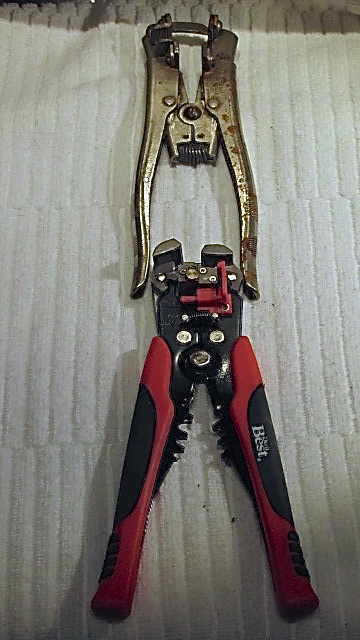
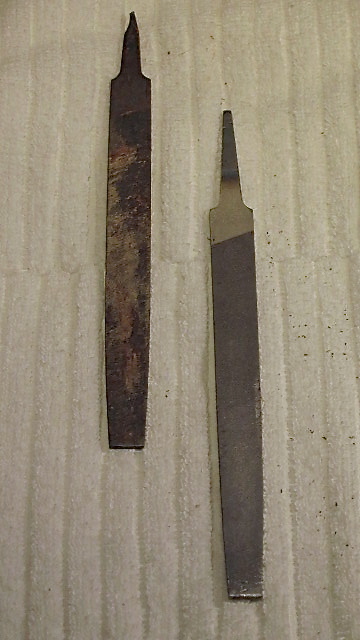
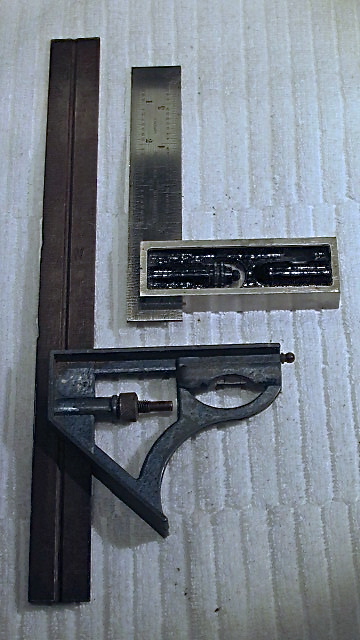
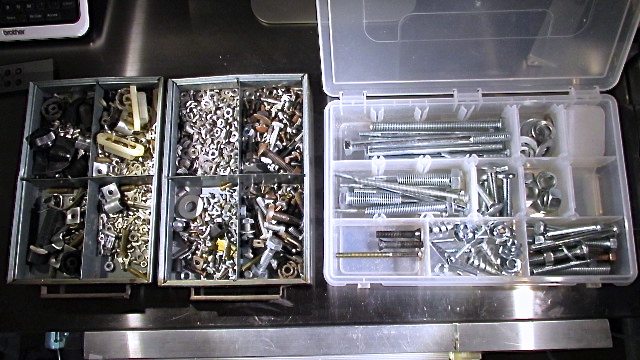
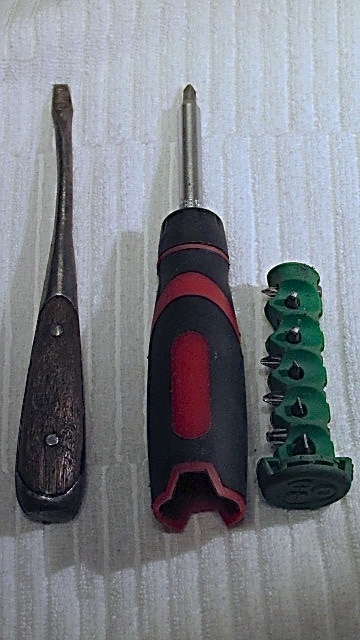
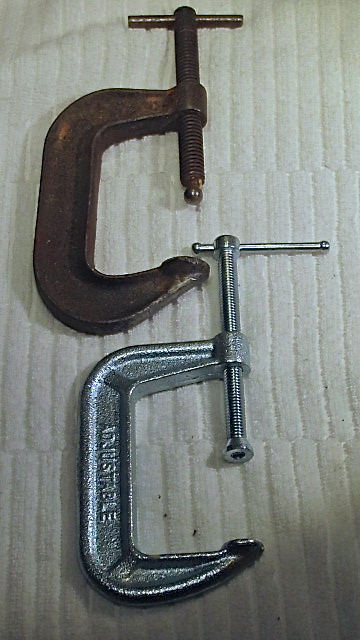
Except, there was one trail which we’d never bothered to follow: a couple of phenomenally heavy boxes which contained an enormous array of hand tools, parts, components, knobs, fuses, and rust.  These boxes had been buried in my brother’s basement for years, neither he nor I had any practical use for them.  In fact, they reminded both of us of particularly painful memories when both of us declined our dad’s invitation to study drafting in high school (and therefore follow his life’s path) and turned our attentions to the performing arts.  That was when I could feel my father’s pride drain from him as though he’d just been gutted.  But fifty years later, after I endured a break down and was determined to entertain my curiosities and creativity I spotted the art of wood working.  And I read a passage: “A Woodworker works wood with hand tools, he doesn’t machine wood with power tools.”  And so began my acquisition of various tools, all with specific purposes, and some which looked distantly familiar, as though I’d stumbled across them long ago but didn’t know what, if any, use they’d have.  What I didn’t understand then, I clearly understand now: Context was missing; meaning was missing; purpose and use and technique and discipline and understanding were all missing the first time, as an adolescent, I had found them.  But today, as I work wood with my hand tools I finally understand my father’s native language.  A language of tools and imagination and creativity.  A language of applied science.  A language which died the same day he did.

But it’s been rediscovered and is as important to me as the discovery of the Dead Sea Scrolls.  I finally understand the language he’d been speaking, how he saw his world, what he’d use to solve problems, and why he was so devastated when my brother and I impolitely snubbed his advice about drafting class and joined glee club instead.  And while I’m overjoyed to finally uncover a common thread uniting me to my dad, it’s also bittersweet: It’s a reminder that he’s gone and a wish that I’d give anything if he and I could, for just one day, sit together in my work space and “talk shop.”

The attached pictures show my dad’s tool at the top or the left and my tool underneath or to the right of his.
Do I Look Like A Pigeon?

There’s a basic tenet of parental behavior to which many ascribe:  Whatever you don’t like, don’t understand, or frightens you about your child, you’ll try to ignore it, or threaten it, or eliminate it under the guise of childhood protection.

If you had known me as a child you would never describe me as: bashful, shy, inhibited, reserved, demure, or innocent.  Especially innocent!  I blame my lack of innocence on a creative incarceration complete with shackles, pillory, and thumbscrews (metaphorically speaking) as the adult-authority’s recommended protocol for youngsters that emigrate to the shores of their imaginations.  My crime?  Being entertained by my imagination’s liberty to dream of things or experiences which landed far beyond the limits of our lower-middle-class capabilities, and of which I insisted were possible despite our depressed economic status.  Not that I asked for things that we couldn’t afford.  I asked for things which required creativity or compromise or cunning.  I only asked for things which were possible but perplexing; things which, if I were taller or older or motorized I could procure.  But I was a short, plump, uncoordinated child that wrestled with an unbridled imagination and raw creativity which everyone described as teetering between adaptation (the positive, yet painful struggle of change: unyielding animosity between divorced parents, recent move to the south side) and abdication (an attempt to cope by disengaging himself from his misery by displacing reality with imagination).  I had just begun implementing a plan which might conquer both my hells (before/after move).  Using creativity and imagination I might be able to map my way free of their self-centered, ego-inflamed romantic ideals and out from under the shitty and selfish mess the adults-in-charge created, then forced down my gullet like corn down the throat of the holiday goose.

So authority figures convened to develop a strategy designed to lower the volume of my imagination and increase interest in my new-world order.  By discouraging escape and encouraging capitulation they hypothesized that I would slowly build a positive (and comfortable) reality without careening into fantasy, imagination, or creativity.  In other words, we’ve tested him and he ain’t no Einstein, scored dead-center 50th percentile, and, thank God, kind, dull, unambitious, and docile: he’s simply avoiding change by daydreaming.  So the adults broke their huddle and walked to the line of scrimmage; a defense full of adulthood, authority, corporal punishment, and varying degrees of coercion designed to obliterate the supply bridge between me and my creativity and imagination.  But I was on the offensive and understood that in a matter of seconds my pulverization would commence; I mustered some resistance, usually a subtle mockery of mumbled affirmations.

Their boundless resources, their freshly recruited therapists (secretly screened in the convent) hammered my resistance and during a nighttime raid caused a debilitating breach, a nightmare, which cast doubt on imaginations allegiance.  Creativity wasn’t strong enough to deflect their incessant whittling away at my corners, sanding down my resolve in order to spit me out at eighth grade graduation: a shining example of what to do with a square peg when the world offers only round holes.  The nuns, lay-people, and counselors believed that by distracting my distractions, by motivating and redirecting and sympathetic yet tyrannical concern and instruction, they could successfully extinguish what, at the time, was thought to be simple imagination.  And I would take my place among my fellow eighth grade graduates poised for the adventure of public middle-school, then high school, and finally be added to the third-shift at some manufacturing or assembly plant as one more blue-collar-assembly-line-lifer with low expectations and very little hope.  

Tragically, these nuns and educators were in pursuit of an example, a trophy, proof that plucking me from a sea of personal trauma and forcing me to face the reality to which I was born.

How nearsighted they were to think they eliminated my problem.  It was much worse than that.  They confirmed, even back then, that it was real and I wasn’t just imagining things.

Maybe We’re Just Like Ducks

It’s called imprinting, the rapid learning process by which a newborn or very young animal establishes a behavior pattern of recognition and attraction to another animal of its own kind or to a substitute or an object identified as the parent.  Ducks must be given full credit for bringing this natural attraction to the world’s attention.

We’ve all heard of some unusual attractions that ducklings have developed: humans, dogs, even beach balls.  So, if a duckling can blame nature for his predisposition for beach balls, perhaps our sexual proclivities are the combination of imprinting and sexual awakening: Love Potion No. 1.

My Duck Day coincided with the appearance of the concrete caravan and my budding sexual identity.

It happened during the dog days of summer, near the end of a blistering July, 1966 that the concrete caravan first appeared at the top of the hill on National Avenue and slowly made its way past Lapham Street, past the Roebuck house, skipped the alley, patched Elmer’s front walk and finally stopped to repair the crumbling curb in front of my house.

Most of the cement-men were career contract-labor: exceptionally efficient at chain-gang-hard-labor; blood-orange skin from the unrelenting sun, hints of aging hair poked from beneath hats, enormous bellies born from beer, and exhausted cigar stubs deeply wedged at the side of their mouths.  And then there was this one guy, unlike the others, this one guy resembled the older brother of everyone’s best friend; this one guy was the guy that came to pick up your sister, bewitched your mother, and worried your father; this guy, handsome in a blue-blood kind-of-way but absent of the sophisticated grooming; his countenance was basic, organic, and naturally simple; his body was whittled by the repetitious pounding of pick-axes; his age was disguised and  purposefully vague evoking my curiosity; he was a pioneer, trailblazing through his indecisive twenties.

He wore identical clothing each day: A clean, sleeveless white T-shirt absent of any distracting graphics; tattered by abrasions, the frayed front pockets of his torn 501’s gave witness to his desperate deep-hand searching for loose change to feed the pop machine; a thick, brown belt wormed its way through the faded-to-white belt loops and cinched the denim preventing its avalanche; a navy blue bandana was tied tightly across his forehead to restrain a chalky cowlick; and concealing safety glasses which rationed the gleam of his lapis colored eyes.  Draped yet suggestive, his broad shoulders were easily double the width of his narrow hips which plunged into the deeply concave impressions of his hindquarters which were kept aloft by fleshy legs challenging the denim’s restraint.

Each morning he would arrive fresh like today’s baked bread.  As the toil took its toll his sweat marked then saturated his T-shirt prompting its removal which resembled pulling peel from fleshy fruit.  From my perch on Mrs. Bower’s front steps I mapped the pathway of his perspiration, its headwater found near his neck where it gathered then overflowed and trickled south swallowing isolated beads of sweat and tributaries which first appeared on his capped shoulders and added volume and speed which breached the sinewy levee of his spine and flooded the darkening waistband of his 501 ‘s as well as the white cotton banding which sat low on his hips.

I watched him for more than a week when my mother took notice and opportunity of my afternoon routine of sitting on the front porch.  It was her idea that I take the hose and water Mrs. Bower’s flowers and front lawn.  Perfect, I reasoned, an alibi should allay any suspicion caused by my daily observations.   On Tuesday of the second week of their construction I walked through the gangway with the spitting hose and began to shower Mrs. Bower’s flowers.  By the time I started to water the parkway (grass between the street and the sidewalk) the man in the blue bandana ambled cautiously over to me like a slow, curious cow to a farmer holding a bucket of feed. I stood on the sidewalk and thumb sprayed the grass when he asked, “Mind if I have a drink from there?”

I stood dumbfounded and handed him the hose, his wide, thickly calloused hands reaching across the freshly poured concrete for Mrs. Bower’s  Craftsman “Kinkless Guaranteed” one hundred foot garden hose, and moved the bubbling water to his mouth, drinking quietly, his lips pursed into a muscled “O”.  I watched with a great deal of curiosity as his Adam’s apple moved up and down with each quenching swallow, the dimples in his cheeks mirrored the rhythm of his bobbing Adam’s apple.  When sated he returned Mrs. Bower’s hose to my care and said, “Thanks; I’ve seen you watching us for a couple of days; thinking of a career in concrete?  What’s your name?”

“T.M.,” I said quietly.

“Thanks for the drink, T.M.” he said with a wink, then turned and rejoined his crew.

July, 1966 became known as The Summer of Eye-High Marigolds and Mrs. Bower’s Famous Flowers as reported in one local paper.  That July day in 1966 when Bandana Man put his lips to Mrs. Bower’s Craftsman “Kinkless Guaranteed” one hundred foot hose and quenched his thirst, I, instantly developed an unfamiliar thirst rising from deep within, a thirst temporarily doused by Bandana Man’s proximity, but which would reignite moments after I switched off my bedroom light later that night; by morning I longed to be near Bandana Man.  My disquieting need to putter around the front yard required a significant diversion, an understandable reason why I needed to be there.  Which is why my camouflage became an avid interest in gardening.  I think Mrs. Bower’s was exceptionally proud, and I’m happy that she took all the credit.  It was her front yard of course which received my best intentions while I continued to catch furtive glances through the gardens towering stems.

It took the concrete caravan an unprecedented three weeks to complete its concrete repair from the Roebuck house on the north end of the block to the Nichols’ house at the south end.  It was a Friday, I think, that the inevitable happened: I ran out of hose.  The crew had just turned the corner and was heading west on Mitchell Street. I stood there, water pouring from the stretched hose, acknowledging yet not understanding life’s cruelty: Why were we both at the same crossroad at the same time, if all it meant was fame for Mrs. Bower’s flowers?  As Bandana Man turned the corner he stopped, looked back at me, dropped his pick-ax and trotted in my direction, his tanned torso rippling like sheets on a clothesline.

He untied his bandana and held it beneath the cold water, wrung it out, then wiped his face and neck, returned it to the cold water and said, “You look kind of hot.  You hot, T.M.?”

“Yes,” I answered while nodding my head.

He took the hose from me letting it drop to the ground, turned me around, and wrapped the navy blue damp bandana around my head and tied it snuggly in back.  He spun me around, studied me for a moment, then said, “Cool man, you’re one of us now!”  And with a tousle of my hair he turned and ran to catch up with the crew which from afar resembled a motley gang of vagabonds.  I remained at that spot and allowed the water to drip down my face, catching a few droplets with my tongue, detecting a hint of salt which I knew was my first real taste of men.

Back Then, Ignorance Was De Rigueur

At the end of the 60’s and carrying into the 70’s there still seemed a deep-rooted sentiment: if it’s none of your business, then keep your nose out of it.  Which seemed to work fine for most people.  Of course every neighborhood had its busybody, just as it had its grouchy-keep-off-my-grass-senior-citizen, and bubble-gum-snapping-younger-than-her-bosom-suggests-daughter-of-a-longshoreman.  But by-and-large, if it didn’t directly involve you then you were commanded to stay-out-of-it.  And woe be the kids with clumsy feet: too inattentive or naive to jump when they spot trouble; or those nearest the melee when it explodes, or the small-fry-wanna-be whose taunts often ignite newly produced testosterone because they all will be hauled to the principal’s office for punishment followed by the famous litany of idiotic parental rhetoric: “. . .well, if he jumped off. . .;” “If I’ve told you once. . .;” and the classic “I  could see those <insert surname  here> boys were trouble. . .”   But the message was always the same: mind your own business.

Now, that’s not to say there was a lack of dinner-table rumor-mongering, my mother usually updating us on the goings-on of the neighborhood.  But, if the rumor was rated PG-13 and above, we were given the briefest synopsis, censored beyond recognition, devoid of any example of debauchery, infidelity, or any despicable acts whether or not the “I’m-not-naming-names-neighbor-three-doors-down” was perpetrator or victim.  My mother’s talent for omission was legendary, but her dinner-table-abridging offered very little by way of a storyline, but witnessing her agility at avoiding incriminating details while maintaining a conversational tone was so entertaining that my older brother wanted to call the Watergate crew and offer them her secret of how-to skirt the truth and avoid prison for perjury.  He said he tried but was told they don’t take messages for inmates.

But even spreading gossip was considered a breach of social convention and was practiced with the highest degree of discretion.  I overheard my mother talking on the phone about Mrs. Bowers and her recent loose-lipped huddle at Kroger’s with Mrs. Hanson about boys, booze, broads and a bathtub: to Mrs. Bowers chagrin the broad and bathtub belonged to Mrs. Hanson.  Right there in aisle 5-A Mrs. Hanson’s strong upper lip began to quiver and like a mudslide, her conviction simply gave-way taking her sand-bagged courage with it and Mrs. Hanson dropped to the floor as if someone had cut her marionette strings.

Back then the message was loud and clear: keep your mouth shut! 

And I suppose it was that exact 1960’s deflection of responsibility, respect for authority, and absolute ignorance of any activity which happened outside the euphemistic “four walls” of our family (and home) that created a vacuum of moral accountability.  This social ignorance was the fertile ground from which victims sprouted already marinated in the tenets of civic propriety: keep your mouth shut and mind your own business.  Now add a new genus of Catholic leadership: an indubitable, irrefutable and influential priest whose intentions, if questioned, are defended rigorously by the diocesan hierarchy.  These two social renunciations: bewilderment on the part of the parents and blindness on the part of the Catholic Church created the perfect playground for sexual predators that mocked piety and disgraced through indignity and malice, the Christian image of the protector of children.

We had a predatory priest back in Catholic grade school.  As a pedophile he’d developed quite a reputation and a skillful set of traps which left little, if any scars, except those which appeared years later.  He developed a certain degree of notoriety: A staggering example of the decades-long failure of the Church’s treatment (reflection and counseling) resulting in reassignment or perhaps the estimated number of casualties he produced (across generations in one family).  His ecclesiastic devotion was a stark contrast to his budding reputation as “overly affectionate” or “physical with boys beyond acceptable behavior” so the Arch Diocese of Milwaukee continued to pry his paws away from parishioners at one church (akin to “running him out of town”).

He was hurried over to a safe house for an overhaul: counseling, hand-slapping, celibate reminders, penitence, forgiveness, and then off to some R & R (restoration & repair), placed back into the deck, reshuffled, and dealt to an ignorant congregation of affable and duteous parents who’d bred reverent and obedient children.  Some devote parishioners believed that the affection of a doting priest was reserved for the innocent of the innocents, were venerated by God and anointed (via the local messenger, i.e. priest) with an extra helping of divinity.  I remember hearing that some devoted parents would volunteer their children’s time to vocational pursuits i.e. ironing vestments, vacuuming sacristies, opening the weekly offering envelopes, in order to maintain proximity to the priest should a divine message be received.  But back then, back in 1969, that’s how Catholics behaved because they were taught that a priest was called by God to act as emissary here on earth; and the most important (mysterious, and grossly misunderstood) tenet of a priest’s appointment was his unconditional vow of celibacy (the state of being unmarried and, therefore, sexually abstinent).

And that presumption, that priest’s were not sexual, was the perfect degree of insulation these priest’s and their superiors needed to stave off accusations of impropriety brought to the diocese.  And here’s the revelation:  No matter how impassioned, no matter how unthinkable the alleged violations seemed, no matter that these abominations were reruns from previous parishes, the victim, a child, with nothing to gain (and so much to lose) were often suspect!  First by the parents, then the parish leaders, then when facing the priest in his rectory, and then, if pursued, again face-off with highly respected and very suspicious diocesan officials and the priest (whose interest and adorations became manipulative, threatening, painful episodes and were so outrageous and impossible to prove, that the only logical and least damaging conclusion anyone with any sense could draw:  the child is  exaggerating, misconstruing, or unintentionally and without malice positioned themselves near the priest and misunderstood their physical contact as egregious.

And frankly I don’t know which buckled first: The highly improbable assertion that a child repeatedly seduced a religious official vowed to celibacy or the unquestionable devotion of generations to the Catholic Church (the age-old collapse of a faith in God and a faith in the Godliness of men ordained by Him).  But what it took to shift the burden of proof from the victim (child) to the perpetrator (priest) was a departure from isolation and silence to community and conversation.  When adults decided that blind allegiance to any organization purely based on what that organization tells you to believe is, in and of itself, questionable, was when the fortified walls of some of the world’s oldest and most revered organizations began to weaken.

It’s not what we’re told by leaders (whether religious, political, corporate) that has the capacity to tear this world apart.  It’s what we believe that we’re told.  It’s not the children’s fault that the Catholic Church protected and permitted decades of sexual abuse.  It’s the adult’s fault (whether or not your the priest or the parent or the pope).  It’s an adult’s responsibility to question authority each and every time it violates freedom!

There isn’t one person on this planet that stands above repute.  Except, that is, perhaps the children.

Loosing Elasticity

It seems that my mind is like a farmer’s field: memories, like field stones continue to break ground.  And like the farmer, which stones I remove and which stones remain is largely one of effort: some stones rise wholly like a new moon; others merely crack the surface, their real mass remains solidly rooted; these unearthed boulders are marked like land mines.  But unlike the farmer who can adapt to the obstacle, I am intrigued by the coincidence of its appearance.  So I am willing, on occasion, to recall an incomplete memory: as a writer of a particular age I no longer rely on the creative end of creative writing.  Instead I dip my hand into the cold creek of memory where most recollections lay scattered, scoop up what my numb fingers can manage, and attempt to detail, at best a mosaic of my memory.  For instance:

Not yet school age, one early afternoon I watched my mother organize her ironing station in front of the television in anticipation of the daily broadcasts of her favorite soap opera’s  No more than three minutes into the first program the telephone rang.  My mother, hypnotized by her program, allowed the  phone to ring six times before answering.  I vaguely recall the immediate change in my mother’s telephone voice (from pleasant to pointed) she confirmed leaving a message, and agreed to hold for that department.  Moments later she was complaining to a sales clerk in the lingerie department at Gimpel’s that the bra she’d purchased three months earlier had lost its elasticity, which without, failed to uphold its purpose.

The clerk understood my mother’s tone immediately and transferred the call to a junior manager who was, I gathered, an obstinate, pushy and unapologetic salesman who strongly suggested that my mother purchased the wrong size.  Speechless, my mother put the phone down and stormed to her bedroom.  I picked up the receiver just in time to hear the insolent salesman male suggest to one of his minions that my mother might wish to engage my father’s help in gauging her size, as he (the salesman) was quite certain your husband (my father) was absolutely certain as to the size of her breasts.  At that moment my mother yanked the phone from me: I repeated the salesman’s suggestion: pause: slam!

Ten minutes later my mother was dragging me in one hand and her bra in the other uptown to Gimpel’s.  Never before and never since have I heard my mother use so many words in such a short period of time in such a loud voice which naturally attracted female shoppers, then clerks from other departments, department managers, and finally three men in dark suits that parted the crowd like royalty, and in a vain attempt tried to interject while my mother’s consternation whirred on like the blades of a window fan.

We rode home in the back seat of a large black sedan, just my mother (who actually radiated a self-confidence and fragrance (thanks in-part to a gift from Chanel), and I.  And at our feet were bags and bags and bags of bra’s compliments of the three dark suits; Executive’s, my mother said proudly; Chief Executive’s, the chauffeur added with a little laugh.