Humiliation comes in many flavors: decline, disgrace, resignation, ridicule, shame, stigma, and upset.
HUMILIATION BY RESIGNATION AND SHAME
A bike to a 11-year old is like a compass to an explorer; it ensures progress, freedom, and discovery.
I was eleven or so and riding my Columbia 3-speed (I really wanted the cocoa brown 10-speed Schwinn but when my father asked without  looking at me – (a seldom used, but spot-on tactic {for parents reading this, it’s found in appendix C entitled “How To Use Their Own Ignorance” page MCDL of the “Parental Handbook} letting the child see for him/her self that they don’t know why they need the thing they’re asking for) “What difference can seven more gears make? How is ten gears easier to ride than three gears? I, of course, didn’t know about torque and gear ratios so I settled for the defensive approach, which really set myself up by saying a parent’s favorite answer, “Because everyone’s riding them! Who rides a lime green, lame 3-speed, Columbia bike?” And then, in true triumphant spirit (knowing he played this round perfectly) my father delivered the estocada with deft precision, “You do, my boy! You do!”
 And so I did, and so I was the only kid puttering around our neighborhood with a 3-speed which was okay until I reached the piedmont of the Great Lapham Hill. Three speeds were clearly insufficient to maintain both balance and momentum required to propel me to the Hill’s summit. Any bicyclist knows you need at least five or better ten gears! And so I tried pedaling my 3-speed Columbia up the 47 degree slope and then it began, the gear torque problem; the gears on a 3-speed couldn’t withstand the amount of torque my slow pedaling and they began to slip, which in turn caused my pedals to slip, which in turn interrupted my concentrated, all-out pumping. When my pedaling failed to produce any forward movement, which caused a stall, followed by imbalance, and eventual failure expressed by my bike and I crashing onto the street and sliding downhill several feet. Laying in the street against the curb I was utterly ashamed of my feeble attempt and was, at last, resigned to the truth that my father’s tyrannical reign was impossible to denounce. I felt absolutely deflated and a prisoner of my father’s own mania expressed by indifference and cruelty. I was forced to wiggle from beneath the damned 3-speed and push not
  ride my 3-speed bike up Great Lapham Hill cursing at my father, which intensified with each step, while dragging my boyhood pride behind me. Suddenly, from behind like a leash of Greyhounds, my classmates rode Schwinn Varsity Double-Shifter 10-Speeds flew past me and quickly disappeared behind the crest of the summit. And then he approached quietly in the 1965 Rambler Wagon, pulled up next to me, lowered the passenger window and began his litany of taunts using his professorial tone. At which time I sensed a kind of heartburn, but deeper and with greater volume. I began to perspire, brow first, then neck and shoulders. This isn’t going to end on a positive note, I told myself. And when I couldn’t restrain it any longer, out it flew like a bird set free. But it wasn’t lunch that exploded from my mouth but a raw, quick, and cheeky bombardment of varied and loud expletives and vocabulary usually reserved for drunken sailors on furlough. I was still screaming when he slowly closed the passenger window, put the Rambler in gear, and floored the V-8 engine which bellowed the blue smoke of burning oil.
Why did I challenge Great Lapham Hill when I possessed three crippling debilities: Obesity, three speeds, and an overwhelming hatred for my perpetually condescending father who refused to buy me a 10-speed as an example of his dominion. Not because he was a tightwad, not 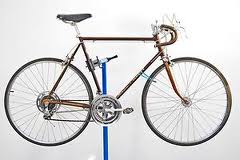 because he couldn’t afford it, but simply to crush whatever degree of animosity I may harbor against him. Looking back, he baited me at the very start by taking me to the bike store; then he fed me frenzied hopefulness when he stood before the twin-shifting, steel-forged and welded frame, drop handlebars, and racing seat, all painted a beautiful metallic cocoa brown, and asked, “How about this one?” That was the exact bike I dreamt of every night. But as I moved closer to where he stood, his eye caught the glint of a lime green bike obscured by Varsity’s and Paramount’s. Yelling across the store at the sales clerk he said, “We’ll take this one.” “But what about this one? The Varsity? This is the one I want. . .”
The sales clerk stood next to my father, paperwork in hand, when my father asked without looking at me – (a seldom used, but spot-on tactic {for parents reading this, it’s found in appendix C entitled “How To Use Their Own Ignorance” page MCDL of the “Parental Handbook} letting the child see for him/her self that they don’t know why they need the thing they’re asking for) “What difference can seven more gears make? Besides, if you can’t ride up Lapham Street on your very own 3-speed, why bother buying a bike? Let’s get a baby carriage that you can push up the hill and have a tea party like a good little nancy.”
Related articles
- A Bicycle Built for You! – Hey, pedal pushers: Celebrate Bike Month by choosing the right ride (theinsider.retailmenot.com)
- The Evolution of my Fixie as I get Older (chrisabraham.com)
- Smartphones bring the automatic gearbox to bikes (phonearena.com)
 survivors have been inoculated with indifference. Recently, our society welcomed the technological efforts to promote the importance of the individual thereby neglecting the citizen’s toil required to maintain a
  cohesive and unified
  That is, until the power goes out.
 grass. I sat next to Mani A. who opened up like a teenagers compact, and divulged his
  Mani showed me how to survive. Mani and I have maintained our friendship for over forty years. One of the things I admired about Mani was his
  town the “
 autonomy. Mani was finally emancipated; freed from the crushing compliance of decency and propriety, he ignored laws, took chilling risks, discovered a steady stream of opiates which he washed down with lethal liters of alcohol, ignored vows, ruined friendships, tossed out of jobs, denied benefits, and finally barricaded himself in the office of a psychiatrist who eventually evicted him, and reinstated my authority over the dominion of my life.
 unfamiliar with the layout of their home, I was quiet as a
  ce the age of three when I recall my father dragging me through the front door of Dr. Olson’s Dentistry Office and it’s tagline etched into the front window: “You’ll be happy to talk after just one visit!” Every adult within a thousand feet knew that I didn’t want to be there; my father had to lift me, then hold me while Dr. Olson wrapped nylon-webbed belts around my shoulders and stomach. Once I was trussed and couldn’t squirm, Dr. Olson slowly approached with that tiny mirror and that double-ended pick with which he digs cavities to fill. “Open wide” the doctor ordered. Nope. Then came the first of three slaps to the back of my he
 escriptions designed to mask the symptoms yet never correcting the reason for my discomfort; I’ve become dependent on prescriptions for that simple reason: They manipulate your reasoning of treatment asserting that the absence of symptoms infers successful intervention, when it’s really sleight of hand and our assumption that doctors cure our ailments. Disappear and cure are

 HARLAN DIDRICKSON