
. . . later that night . . . (excerpt from “The Other: A Collection of Doubt”)

“So, what did you want to know?” Scott asks placing the bottle of wine on a coaster.

Tom stands, adjusts the flame and walks to the sofa where he sits.  Scott sits cross-legged at the corner.  “Well, how you came to be here.  Not here, in my house per ce, but, I guess, how you came to be period.  I mean, I know about your mom and your dad and how they came from China and about your sister, but I don’t really know anything about you besides you’re an excellent kisser and I love the softness of your skin and blackness of your hair and your smell.  I want to know about you.”

Tom reaches for the bottle and pours himself more wine and refills Scott’s glass all the while struggling with the desire to simply strip him naked and bring them both to a mind-blowing orgasm.  Scott remains steadfastly silent.  “You don’t have to tell me, if you prefer,” Tom adds finally.

“I don’t know how to answer.  I mean, no one has ever asked me that question before.  Has anyone ever asked you to tell them about yourself?  How do you answer that question?  I feel like anything I say will sound grossly trite and insignificant.”

“But those are the things I want to hear.  And I’d rather than hear them now. . .than after.  Maybe I’m afraid that. . .after. . .you won’t feel so compelled to share them with me,” Tom says feeling suddenly embarrassed and insecure.  “I’ve never had anyone over to my house like this,” he admits.

“Like this, like what?” Scott asks.

“Like you,” Tom continues.  “And it’s not like I’m trying to protect the house or even myself for that matter.  It’s just that this is all so unusual.  This morning, this day, tonight, even you.  It’s all very unusual.   I don’t normally behave this way, not that the way I’m behaving is bad, it’s just different.  Different is all.  And I guess I want to understand you.  In a way that’s bigger or deeper or larger than kisses and erections and orgasms,” Tom says sheepishly.

Tom feels that slight sickening feeling of overexposure, that sorrow you feel when you realize you’ve stayed out in the sun too long and you’ve got a fitful night of prickly sunburn ahead of you.  Perhaps he should’ve kept his mouth shut and quickly stripped Scott in the kitchen and wasted no more than ten minutes including the awkward “so long.”  Perhaps by now he’d be in his shower washing away the remnants of weakness.  Simple.  Easy.  Clean.

Tom takes a long swallow of wine and looks at Scott, at the front of Scott’s jeans which no longer suggest his passion, but which now sit folded politely much like his own.  All that remains of their bodies collision against the countertop is an unforgiving stickiness.

“I never knew what I wanted.  Growing up, I never knew what I wanted.  What I wanted to do, wanted to be, or who I wanted to be with.  I knew almost immediately what I didn’t want.  What I didn’t want to do or who I didn’t want to be or who I didn’t want to be with.  And it seemed easier, I guess, to eliminate things than to chase things.  So I’ve spent the better part of my life in a state of subtraction.

“I never gave it much actual thought, you know, the reason for the activity of eliminating things from my life.  I guess I just found it to be an easier way to get by. And somewhere, some time I thought that I’d eventually find something that I’d be interested in enough to actually add to my life.  Something that I’d be willing to pursue.”

Scott takes a long drink and studies the wine as though he were reading tea leaves.  Tom watches Scott’s intense stare into the wine glass.  Leave him alone, Tom thinks.  Maybe all Scott wants is a quickie and you’re trying to make it into something more.  Maybe all this talk will lead to nothing.  Maybe Scott will find you too needy.  Maybe you should simply lean over and kiss him so you can get this over with; but Tom feels that their attraction has waned.

“I can give you a ride home if you’d like,” Tom says quietly, uncertain of Scott’s desire to stay.

“Why?  Did I say something wrong?”

“No, no you didn’t say anything wrong.  I just thought that. . .” Tom adds quickly, trying to allay Scott’s uncomfortableness.

“See?  This is exactly the reason why I never tell people what I’m thinking!  It’s like they think they want to hear it, and then when I’m straight with them they realize that they’re not really interested.  It happens all the time.  So I think it’s just easier to do what we both want and get it over with.  Simple.  Clean.  Easy,” Scott says defensively.

Tom stands up and walks to the fireplace for no reason than to move away from Scott.  He studies the fire and wonders how this day could end this way.  “Well, what is it that you think is so simple, clean and easy?” he says without looking at Scott.

“The same thing you do,” Scott says still studying his wine.

Tom watches the fire immediately realizing that they have reached the fork in the road.  The same divergence he has reached scores of times before: the familiar scenarios play out in his head like a montage: Scott stands and lets himself out; Scott stands up and walks to him, kisses him lightly and leaves; Tom walks to Scott, kisses him and they do indeed play out the inevitable, in exchange for the fifteen awkward minutes when scraps of paper with false phone numbers are exchanged and Tom locks the door securely behind Scott.  They all seem obvious.  They do seem simple and clean and easy.

Tom rubs his face with his hand, “I don’t think so, Scott.  I don’t think I want simple, clean and easy.  Not this time,” he admits finally looking at Scott.  “I think this time I want it difficult, dirty and hard,” he says walking to the sofa.  “And I think it all has to do with you, with you Scott” sitting next to him, “and I think it’s all about me letting someone in and all about you knocking on a door you want to open.  I think it’s all about you and me, here and now.  I think both of us are done, at least right now anyway, with simple, clean and easy.”

Tom reaches a hand to Scott’s face which he tilts upward.  Scott’s eyes meet his.  They both sit in silence for a few moments.  Tom’s thumb gently caresses Scott’s cheek and chin feeling the soft stubble of his beard.  Scott smiles slightly at his tenderness and reaches a hand to Tom’s face which he touches softly.  Tom thinks that this is the tenderness discovered between friends, friends willing to be naked and exposed, friends that share intimacies deeper and darker than just sex.  These are the moments which relationships are built on he thinks as their tender caresses continue.

Scott leans forward and kisses Tom’s cheek, then pulls away slightly, “no one’s ever taken the time to articulate it like that,” he says, “usually they simply dismiss me.  Usually by this time I find myself on the stoop of their house wondering how in the hell I’m going to get home.”

Tom takes Scott’s hand off his cheek and kisses his exposed palm, “but are you up to it, Scott?  Up to the difficult, dirty and hard?  Because I am, I mean, at least I think I am, right now anyways.  If you’re not then I’m not sure I want to complicate this any more,” he admits, again kissing the hand, “and I think that that would be a shame because it seems that we’ve already achieved a certain distance.  Given all the opportunities we’ve had today to simply sprint to an orgasm it would seem odd that you’re not up to the long distance run,” he adds.

Scott lifts himself out of the corner of the sofa and kneels at Tom’s side.  He leans in close and turns Tom’s face to his and kisses him devotedly, closed mouth, without passion but with longing.  “I’ve trained for a run like this all my life,” he says quietly while kissing Tom’s cheek.

Tom stands and places his wine glass on the coffee table.  He moves in front of the fireplace and slowly begins to undress starting with his shirt and opening one button at a time.  His fingers move slowly over the fabric feeling its softness, the stitching of the buttonholes; as he pulls the tails out of his trousers Scott takes a drink from his glass, places it on the coffee table next to Tom’s and walks in front of him.  Scott reaches for the hem of his fleece and in one smooth motion pulls it over his head and drops it on the carpet at his feet.  Tom peels the shirt off his shoulders, pulls his arms out of the sleeves and allows the shirt to slip out of his hand and fall to the floor gathering in a cotton heap.

Scott reaches slowly for the buckle of his belt, pulls on the length of leather which winds its way through loops, tugs at it, and unbuckles the latch.  At the same time Tom undoes his own belt.  They are now in-sync with each other as they both reach for the closures on their pants: Tom’s clasp and Scott’s button.  Both pop open as they grab the metal tab at the top of the zipper and slowly pull down, the metal teeth sliding into a wide-mouthed grin showing the soft fabric of their underwear to each other; Scott’s being steel-gray with Tommy Hilfiger emblazoned in purple on the waistband and Tom’s being simple, white Nautica boxers.  They stand motionless for a moment studying each other.  Tom grabs the edges of his wool trousers and lifting one knee withdraws one leg and then the other from his trousers; Scott simply allows the added weight of keys, cell phone and change to draw his jeans off his hips and down his legs like an anchor being dropped into the ocean and settle at his feet.  He stands watching Tom fold his trousers neatly laying them on top of his shirt.  Scott pulls one foot free from his jeans and then slowly, the other.  He kicks the denim to the side.  They stand three feet apart in only their underwear looking at each other.  Scott moves first, slowly hooking his fingers in the waistband of his shorts and drawing them down his hips, past the curve of his buttocks, out and over his erection and past his thighs releasing his hold on the cotton which folds like meringue at his feet: now naked in front of him.  Tom hooks his own fingers into the waistband of his boxers and pulls them in one swift motion off one leg, then the other finally naked to Scott.

Tom feels the heat of the fire brushing his back as he studies Scotts body: his long, lithe neck meeting the angle of his clavicle dissected by its horizontal bones; shoulders which spread out and bend with muscular caps bow slightly at the junction of his biceps and triceps; the mounds of his chest crest with lean muscles and are topped with two, quarter-sized auburn nipples which are separated by small, sparse hairs; the chest falls onto the ribs which look like pale piano keys and descend into the diamond form of his abdominals which drain into the slightly indented bellybutton centering his core; muscles like hands forming a “V” fan out on either side of his groin, a furrow of muscle rising from his crotch up to his hips and disappearing into the flesh of his buttocks; his hairless thighs give way to bony knees and lithe, muscular calves which have a splattering of stray, black hairs.

Scott studies Tom’s form: the wide chest painted by brown hair which continues down his stomach and empties into the hair surrounding his erection; muscular thighs support the heavy foundation; the most obvious characteristic is the abundance of body hair which Scott finds very sexy; Scott yearns to bury himself in Tom’s masculinity.

“You’re absolutely beautiful,” Tom hears himself whisper, afraid he’s sounding trite and wishing he could summon up words he thinks would be worthy of the apparition.  He wishes he could utter the oohs and aahs reserved for firework displays he enjoys.

“You’re better than I had imagined,” Scott admits while feeling himself pulled by an invisible string into Tom’s embrace.  Better than I imagined, Tom thinks to himself, better than he imagined.  No one has ever said that to him before, and, he wondered, if anyone had ever even thought it.

At the same moment they both take steps towards the other and meet in the middle of the carpet, Tom feeling a cooling of his backside and Scott feeling the warmth of the fire wash over his body.  They stand less than a foot apart, their hands at the same time begin to touch areas of acute attraction; Scott to Tom’s formidable chest hair, Tom to Scott’s slender hips.  At first their touch is tentative, as though they can’t quite believe they have acquired permission, but quickly their caresses gain momentum and purpose.  As they move closer together their hips, pressed tightly together as hands continue to roam, to explore, to touch and discover.  Tom’s hand leaves Scott’s hips and move hastily around to his back then hungrily to his bottom, groping, kneading the soft flesh which tightens as Scott pushes himself against Tom, feeling himself being blanketed by Tom’s abundance of soft yet protective hair, recalling a similar feeling when his mother would pull the blanket to his chin and tuck in the sides; bliss he thought, blissful then and simply bliss tonight.

Chicago Tribune Feature – Published Sun., Aug. 26

No rhetoric; no sublime style; no lexicons or etymology.  Pure and simple disclosure of disquieting issues.

Please, REPOST THIS ON YOUR BLOG.  Personally, I prefer privacy over publicity; I exposed my life in the hope that the stigmas of mental illness, obesity, and homosexuality might be reconsidered to be human conditions worthy of respect and empathy.

http://www.chicagotribune.com/health/ct-met-bipolar-20120824,0,3948031.story

Bipolar II disorder: Another Chicagoan’s story

Like Jesse Jackson Jr., Harlan Didrickson has the illness and has had weight-loss surgery

 Harlan Didrickson poses outside his Rogers Park home. (Chris Walker, Tribune photo / August 17, 2012)
By Barbara Brotman, Chicago Tribune reporter, August 26, 2012
Harlan Didrickson was a model of middle-class stability.He lived with his partner of more than two decades in a handsome Victorian on a leafy North Side street. He worked as manager of executive and administrative services for a high-powered architectural firm, where he made hospitality and travel arrangements for large meetings and oversaw budgets that ran into millions of dollars.He was not the kind of person who would go to lunch with friends and come home having spent $4,500 on a puppy and a month of obedience training.

Or who would get up at 2 a.m., go to Dunkin’ Donuts, then drive to Indiana and back, snacking on Munchkins.

But that’s who he became.

Four years ago, his life was upended by bipolar II disorder, the same illness recently diagnosed in U.S. Rep. Jesse Jackson Jr.

This is not Jackson’s story. People with the disorder — nearly 6 million in the U.S. — have unique experiences with the illness, which cycles between moods of manic energy and deep depression.

“The symptoms of bipolar disorder can be very different from one person compared to another,” said Dr. John Zajecka, a psychiatrist with Rush University Medical Center who specializes in mood disorders.

Manic states leave some people euphoric, others irritable. “There are people who can function their whole lives in these hypomanic states,” though they may lose marriages, jobs and money, Zajecka said.

Depression, too, can appear in a variety of ways. Some sufferers stay in either mania or depression for decades; others cycle between them many times a day. And people respond differently to treatment.

But Didrickson’s struggle provides one look at how bipolar II disorder and its treatment can affect a life.

And he does have one key factor in common with Jackson. Like the congressman, Didrickson, 54, had weight-loss surgery before being diagnosed with bipolar. He had a gastric bypass procedure; Jackson had a duodenal switch.

It became a serious complication in his treatment. The weight-loss procedure, which causes the body to absorb fewer calories, prevented him from absorbing the full dose of his antidepressant medication.

Didrickson’s illness began when he started feeling extremely stressed at work. He considered himself skilled at his job but felt beleaguered by office politics.

“I felt as though I was fighting a lot of fights on different fronts in my life, and that I didn’t have the wherewithal, the energy,” he said. “I was profoundly unhappy.”

He changed jobs, twice. He still felt miserable. And he also felt trapped, having to do work he now found unbearably stressful.

More than 60 percent of people with bipolar engage in substance abuse as they try to self-medicate their inner pain. Didrickson was among them. At night he would wash down some hydrocodone, an opiate he had been prescribed for a back injury, with beer. He would stay up till 4 a.m. watching TV, then take Ambien to fall asleep.

“At 6 o’clock I woke up, got dressed and went to work. I was probably still high,” he said. “Then somewhere around noon, I would crash. I would go to the men’s bathroom, go sit on the toilet and fall asleep.”

His partner, Nick Harkin, a publicist with an entertainment and lifestyle marketing firm, had no idea how deeply troubled Didrickson had become.

But then Didrickson didn’t show up on time for a planned out-of-town getaway. When he arrived the next day, he was morose, secretive and exhausted. “It was a very abrupt shift,” Harkin said. “It was quite obvious that something was very seriously wrong.”

Didrickson was thinking of ending their relationship, he told Harkin. And he wanted to move to California’s Death Valley. He wanted to start a new life.

“I was falling apart,” Didrickson said. “It was this desperate: I will do anything to get out from under this pressure.’ It was like having a heart attack, and if you don’t get out from under it, it will kill you.”

Back home, he called a friend who had once been his therapist. She asked if he was suicidal.

“I was, like, ‘Of course I am. I think about it all the time,'” he said. “‘It’s the only comfort I have.'”

She told him to see a psychiatrist. He did, and was told he had depression — a common initial diagnosis for people with bipolar, who generally seek treatment during a depressed phase of the illness.

The antidepressant the doctor prescribed didn’t work. Didrickson developed memory problems, to the point where he forgot how to do simple tasks like using a phone.

“I could not take a shower, because I couldn’t recall the sequence of activities … turning on the water, stepping into the spray, getting wet, washing,” he said.

He lost 40 pounds and neglected bathing and grooming. And yet there were also times when Didrickson felt powerful, energetic, nearly like a superhero. He could do anything he wanted, no matter how dangerous or destructive, with no consequences.

He ran red lights. He drove the wrong way down one-way streets. “I felt like I was back to being in charge, like I was back to saying, ‘It’s going to go like this because I said so,'” Didrickson said. “I felt kind of emancipated.

“I thought, Wow, this (antidepressant) Paxil is really working.'”

But it wasn’t. A psychopharmacologist gave him a new diagnosis: bipolar II disorder, a form of bipolar disorder with less extreme mood swings.

His new doctor told him to stop self-medicating — Didrickson said he hasn’t had a drink or abused a drug since — and put him on a mood stabilizer. And then began the painstaking process of trying to find the right antidepressant: six weeks getting to a therapeutic amount of a drug, then six weeks being weaned off when it didn’t work, again and again.

“My symptoms came back. I just felt terrible,” he said.

He was still manic, once getting up at 4 a.m. to drive to Lake Shore Drive to look at newly fixed potholes. He spent money recklessly. He spent hours obsessing over the paper stock to use for custom stationery.

The manic states always turned dark, ending with him lashing out at people — usually Harkin.

“When I begin my mania, it’s a great party,” he said. “But when it gets to be months into it, it gets uglier and uglier and uglier, to the point where you really are a monster.

“Mania isn’t happy; mania is crazy,” he said.

No antidepressant worked. Then a friend with bipolar recommended Adderall, the stimulant often prescribed for attention deficit disorder.

His doctor prescribed a standard amount. It did nothing.

So Didrickson took another dose. And he felt a little better.

“I started to feel buoyant,” he said. “I always talk about feeling underwater. I felt like I was finally breaking the surface.”

He didn’t know why he needed a higher dose. But then he came upon online message board postings by people who had undergone gastric bypass surgery and then found that their antidepressant medicines stopped working.

The gastric bypass surgery he had undergone years earlier to lose weight, he concluded, was keeping his body from absorbing the medicine.

Indeed, Zajecka said, gastric bypass surgery can change how people absorb medicines given for bipolar disorder.

The Mayo Clinic statement announcing Jackson’s diagnosis also noted that the weight-loss surgery he had “can change how the body absorbs food, liquids, vitamins, nutrients and medications.”

Didrickson’s doctor would only marginally increase his dosage of the notoriously abused amphetamine. It wasn’t until he switched doctors because of a change in his health care coverage that he got what he found to be an effective dose.

His longtime internist, Dr. Eric Christoff, assistant professor of clinical medicine at Northwestern University’s Feinberg School of Medicine, gradually increased Didrickson’s dosage, with weekly appointments to check his blood pressure.

The depression lifted. He has been on the higher dosage for a year and a half.

“We have never seen any evidence of drug toxicity or high blood pressure,” Christoff said. “He’s really not absorbing much of any dose he’s taking.”

Many people with bipolar disorder are able to resume their previous lives.

“It’s one of the most treatable illnesses we have in medicine,” Zajecka said. “If it’s diagnosed properly and treated appropriately, there’s no reason they can’t get back to resuming a normal lifestyle and their normal goals in life.”

But Didrickson has been unable to go back to work and still has periods of depression and mania, though much milder ones. He manages the house, cooks and has taken up woodworking.

“Going out in the evening can be very, very, challenging for him,” Harkin said. “If we go to a concert or a dance performance and it’s too noisy, he’ll have to leave. If … there’s someone in a film who’s violent or cruel, that’s very upsetting to him too.”

“It’s nothing like I thought my life would be,” Didrickson said.

“The good thing, I guess, is that I don’t hold on to yesterdays,” he said. “That’s a blessing, I think, frankly. But I also don’t have tomorrow. My life isn’t about tomorrow.”

He has gone back to writing, which he did in college. He writes a blog about his experiences with bipolar, under the name T.M. Mulligan. The moniker stands for “Taking My Mulligan.”

“I’m having my do-over,” he said. “I’m taking the second chance.”

Copyright © 2012, Chicago Tribune

My One and Only Rolex

Fifteen years ago I developed an obsession for Rolex watches which eclipsed practically every other interest or desire.  Its greatest impact was felt by my spouse: He was hostage to my unyielding resistance to any gift that wasn’t a Rolex.

Eventually Nick’s patience and resolve buckled beneath the burden of my expectation.  One Christmas he handed me an easily overlooked brown paper bag.  As I took it from him I felt a significant heft; I heard a steel bracelet shift at the bottom; I spied a bezel and Oyster case peeking out from an afterthought of concealment.  I slowly lifted the folds of vaguely familiar tissue paper which revealed the indubitable shape and renowned style of the classic stainless steel Rolex.  He said he’d been looking for one (for almost a year) when the week before a dealer called to say that a customer recently presented a used (and much older) Rolex as a trade-in and it’s “as-is” retail price is with-in Nick’s price range.  He purchased a Rolex manufactured in 1958 (the year of my birth) and it wasn’t until this year did I learn the historical significance of this watch.

A month later I found myself overheating in a Puerto Vallarta hot tub.  I dragged my lobster-red body to the swimming pool and jumped in.  Upon surfacing I heard Nick ask for time. While wiping away the stinging chlorinated water I noticed that there was moisture condensing on the inside surface of the watch crystal.

The Rolex watch is often perceived as an extravagant luxury and status symbol outshining its fundamental purpose: telling time.  But Rolex, SA (manufacturer) has played a significant role in the history of the wristwatch.  Rolex, SA can lay claim to being first at: automatically changing date on face; show two time zones at the same time (GMT Master (designed by request of Pan Am pilots); automatically changing day-and-date on face; earning “chronometer” designation (meaning that it’s mechanical movement is extremely accurate and consistent that it can be used to navigate ships.  But the fundamental and most notable characteristic (which it achieved first in 1926 and again in 1953) is being waterproof (1926); not water resistant; waterproof to a depth of 330 feet BSL (1953).

Obviously Nick’s gift had forfeited that foremost characteristic.

I was greatly disappointed that the Rolex Nick had worked so diligently to uncover had been compromised by irony: its fundamental purpose (time keeping) was also its assassin (time passing, i.e. years of use).   I took the infirm watch to the only certified Rolex repair center in North America (at the time) and was saddened by their conclusion: it would cost more to rebuild than the price Nick paid.  A friend gave me the phone number of a reseller in Georgia that represented Rolex watches on consignment.  Overnight I received three brand new stainless steel Rolexes from which to choose.

When I slid on the first, then the second, and finally the third I had exactly the same reaction: These Rolexes had lost their mystique, their meaning, their value; these were simply very expensive watches.  (And frankly, my time isn’t that valuable!) 

The watch given to me by Nick was, in my opinion, the only true Rolex because it was the one he generously gave me.  I wanted that Rolex; and I wanted that Rolex to function like any other Rolex.  So I returned to the Rolex repair center and placed it in their expert hands.  Six months later it was returned to me in pristine condition.  It is now thoroughly serviced every three years to keep it in working order.

So why did I share this with you?

You may get what you ask for in life, and while it may not be exactly what you wanted, you were very fortunate to have received it.  It may be imperfect, or damaged, or used.  But it is less about what you’ve been given, and much more about how you hold it, what it means to you, and how you care for it.

The Bay Window With A New Outlook

The previous owners of our little Queen Anne Victorian house renovated the back porch into an extension of the kitchen.

Architecturally speaking, the renovated back porch is the antithesis of design style compared to the rest of the house.  The renovation didn’t stop at the load bearing central wall and chimney stack.  It carried on for six more feet thus absorbing one of the three bay windows of the dining room (which are mirrored at the front of the house (the living room).  They omitted lighting fixtures and HVAC ducts; installed one 2-gang outlet and a very narrow skylight; and failed to insulate the floor or remove that one bay window and convert the opening to a doorway or seal it with drywall.

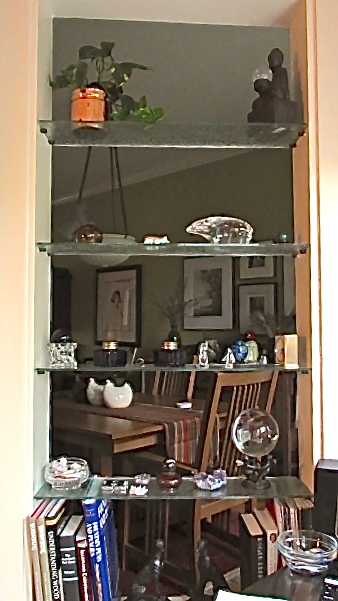
Well, after 12 years of living with an interior, vinyl-clad double-hung window which opens into the enclosed back porch, I had the idea to demo the window and modify the opening with antique glass and the velvety alabaster color of poplar into a double-sided book-case.

And I must say it turned out beautiful; but more — unique.

Sometimes, I’ve discovered, that people see the obvious as the only answer.  Obvious things tend to be common, expected things.

What if a window were a book-case or a picture frame or a Gemini Clock?

As a Playwright: Notes & Excerpt from “Afterward”

Initially my focus was poetry: Simile and Metaphor; juxtaposition; possessing the “ear” to hear.  That is, to identify words not only by their meaning, but also how they sound when blended with their kin folk in the paragraph.  Some call it style: I was taught that it was called my voice.

I attended the only university that accepted me.  Good fortune (cousins twice removed to Serendipity and Veracity (both of which I mention in a couple of different posts) eventually led me to the Chancellor’s office, Dr. Warren Carrier, a contemporary poet, and my mentor for three years.  Through Warren I met esteemed poets such as William Stafford, Richard Hugo, Madeline DeFrees and Robert Bly.  I asked Warren, upon completion of my first publishable poem, “Do I have my voice now?”  With a quiet chuckle he replied, “Voice?  You’ve just begun to whisper.”

When I tired of poetry’s whittling, I turned to a genre which permitted a certain degree of gluttony:  Playwriting.  Since then I’ve written over a dozen full-length plays.  The following excerpts come from my latest play, “Afterward.”

A little about “Afterward:” it’s based on the premise that everything happens because of something else. In this case Joe is uncertain whether he loves Rene enough in order to continue their relationship; and Jeffrey, having recently dissolved a male menage trois is seeking desperately for a new relationship. It’s a play of parallels: Joe’s uncertainty of his long term relationship and Jeffrey’s uncertainty of his freedom. Yet both men’s angst often cross paths when they articulate that what each of them has is indeed what the other is seeking. And therein lies the conflict. How does someone argue his point free of his own emotion; or rather, can someone advise a close friend to stay where they are if, indeed, that is where they wish to be? I haven’t been able to write its conclusion because I haven’t quite lived the conclusion. There are a few elements which I have yet to introduce: Joe’s testosterone therapy which has increased his sexuality, and in turn, has brought his desire for men to the forefront. How does he explain this uncovered desire to Rene who has known him only as heterosexual? One would think that it would be simple: tell her. But what if Joe has met someone with whom he wishes to bed? With low testosterone your sex drive decreases and, harshly put, Rene was enough for him. Now that the testosterone is normal his sexual appetite has increased unleashing desires which Joe is unused to communicating. And more recently my experience with depression will undoubtably wind its way into the action. Perhaps Joe is on the verge of collapse? And like me, the perfect storm is brewing. Perhaps I should re-title the play “Convergence”.

Aristotle, the father of drama wrote about three unities: Time, Place and Action. He argued that a well made play should embrace these three unities. Time means all action takes place in real time: If the action starts at 8:00 pm and the action lasts 90 minutes, then the play should end at 9:30 pm; Place means all action occurs at the same location; Action means all characters involved in the play are seen on-stage. I don’t need to tell you that abiding by these three unities is no easy task. Action is the easiest to draft; Place is a bit more difficult; but Time! That is by far the most difficult. No ones life is so dramatic that you’d want to watch it, non-stop for 90 minutes. Except some good porn, I suppose. So the inherent problem with “Afterward” is that it MUST be overwritten in order to edit down to 90 minutes of solid drama. The beauty of Aristotle’s unities is that the life of the play lies squarely in the hand of the playwright. It is my responsibility to build, breakdown, build, breakdown, build, crescendo and conclude the most horrific or funny 90 minutes of the characters life. Which again, is no small feat.

JOE

I love Rene. I really, truly do. I love being with her. Touching her. I enjoy her smell. I enjoy her taste. It just seems as though it’s all become expected. Like you expect the door to open when you turn the handle. Like you expect
the light to go on when you throw the switch. It’s all become. . .routine. It’s become a routine. Expected. Except she’s not expecting. Not much anymore. I try all the same old tricks: stroking the inside of her arms, the lingering,
trailing kiss down her neck, the old, common jokes; rubbing her feet, drawing her bath; meeting her for lunch; glasses of wine in the garden; jewelry. We sit and too much time passes between us, too much silence.

JEFF

Silence is comfortable.

JOE

Is that what life becomes? Silent and comfortable? Silent and comfortable aren’t passionate. I remember years ago. . .maybe not even that long ago. . .when fights flared up between us like brush fires. . .hot, screaming, saying things we’d regret. . .painful, hurtful things. . .emotional jabs and punches. . .and then we’d lock each other up like exhausted boxers and throw sexual upper-cuts that landed us both on the floor. . .and all there was was brutality. . .clothes became obstacles, then torn, ripped. . .and we were coupling like animals and the same jabs and punches were thrown lower, thighs pushed open, panting and sweating and screaming. . .until we. . .together. . .at the same time…like trapeze artists flying through the air reaching, grabbing, clutching. . .and freshly embarrassed laughter tripped from our mouths and we both felt madly, deliciously, one, even though by then we had disengaged and fell next to each other and quiet washed over us like a crisp cotton sheet. That quiet was different than this silence. That quiet was a respite, an earned pause. This silence is deafening. This silence is stifling, full of humidity. The silence I hear now is the result of twenty years of conversation. As though we’ve heard it all before. As though we’ve already read this page, this chapter, this novel. Almost as though, predictably, we know how this will end. How can we know the ending? How can a love affair like ours have a predictable denouement? How in the world did we get here? Here has always been where I’ve always wanted to go, but now that I’m there I keep wondering. . .

JEFF

Wondering what’s over there? I can tell you what’s over there. I’m over there. Over there is lonely. You try to shore up the desperation you feel by humping strangers. . .ten different men in a week. . .but there’s no union. There’s the gaze, the dance, the drinks, the touch and rub and grope and zip and grind and suck and come. And it’s all madly, deliciously sexual. But there’s no investment. There’s no pain. There’s longing, but not the longing for what once was. There’s no memory. There’s not even hope. It’s started and ended in ten brief minutes and you’re now more of a stranger than when you walked in the door of the bar because you gave something so familiar to someone so unfamiliar.

JOE

So what’s a guy to do? How come once we get to where we thought we wanted to go the place looks strikingly different than the brochure? Where’s everything we’ve always been dreaming about? Where’s the cottage and the lake and the loons and the pine trees and the two-person row boat and the big fluffy bed and the sunset? How come I don’t see that? Christ, I love Rene. And isn’t love enough?

JEFF

Maybe you’ve gone away. Have you thought about that? Maybe you’ve gone away. It doesn’t sound to me like Rene has gone anywhere. It sounds to me like you have. Have you? Have you, Joe? Have you gone away?

JOE

I don’t know. Maybe. Maybe I have. Maybe. Maybe I should just masturbate more. Maybe that’s what I should do. Masturbate more. And don’t dare reduce this to the whole mid-life crisis thing. I’m past the mid-life crisis thing. My mid-life crisis is parked in the garage: Midnight blue, six cylinder six-speed, satellite radio equipped convertible. It turns heads. I smile on its behalf. That’s done.