Has Been’s, Could’ve Been’s, Once Was’s, and Children

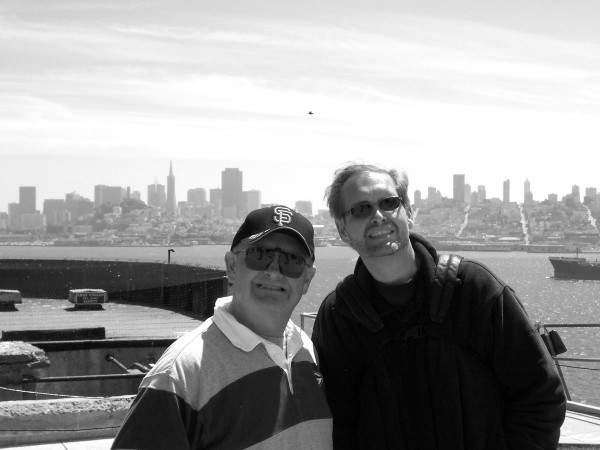
My brother got my dad’s physique; I got his mental illness.

Once I assumed the role of cook a couple of years ago, I planned my menu so that every other day I’d prepare a new meal.  The only cookbook I owned was a 1960’s copy of Betty Crocker’s Cookbook.  This cookbook was my mother’s, and if you saw it, you’d think Betty Crocker herself passed it along to my mother.  It was a solid first-step for me, my hesitation quieted by my mother’s obvious use of the cookbook, evidenced by the incredible number of batter-splattered pages; missing pages; half-pages; and an index at the rear which resembled the color palette of Crayola’s 64-Color box of crayons.  There were highlighted recipes; notations at the margins; and just a few, but oddly significant in an extreme way, an ad infinitum decree by way of thick, heavy lines, one or two eliminated altogether by a formidable, dense marker, applied as determined and repeated coats, forbidding any chance that these recipes might appear on our kitchen table.

My father was already a train wreck when my brain began recording his presence.  Failing at life (mainly due to his undiagnosed mental illness, bipolar), his appearance was infrequent: his social mask was one of humor: albeit acidic sarcasm and shearing, pointed wit composed in the key of tease and enacted before an unending column of untried yet promising second-shift ladies.  His role as a bullying, boorish big shot, whose sole domestic purpose was to reprise the 1963 verbal variety of water boarding. His peacocking drove us  closer and closer to suffocation, as though with each matinée he pressed another thick pillow of despair onto our faces and then, just when our desperation went quiet and we felt that first, foamy wave of disappearance, back we’d go into his second act and the shrill, ingenuous cackle of his subordinate’s callow laughter warned us that he was gaining adoration.  And the louder the laughter, the more lewd, raunchy, and viscous his anecdotes became, and our mention increased proportionally until, by the end, the three of us, his family, descended well past indecency, a good way beyond degenerate, and somewhere between contemptible and worthless.

And as the ladies stood and he, broadcasting his manners, helped them with their coats, those ladies whose saturating attention fueled my father’s mania sending him further and further afield, looked at the three of us, fodder of my father’s insanity, and delicately lifted the corners of their mouths in an effort to produce a symbol of empathy that my father couldn’t decode.

But what those lips produced was that sneer tossed at has been’s, could’ve beens, once was’s, and children who repeatedly witness their father falling apart.

The Run For President Is A Bully’s Pulpit

Me?  I deplore competition.  I have hated competition since I was very young because, I assert, I was a fat child (that was before it was sassy, vogue and fattering – my modern form of flattering, as in “are these jeans fattering?”) and competition was synonymous with failure and embarrassment and yet another reminder that I was one of the periphery boys.

Although I joined seasonal teams through high school, I was never competitive, i.e. an athletic threat, to any opponent.  I weathered all those losses because it was smarter to belong to and be a loser, than to be a loner and a loser.  Loner losers were to high school what a duck that clangs is to a shooting gallery: irresistable to insecure men that accumulate trophies as proof of their asserted dominion.

Haven’t we witnessed too many examples of the tragic consequences when potent, tightly-wound, explosive or obstinate pack leaders torment the dissimilar, solitary and contradictory by exhaustive humiliation, unyielding fear, and physical harassment to an exasperated degree of hatred and revenge expressed externally as murder or the lowest depths of hopelessness that the victim’s acrimony and contempt is so great and that their thirst for retribution will never be quenched, so they turn inward to find their self-inflicted exoneration and release from misery.  When did we, as a nation, agree that in order to succeed we’ve got to hit the disenfranchised with such a degree of “shock and awe” that they’ll eventually submit to extinction?  When did we, as a nation, adopt bullying as our de facto reaction to threats and danger?  It’s the exact moment that the practice of instilling fear into the minds of the voting public by egregious negative attack campaigning accusing the opposing party or candidate of misfortunes, errors in judgement, or personal infractions so dubious or diabolical, that if the opponent won the election America would resemble the wasteland once known as Cherynobl.

When bullying is permitted, incited, or rewarded as a rite of passage or a strategy in a competition, it reinforces a recent and troubling change in our idea of sportsmanship.  Competition used to be the identification of “winner” as one that was better at <whatever> than his/her opponent(s) and was able to prove his/her superiority by way of fair, impartial, and equal sportsmanship.  Competition has become the identification of “winner” as one that was better at pointing out weaknesses, instilling doubt through repetitive and escalating degrees of fear, taking advantage of the recent breakdown in civility and propriety by deliberate and calculated unearthing, followed by wanton pillaging and inference, leading up to the zenith: a quiet, little leak to cable news outlets which, within a few pre-dawn hours hits all the major wires and airs as the lead story on every morning news program and goes viral in time for most voters coffee break.

Teasing Isn’t Equal Parts Humor/Love: It’s the Bully’s Opening Act

During my previous career there were objects which I craved to such a degree that one might say I was obsessive about them.  In hindsight I understand that it wasn’t the item or its purpose as the correct tool for the task, it was the representation I craved.  By selecting this particular briefcase (never mind the cost) conjecture begins: The object goes first and followed by me. Those that scoffed were ignorant of classic style; those that recognized both the object and its “place on the style scale” applauded my devotion despite the price and subsequently elevated my degree of style from “studied” to “au courant.”

The most important opinion I sought was one I should never hear.  If heard, or worse, tipped-off to that opinion by another that my coveted object became a subject, it and its notoriety, no matter my admiration or its usefulness, or despite the degree of impudence of cheeky sales people aghast by my shameless reconsideration of the transaction and eagerness to “hand it over” (“it’s Bally, not a puppy for Christ’s sake!”), the object I taught myself to covet and which, to me, represented a piece of the Big League uniform, would be returned immediately via courier in order to derail further heckling.

Sacrificing the object was a lesser price to pay than to have it become the subject of insignificant but derisive chit-chat employed by uncomfortable executives to desperately pad the awkward silence that descends among supposedly well-mannered and well-groomed executives who have an adversarial relationship with their colleagues.  Better to criticize underlings than to have their own activities or choices be reduced to fodder  for teasing. This is the opportunity an executive bully (or cadre of bullies) can’t resist.

A significant part of my previous career demanded that I be available at all times to any partner or partner’s client.  And these partners were notorious for the outrageous stresses they placed upon their minions.  When asked why they managed their staff with such contempt, they’d answer, without pause, almost by rote, “it’s how I cut my teeth. . .” and the story would trail off point like a sleepy motorist struggling to remain alert, but who predictably drifts to the unpaved shoulder rattling the chassis, quickly over-correcting. . .and the partner, finally cognizant of his detour, arrived at the same conclusion as every partner when asked, “. . .and I’m a softy; when I was coming up the atmosphere around this place was brutal, toxic, practically inhumane; but I made it and so will others, those willing to do what it takes.”

And there lies the evolution of a corporate culture whose purpose is to bully staff, in order to strengthen devotion and eliminate chaff, until those few that accepted, expected, and survived the harshest, unyielding, and indulgent bullying by the partners, understood that success wasn’t measured solely on talent, or survival, but mostly on eliminating threats from within by systematically teasing, then embarrassing, and eventually bullying them out of the firm.

Since I spent the majority of my time in close proximity to the partners, I witnessed weekly smack-downs.  At first I was repulsed by the duplicity; then I wondered why I was witness; and as time went on I saw a pattern emerge: the harshest bullying happened to employees that caught the partners attention.  In order to avoid bullying, it was imperative that I disappear until summoned and I must never do, say, or have anything which might draw attention or raise a question.

At the time I thought my method of survival was very creative: appear only when summoned; deliver beyond their expectations; avoid pretentiousness or the appearance of any form of treatment reserved for them; and above all, never, never, ever give them the slightest reason or smallest idea that I think I’m one of them.  If my behavior ever stepped across these lines, alienation would be immediate swiftly followed by a quiet escort off the partner floor, a silent elevator ride to the lobby when at last my escort, a chief of something or other would inform me of my dismissal and remind me of my agreement of confidentiality.

My elimination would’ve been well-mannered, respectful, and final.  I would experience their finest bullying, reserved for those that commit any degree of suspected corporate treason.  I would be ignored, failure to exist or ever had existed, never mentioned or contacted; to them I was never there and therefore never saw or heard or read or witnessed anything.

A bully bullies people perceived as different; bullies are selective, unrelenting and unforgiving; bullies rarely forget and never forgive; but there is one caveat: almost all bullies are deathly afraid of exposure, the identification of their own perceived shortcomings (usually any degree off of normal).

Even these partners, leaders in world-class architecture, are hiding their fears (or weaknesses).  To be privy to them is an immensely heavy burden, not too mention loaded gun, both of which I never wanted and both of which I continue to carry.  My saving grace?  I never wanted to be one of them.  My job was to be there unconditionally, which I held as an honor and today is one of those things I have tried so hard to hide: the ugliness of working for professional bullies.