The Architect (3/10 – “The Other: A Collection of Doubt”)

“You’re my distraction,” Gabriel says while looking down at his tuna wrap and peeling back some of the thin paper wrapping.

“I don’t know what you mean,” Nathan says acting sheepishly and fidgeting slightly against the hard and poorly designed plastic chair.  The plastic curvature mocks the male form; he feels the alleged lumbar support bend; the spindly steel legs poke through the seat like an attention-seeking child asking impossible questions.

Gabriel leans in closer, touches Nathan’s shoulder with his own, feels the cushion of cashmere and wool, and turns to catch Nathan’s darting eyes, “It’s you I think about when I’m not thinking about anything else.  It’s you that I look forward to seeing in the elevator in the morning.  It’s you that makes me feel giddy.”

“But you’re married,” Nathan admits, taking a long swallow of his pop “shouldn’t you be thinking of her?”

Gabriel laughs slightly and leans in closer, more of each other touch like vertically stacked lumber.  Quietly, Gabriel confesses, “the moment I start thinking about you, I start thinking about her.  You’re in the foreground and she’s in the background.  You’re in sharp focus and she’s rather blurry.”

Nathan stirs his curried pilaf which steams in the thin Tupperware bowl.  He moves the pilaf around the bowl slowly.  He stares at his lunch for a moment then slowly looks up at Gabriel.  “I have a girlfriend.  I think about her.”

“I’d expect you to,” Gabriel says before taking a bite from his Caesar chicken wrap.  “Just because you and I are attracted to each other doesn’t cancel out anything that came before.  Those people, Adrienne for you and Emily for me don’t just go away.  Maybe they just get set aside for a time.   Do you think about Adrienne when you think about me?” Gabriel asks unsure of the answer, though willing to bet on the answer.

“No, not always: It’s not until after that Adrienne pops into my mind,” Nathan offers.

“After what?” Gabriel asks quietly.

Nathan shifts is his chair uncomfortably.  He sits back unexpectedly and then moves quickly forward. “Don’t make me say,” he pleads.

Gabriel takes a long drink from is Diet Coke and sits back in his chair, feeling the white neoprene give way under his weight.  He suddenly becomes aware of the location of his tie and straightens it.

“You do that a lot,” Nathan says looking at Gabriel, then looking down at his cooling lunch.

“Do what?” Gabriel asks watching Nathan.

“That thing with your tie: you’re very conscious of your tie,” Nathan says looking at Gabriel.

“I like things neat,” Gabriel counters, feeling strangely naked, and again adjusts his tie.

“See?” Nathan points out, laughing slightly. “Besides, this is hardly neat.”

“What?  What’s hardly neat?” Gabriel asks feeling suddenly vulnerable and off his game.

“This.  Us. . .I mean, you and me; maybe just me. . .Jesus, this is anything but neat!  This couldn’t be farther from “neat” than if I leapt across this table and kissed you!” Nathan says sounding exasperated.

“All this about my tie?  What’re you talking about?” Gabriel asks, certain where this conversation is going, and absolutely uncertain he wants to go there.

“Listen. . .I don’t know how we got from friends. . .to. . .wherever we are. . .” Nathan says quietly, “but it makes me. . .”

“You what?  What does it make you?  Am I making you anything?” Gabriel says leaning across the table.  “Let’s go. . .” Gabriel says pushing himself away from the table.

“Where?  Back to work?” Nathan asks.

“No.  Let’s go down for a walk.”

Nathan and Gabriel place their dishes on a conveyor belt and walk silently to the elevator.  They press the down button and wait impatiently for the elevator.  “What about my work?  Shouldn’t I call?” Nathan asks.

“You’re with me.  It’s no bother.  If anyone says anything, tell them to talk to me.  Don’t worry about it.” Gabriel says as the elevator doors open.  Gabriel steps inside, but Nathan hesitates.  “Are you coming?”

Gabriel knows that this is a defining moment.  If Nathan steps into the elevator Gabriel will see this as a sign of Nathan’s interest.  The elevator doors begin to close and Gabriel reaches for the “door open” but stops.  The doors continue to close, but Nathan sticks his hand between them.

“Jesus Christ. . .” Nathan says as he steps into the elevator car.

“I’m not forcing you, you know.  This is your choice.  All yours,” Gabriel says defiantly.

The elevator doors close and they look at each other for a moment, then slowly Nathan reaches out to press the lobby button.  Gabriel can’t take his eyes off Nathan standing at the far side of the car, nervously shoving his hands deep into the front pockets of his jeans masquerading any hint of interest.  Nathan turns to look at Gabriel standing at the far corner dressed smartly in a dark blue garbardine suit, crisp white shirt, subtle blue and white striped tie, polished shoes.  Gabriel places his hand into his jacket pocket when he feels himself moving, then abruptly stopping, pressed tightly against the mirrored walls of the elevator car by the dense weight of Nathan’s body.  He looks up moments before he feels the faintest touch of Nathan’s lips teasing, taunting, then finally meeting and opening his own lips, which had partially opened by his surprise.  Nathan presses himself against Gabriel and worms his hands under the tailored suit jacket, over the cotton shirt and up his back. Nathan breaks the kiss and pulls away from Gabriel as the car comes to a slow stop.  The doors open slowly as both of them step into the lobby of the building in complete silence.    Gabriel is at once self-conscious of his disheveled appearance as Nathan walks briskly ahead of him and into the bright mid-day sun.

“So, where are we going?” Nathan asks as soon as Gabriel walks through the revolving door.

“Give me a second to make a couple of calls,” Gabriel says as he walks past Nathan to the buildings overhang.  Nathan waits impatiently, pacing, wondering why in the fuck he did what he just did, but couldn’t, for the life of himself, take his eyes off Gabriel.  Gabriel dials a few numbers, speaks quickly and quietly, then places the Blackberry back into his breast pocket.  “Come on,” he says to Nathan, I know where we can go.”

Gabriel and Nathan walk down Monroe Street east until they reach the front door of the Burnham Hotel.

“You’re taking me to a hotel?” Nathan says, stopping dead in his tracks.

“I know the GM here.  He’s a good friend of mine.  We did the interior.  Yes, we’re going to a hotel, but we’re not just going to a hotel.  You’ll see,” Gabriel says, grabbing a hold of Nathan’s arm, “trust me.”
Nebraska

I know Nebraska.

It’s by Iowa, next

To it, beneath it, west,

To the left .  I know Iowa

There’s a river there, in Iowa

Where I crossed and

My foot tickled water

With a stream of red silk; I

Fell ill from there.

I’ve seen Nebraska.

From the sky, I think it was

Nebraska, or perhaps a quilt

Covering Nebraska, but it was golden,

Like your hair, as wavy, as thick

This grain atop earth.

Nebraska is not a place

I remember, not a place

From my childhood, I never

Summered there, it never

Appeared in an essay

About what I did or where

I had gone.

But now Nebraska stands

In front of me, bold, barefoot

A scarecrow perhaps amidst a field

Of green-to-yellow corn; Nebraska

Stands in front of me, fresh

Untilled, quiet

And yet quickly violent, tossing

Its earth high as a pin pokes

The plains.  Nebraska,

You are a song in reeds

Which line creek beds; Nebraska,

You are the stretch of dusk

On a flat, broad edge; Nebraska,

you are sleepy, cool nights.

By-(pass) & Bi-(polar)

Please note:  If you know of someone who has had gastric by-pass surgery and is having similar experiences as I’ve described, please share this post with them.  They can send a note to: questions@bypassandbipolar.info.

Fact:  We cannot predict the future.  Fact:  Life has no guarantees.  Fact:  New ideas can be both liberating and debilitating.  Fact:  Those offering a service resulting in permanent physical modification should fully understand the immediate impact as well as future consequences.

Myth:  The Medical Community at-large fully understands the alternative treatment options researched and developed by medical professionals specializing in gastric by-pass surgery due to the post-gastric by-pass patients insufficient absorption of oral medications.

It’s been ten years since I elected to undergo the radical Roux-en-Y gastric by-pass surgery and permanently remove most of my stomach and a length of my small intestine.  The alienation of these two components produces significant weight-loss because: 1) You can’t eat much; and, 2) You can’t absorb much.  Yes, there is a fair amount of adjustment, but the weight literally falls off and stays off with an average regain of ten percent.

Remnants of the “old you” are carted to resale shops or, in my case, high-end tent and boat sail manufacturers.  Everything is absolutely wonderful until you hit a bump in the road say, like a complete mental breakdown. Psychiatrist’s whip out the antipsychotics and antidepressants like they were six-shooters; their effects are hardly immediate; many take as long as six weeks to burrow into your blood stream; still crazy?  No problem, the psychiatrist’s reach for the tommy-gun and another six-weeks pass; nothing.  Up and up and up we go until finally the two of us are sitting in a missile silo and his finger hovers above the launch button.  Dabbing his ever-perspiring brow with a cotton kerchief he mutters repeatedly, “this is unnatural, this is unnatural. . .”

It is unnatural!  Post-gastric by-pass patients have been modified, re-engineered; fundamental human mechanics, basic organ responsibilities, broad physical and chemical hypothesis tested and tried and approved by the FDA have little (if any) effect; we’re the svelte yet queer abomination of opportunistic, profit seeking surgeons that prey on the desperate obese willing to do anything to permanently lose weight.  Malabsorption is the snake oil the surgeons are hawking.

If I sound particularly harsh toward the bariatric profession it’s because I firmly believe that they have abdicated a large chunk of their responsibility not only to their patients, but to their fellow medical colleagues as well.  In  the ten years since I had gastric by-pass surgery, I have learned from a very reputable source, a doctor of some notoriety in the field of obesity, that to his knowledge, no one is, nor anyone has bothered to explore and/or discover and educate the medical community as to an alternative method of transporting medications into the body when oral absorption is impossible or only 25% effective (as is my case).  Or perhaps they could propose a mathematical equation which other medical colleagues could use to increase a gastric by-pass patient’s daily dosing.

The only medication that provides any relief from my mental illness is dextroamphetamine salt prescribed in a volume that aroused the suspicion of local pharmacists who publicly (in the presence of their staff and other customers) strongly suggested that I was either A) An addict or B) A pusher, then flatly refused to honor my doctor’s authorized prescription.

I suffer from a mental illness that kills 40% of those diagnosed by suicide; the commonly practiced treatment of prescribing oral antipsychotics and/or antidepressants is impossible because I elected to undergo gastric by-pass surgery ten years ago; if I become one of those 40% because the doctor’s that promote, promise, and perform these procedures have abdicated their responsibility to provide an effective treatment alternative in ten years, do me a favor: file a class-action lawsuit against every last one of them for their gross negligence!

Was It Something I Said ?!?!?


Ever since I fled from the Windows world and into the effervescent and perpetually happy Apple universe, I’d been sitting at a desk thrown together in twenty minutes and composed mostly of scrap lumber (different colors), 4×4 for legs, and a fair number of exploratory holes, saw marks, spinning-drill-bit-skid marks, a couple of awkwardly placed and slightly askew keyboard and it’s baby sister, the touch pad.  All in all if you saw it you’d immediately ask me, “Who built it, the 3 Blind Mice?”

So after eighteen months of zooming around the internet on my sleek, gorgeous, fast, and sexy iMac which looked ridiculously out of place atop a “lean-to” or “slogbod” much like hanging your Chagall in the broom closet, we gathered our notes and set off for Ikea to buy a desk as sophisticated and natty as my iMac.  And what better place to look than Ikea where umlauts and chic Danish styling meet flat cardboard boxes and a picture-book as instructions.  It’s a maddening place, three oddly shaped floors keep inattentive browsers circling like planes above O’Hare during a blizzard.  The noise level rises with each entrance of a different language or dialect.  It’s the hunch punch of furniture stores!

Our excursion to the suburbs netted a sleek stainless steel desk and return, and a stout storage cabinet for office essentials which, unfortunately, never grew past page eight and was hastily disassembled and now waits in the back of the car like a repeat offender returned to jail.  The iMac went gaga the moment I placed its serpentine stand atop the stainless steel.  At the moment of contact I experienced goose bumps then heard Neil Armstrong’s voice from afar as he set foot. . .but the iMac’s new throne is less a desk and more a table, and the return is really a shelf, and it’s stainless steel veneer shrink-wrapped around a hollow-core interior: “All meat and no potatoes,” as my dad would say when characterizing anyone or anything that scores high marks in one area but falls woefully short in others.  My iMac’s stainless steel desk and return was more representation than substantial.

Today we decided to modify our chic and Danish modern representation of a stainless steel desk by adding a pinch of legitimacy: we installed a sleek, 5/8’s inch steel, pull-out keyboard tray. . .actually we only installed a representation of a keyboard tray.  As the drill bore into the fake under belly of the table it created an incredible vibration causing everything sitting on the desk top to bounce around like kids on a trampoline.  Including my iMac.  Which jumped around like a Walleye at the bottom of the boat.

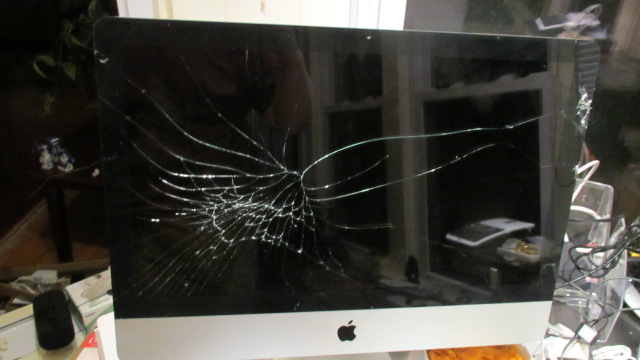
The next thing I knew I went left and the iMac went right as it ricocheted off my head and landed, screen-first on the thickened edge of the stainless steel veneer.  As I write this my head is pounding, my wallet is weeping, and my iMac screen resembles a spiders web.

I’m sure there’s a hidden message in this debacle: never mix chic and cheap? iMac’s are really iWant so iGet? Now I know: Make sure that the pedestal upon which you place the one you love is meat and potatoes!

On The Periphery (novel excerpt)


The school day at St. Joe’s started promptly at 7:30 am with a Latin low mass. We were ushered into the high-backed wooden pews and told to face the altar, to stop fidgeting, ignore a classmates whispers, to focus on Christ’s suffering for our sins and pray to God Almighty for trespassing. The nuns, clothed from head to toe in long black habits waddled up and down the aisles, on the look-out for any misdemeanor, and at the first sign of insurrection, would crush an entire pew of second graders to surprise the hoodlum from behind; her thick, strapping hand landing with phenomenal precision on the scruff of the heathen and plucked him from his spot like an ugly weed.  They all appeared to be well over the age of eighty and kept their hands tucked snuggly beneath wide, white sashes or knotted behind their backs.  Corporal punishment by way of rulers, canes, and paddles was customary even for the pettiest offenses like wetting your pants.  They enforced zero-tolerance of misbehavior almost daily.  It was rumored that they were part of a special Holy See order of nuns responsible for nurturing young and vulnerable catholic students:  Sisters of the Evil Stepmother.

I began St. Joe’s in the second grade.  The coagulation of cliques hadn’t yet occurred so a new kid didn’t draw suspicion and I was able to easily take my seat in the third row, behind Peggy, in front of Billy, and next to Jim.  But it began soon enough, the curdling, the formation of small clumps of friends; those that chased girls at recess; those that sat quietly against the fence; those that hoped and waited for an indication to advance, the willowy ones, still too shy to attract and too timid to pursue.  For the better part of the next five years I sat on the periphery, looking in at the popular, my nose flattened coldly against the window of their circle.  They were the small, the athletic and most importantly the obnoxious boys; the same boys that would terrorize the girls, but those same girls would wait, patiently, like the family dog for the briefest encounter after school.  I’d bet my mom was one of those girls when she was growing up.

That small, popular group of boys appeared to be completely satisfied; life occurred like a roaring adventure; the next day was another step towards their adulthood and independence. But for I and the other three boys on the periphery; Billy (who lacked personal hygiene); Gary (the nerd); Timmy (who had an affecting odor) observing the popular group, each day seemed to be just another  in a long line of days, some horrendously long life-sentence, perhaps passed on generation after generation.   It was a fact that a boy in the popular group was always the son of a popular father, a father that had a full-time job; a father that was a scout leader or athletic coach; a father that was found at home.  That was what the boys on the periphery envied, more than friendship, more than even membership, even more than the popular group leadership, was a home-focused father, a man that taught manliness.  For boys on the periphery it was an abysmal and persistent  absence, a longing to have that one guy to show you how and what and where and when, that guy and only that guy you could call dad; your dad to look up to, to count on, and whose discipline was fair and to the point and feared.  As I look back there was a void, a yearning that was never sated, a howling that never quieted, a wink never seen, a slap on the back that never stung.

The boys on the periphery seemed destined to spend their life in orbit, circling around others, singular, finding comfort in ourselves rather than as a pack.  However, when the popular group would turn their attention to something other than themselves it usually turned  to one of us; one of us on the periphery.   And when the popular boys would begin their attack we would scatter like a flock of pigeons, only turning back to see if we had been caught or remained free.  Unlike their pursuit of girls where each boy would target one girl like a pilot in a dogfight, one of the popular  boys would leave the pack like a scout, sniffing out the school yard for the oblivious periphery boy, and upon selecting his patsy, tempt his thirst for attention through false complements, and finally summon the rest of the pack.  In they’d come at full run to taunt, slap, tease, jeer, punch,  push, tickle . . . any action that would confuse the stooge, until the desired effect would come to pass, tears, stuttering, even urination.    It was in the grotesque embarrassment that the popular boys seemed to draw energy.  It was a hideous game and all the boys on the periphery knew that their time would come when a gangster with wandering eyes and too much time would turn, setting his sights.

I flew under the radar until the fifth grade when I learned that Jim (the boy that smiled when I first arrived in second grade) despised me from the start and his perfunctory “smile and nod,” as benign as it was, didn’t mean “welcome,” it meant “game on, big boy.”  Jim never missed an opportunity to exercise his animosity, a four-year commentary on my shortcomings, misgivings, and awkwardness.  His rancor finally turned the corner of hatred and hostility during a mid-morning lavatory-break: I was using a urinal during his standard, derisive monologue when he noticed the absence of his audience (bullying him is boring, the other boys thought) and that was it, his disgust had compounded daily and that day he decided to close his account.  I felt the hand on my shoulder grab tightly and pull me back, away from the privacy of the urinal; belt, snap, and zipper open, my fingers entwined in the fly of my brief’s, I stood there, the epicenter of mockery, ridicule, and indignity, my distress instantly appearing as damp and darkening spots on my trousers.  Initially there was raucous laughter (to which I’d become accustomed), but slowly, boy-by-boy, the lavatory grew quiet, pity replaced ridicule as boy after boy turned and walked out.  I stood there until Sister Reynolds threw open the door determined to discover delinquents but stopped immediately upon seeing me.  She closed the door quietly, walked to me, and placed her ample arm around my shoulders.  All I remember after that extraordinary display of compassion was letting four years of shame finally come out as sobs and weeping and finally dead silence as I finally understood that I would always remain outside the circle.