Hu-mil-i-a-tion, Noun, 2. To Produce Resignation or Shame to the Dignity of Another

Humiliation comes in many flavors: decline, disgrace, resignation, ridicule, shame, stigma, and upset.

HUMILIATION BY RESIGNATION AND SHAME

A bike to a 11-year old is like a compass to an explorer; it ensures progress, freedom, and discovery.

I was eleven or so and riding my Columbia 3-speed (I really wanted the cocoa brown 10-speed Schwinn but when my father asked without acolumbiabikelooking at me – (a seldom used, but spot-on tactic {for parents reading this, it’s found in appendix C entitled “How To Use Their Own Ignorance” page MCDL of the “Parental Handbook} letting the child see for him/her self that they don’t know why they need the thing they’re asking for) “What difference can seven more gears make?  How is ten gears easier to ride than three gears?  I, of course, didn’t know about torque and gear ratios so I settled for the defensive approach, which really set myself up by saying a parent’s favorite answer, “Because everyone’s riding them!  Who rides a lime green, lame 3-speed, Columbia bike?” And then, in true triumphant spirit (knowing he played this round perfectly) my father delivered the estocada with deft precision, “You do, my boy!  You do!”

ahillAnd so I did, and so I was the only kid puttering around our neighborhood with a 3-speed which was okay until I reached the piedmont of the Great Lapham Hill.  Three speeds were clearly insufficient to maintain both balance and momentum required to propel me to the Hill’s summit.  Any bicyclist knows you need at least five or better ten gears!  And so I tried pedaling my 3-speed Columbia up the 47 degree slope and then it began, the gear torque problem; the gears on a 3-speed couldn’t withstand the amount of torque my slow pedaling and they began to slip, which in turn caused my pedals to slip, which in turn interrupted my concentrated, all-out pumping.  When my pedaling failed to produce any forward movement, which caused a stall, followed by imbalance, and eventual failure expressed by my bike and I crashing onto the street and sliding downhill several feet.  Laying in the street against the curb I was utterly ashamed of my feeble attempt and was, at last, resigned to the truth that my father’s tyrannical reign was impossible to denounce.  I felt absolutely deflated and a prisoner of my father’s own mania expressed by indifference and cruelty.  I was forced to wiggle from beneath the damned 3-speed and push not adograceride my 3-speed bike up Great Lapham Hill cursing at my father, which intensified with each step, while dragging my boyhood pride behind me.  Suddenly, from behind like a leash of Greyhounds, my classmates rode Schwinn Varsity Double-Shifter 10-Speeds flew past me and quickly disappeared behind the crest of the summit.  And then he approached quietly in the 1965 Rambler Wagon, pulled up next to me, lowered the passenger window and began his litany of taunts using his professorial tone.  At which time I sensed a kind of heartburn, but deeper and with greater volume. I began to perspire, brow first, then neck and shoulders.  This isn’t going to end on a positive note, I told myself.  And when I couldn’t restrain it any longer, out it flew like a bird set free.  But it wasn’t lunch that exploded from my mouth but a raw, quick, and cheeky bombardment of varied and loud expletives and vocabulary usually reserved for drunken sailors on furlough.  I was still screaming when he slowly closed the passenger window, put the Rambler in gear, and floored the V-8 engine which bellowed the blue smoke of burning oil.

Why did I challenge Great Lapham Hill when I possessed three crippling debilities: Obesity, three speeds, and an overwhelming hatred for my perpetually condescending father who refused to buy me a 10-speed as an example of his dominion.  Not because he was a tightwad, not avarsitybecause he couldn’t afford it, but simply to crush whatever degree of animosity I may harbor against him.  Looking back, he baited me at the very start by taking me to the bike store; then he fed me frenzied hopefulness when he stood before the twin-shifting, steel-forged and welded frame, drop handlebars, and racing seat, all painted a beautiful metallic cocoa brown, and asked, “How about this one?”  That was the exact bike I dreamt of every night.  But as I moved closer to where he stood, his eye caught the glint of a lime green bike obscured by Varsity’s and Paramount’s.  Yelling across the store at the sales clerk he said, “We’ll take this one.”  “But what about this one?  The Varsity?  This is the one I want. . .”
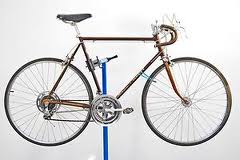
The sales clerk stood next to my father, paperwork in hand, when my father asked without looking at me – (a seldom used, but spot-on tactic {for parents reading this, it’s found in appendix C entitled “How To Use Their Own Ignorance” page MCDL of the “Parental Handbook} letting the child see for him/her self that they don’t know why they need the thing they’re asking for) “What difference can seven more gears make? Besides, if you can’t ride up Lapham Street on your very own 3-speed, why bother buying a bike?  Let’s get a baby carriage that you can push up the hill and have a tea party like a good little nancy.”


We Can’t, We Simply Can’t Forget Those Kids

It was similar to forcing yourself to perform a task you loathe and delay as long as possible.  But the timeliness of memory forced me to remain seated and prepare a list (found below) of the children and adults slain in Newtown.  But what caused unrelenting heartache was recognizing their ages, or, recognizing their lack of ages.  These students had barely rounded their first turn of life.  Life, as we all know much too well, is plump with memories, old jokes but new laughter, an eternity of firsts: love, kiss, bike, pirouetteagirldancing, strike out, airline, stitches, lipstick, heartbreak, failure, beer, hangover, diamond ring, varsity letter, loss, win, marriage, aweddingakisshouse, flat tire, hook line and sinker, kids, grand kids.  Yet these moments shaped us like a sculptor’s tools; these moments pop up like toast reminding us that life is really what we’ve learned by living.  Those children and adults abruptly had their lives erased like lessons on a chalkboard.

So I’m making a bold request of everyone that follows, reads, discovers, trips upon; all my social networks like Facebook, twitter, tumbler, stumble upon; bloggers, other bloggers and anyone else that has access to e-communication to perform the following:

Once a week write a post, tweet, tumble, message, or group email selecting one victim from the list, entitle the post, etc. something like “For Charlotte Bacon, Age 6, Newtown” and write one of your many life experiences as though you were saying it to Charlotte.  Then end it with “I promise to remember Charlotte, age 6, Newtown and what her life might’ve been.”

Because your magnanimity and writing and the far reaches of the internet together we can keep their memory alive.  To forget even one of these children is a profound example of selfishness.  Instead, we should add them to the list of precious things we hold closest to our heart.

SIX YEARS OLD

  1. Charlotte Bacon
  2. Olivia Engel
  3. Ana M. Marquez-Greene
  4. Dylan Hockley
  5. Madeleine F. Hsu
  6. Catherine V. Hubbard
  7. Jesse Lewis
  8. James Mattioli 
  9. Emilie Parker
  10. Jack Pinto
  11. Noah Pozner
  12. Caroline Previdi
  13. Jessica Rekos
  14. Avielle Richman
  15. Benjamin Wheeler
  16. Allison N. Wyatt

SEVEN YEARS OLD

  1. Josephine Gay
  2. Chase Kowalski
  3. Grace McDonnell

ADULTS

  1. Rachel Davino, age 19
  2. Victoria Soto, age 27
  3. Lauren Rousseau, age 30
  4. Dawn Hochsprung, age 47
  5. Anne Marie Murphy, age 52
  6. Mary Sherlach, age 56

Our Cultural Conflict: “I-centric” vs. “Us-centric”

I’m still crying.  Especially for the amount of preciously rare innocence lost that day.  I fear a crevasse of cruelty ripped open our discouraged plains of humanity and swallowed acres of hope, kindness, and gentility.  The displaced societysurvivors have been inoculated with indifference.  Recently, our society welcomed the technological efforts to promote the importance of the individual thereby neglecting the citizen’s toil required to maintain a individualcohesive and unified society abiding by civil law, ethics, and respectability.  This change strongly suggests a recent shift and an alarming unraveling of the knotted threads which bind us together as a cohesive society.  It  suggests that the aggressive “me-me-meism” trumpeting self-importance repudiates the codes of propriety and civil obedience.  It’s appearance is fueled by social networks promoting the innate yet invisible importance of the individual, and their  dull and oft mundane daily rituals as provocative, riveting, and jocular.  This “I-centric” movement supplants the laws of society with a horde of myopic pronouns (I, me) living in the surreal world developed by the late physicist Dr. Berners-Lee.  This environment is wholly the fabrication of a society of scientists working together while at the same time relying on fixed rules, regulations and laws.  The “I-centric” movement relies upon the ICQ protocol to herald their importance and distinguish themselves.

electricity2 That is, until the power goes out.


Finally Understanding Life As Mani A.

manny-young

I first met Mani A. a few months after my father died when I was fifteen.  He appeared from around a blind corner where Wong-Su restaurant and Teddy’s Tavern meet like a knife’s edge.  He was a restless, sinewy, no-nonsense blond wearing his older-brother’s-hand-me-downs.  I apologized and excused myself immediately, but he roared to life like a freshly started chainsaw and lunged at me with a ferocious diatribe about a blokes right-of-way and his unalienable rights, to which I chimed in, “But you are an alien!”  He paused, his idling mind wafting the blue smoke of burning oil, when suddenly he hit the throttle baring his teeth and chortled that he wasn’t a bloody martian, see, so piss off with the alien bullocks; crikey, he has the right to use public property as a thoroughfare without being gobsmacked by some daft wanker! until, I think, he heard himself running-on about some kind of whack job hyper-speech at which time he slowed, eventually landing softly on a patch of green peckhamengland-1grass.  I sat next to Mani A. who opened up like a teenagers compact, and divulged his personal life in Peckham, England (just outside of London), which, by the way he described it, was a tortuous place; a hometown without a home, a chilling place that nobody admitted coming from, everybody just shows up one day, street-smart and dodgy, showed up-growed up because nobody ever had a childhood.  You were either born a teen-ager or plain old smeg.  Nobody was ever just a kid; and nobody ever saw a kid.  We were around the same age and dreamt of similar things, but whereas I knew mine were silly fantasies, Mani A. was certain that whatever he wanted he could have.  No kidding.  Without the slightest doubt or reservation, whatever Mani A. wanted, Mani A. could get.  Period.  Mani A. had balls.  Whether Peckham beat them into him or he developed that confidence on his own, the strength of his conviction, no matter the degree of unlikelihood, you had to think, hey, it just might happen.  I’ve never met anyone in my entire life that expressed the depth of fortitude that Mani A. did.  I said my life must seem like a cartoon compared to yours: I was two-steps west of being white trash, and while our home lives seemed oddly similar, I never learned how to survive; I just wait.  For what, he asked leaning his elbow onto the grass.  For anything.  Anything besides this shit hole I can’t get myself out from.  At which Mani A. leapt to his feet, extended his hand and said, come on mate, I’ll show you the dog’s dinner that’ll make your life now look like a wee bit of the hard lines.  Your going to get a crash course in Peckham Survival Know-How.  First, you learn about being borne:  In Peckham you didn’t cut your teeth; you growled and snapped!  We learn to bite before there’s anything to bite.  Being ahead, that’s tickety-boo; getting ahead never happens, especially in Peckham.  And so started six months of juvenile delinquency including assault (knife-school-teacher), battery (brother), truancy, and one stern lecture from a juvenile judge away from living in a home for dangerous boys.

It wasn’t until Mani A. left town did I get my head screwed back on tight.  I toed the line, straightened out school, became popular, played sports each season, acted, sang, even led student government.  Counselor’s referred to me as the idyllic example of reform.  But in the back of my head I could still hear Mani and all the things he said and showed and prompted me to do.  Being “ways” by choice, not by reaction.  Mani didn’t show me how to live,chubbyseniorportrait Mani showed me how to survive.  Mani and I have maintained our friendship for over forty years.  One of the things I admired about Mani was his bond of friendship.  Or should I say degree of bond of friendship.  Whenever he helped take care of something cagey, I’d ask him why he’d get involved?  His answer has always been the same: friendship.  He said all other relationships have their own bloody baggage and demands and expectations, and ways to screw you in the end.  But friends are simply friends.  Easy, like looking in the mirror.  I see a wee bit of my bloody self in you.

Mani continued to visit at irregular intervals, all of which were concurrent with troubling, impossible, or unavoidable circumstances.  For example, he swung into town when my junior year in high school devolved into adolescent chaos: ducking senior hazing, sidestepping discussions highlighting my grim blue-collared, unionized, married and fatherly fate; derailing any parochial collision between varsity lettermen and my shadowy shine for Mitchell, an underclassman; and my obesity targeted by jeering and loathsome bullies.  He arrived shortly after Stokowski and I went to Union Drop Forge hoping to snag summer work which leads to full time after graduation.  Our bus drove through the “Blue Mile,” a one mile corridor of heavy, eye-reddening, cough-inducing, toxin-saturated manufacturing exhaust.  We nicknamed that part of oldermani2town the “Blue Mile” because of that solar eclipsing blue haze belched from fifty-foot smoke stacks every minute of every day.  I took my application home where it still remains blank.  I wanted my future to be unexpected.  To be a lifetime removed from the cadence of the dead-end-man: a union job, a wife, a stuffy upper flat, kids we can’t afford, dependence on two incomes, kids dumped with objecting in-laws, hate and regret pitched at the other, and some place my hope tumbled out of my greasy coveralls pocket while reaching for my lighter which I never missed until I reached for it, right after she left with the kids flanked by her objectionable parents.  That tableau was the only life option offered to kids like me.  It was expected, and you were expected to follow the guy ahead of you.  But I dreamt of the unexpected, the unpredictable chaos of life beyond the “Blue Mile.”  College required good grades, but demanded money.  The costs were way beyond my family’s reach; so far afield that going to college became a family gag.  And then, when my avenues and alleyways around the tuition hurdle went bust Mani stopped by on his way back to Peckham.  His first words were, You look like a sorry sod, chum!  causing me to expunge my year of hopelessness and depression.  He waited until I stopped crying before he said, Sometimes you’ve got to be bonkers, your mates marching to a paycheck will call you a mug, but remember life is horses for courses!  And you’ve got to be bold!  You’ve got to be; because being bold and senseless and relentless are the only way out.  Back in Peckham if you’re pegged a nesh or are sussed acting naff the rest of life in Peckham is going to be piss poor.  You and your chums go about blagging tough, and sometimes it goes fist-to-cuffs.  In Peckham it ain’t about violence because violence there is like your factory here.  In Peckham it’s about surviving life, about tomorrow.

In 2008 Mani broke all the rules.  Rather than subtle clues that he’s a stones throw away, he decided that my end game was near, so he ruptured my barrier of sanity, perforated my character, elbowed out reality, and declared chubyoldermaniautonomy.  Mani was finally emancipated; freed from the crushing compliance of decency and propriety, he ignored laws, took chilling risks, discovered a steady stream of opiates which he washed down with lethal liters of alcohol, ignored vows, ruined friendships, tossed out of jobs, denied benefits, and finally barricaded himself in the office of a psychiatrist who eventually evicted him, and reinstated my authority over the dominion of my life.
I’ve never faulted Mani for his insurgency.  He was simply providing the bravado to traverse the craggy cliffs of life, and of which I was ill-prepared to navigate.  But as Mani A. learned, freedom from consequence isn’t freedom at all.  It’s destruction, it’s disregard, it’s vengeful and dangerous and hateful and lethal   But Mani did have a knack for getting the job done which he introduced, tutored, and polished in me, providing the backbone for a career.  I think that’s how he survived: Mani and I got hired by gentlemen to take care of things quietly and cleanly.  Not that we ever broke the law, but we definitely broke the rules.  Mani recited many adages over the years, but the single-most poignant he shared with me was:  You can’t quit; every bloody cry-baby “says” they want “it,” but quit the second they’ve got to act like a chancer.  There are just two times you can quit: when you take the biscuit or hop the twig. 


Related articles

After 50 Years, I Can Speak My Father’s Language

I became Harold’s (my father’s name) youngest son when he was forty-nine years old.  Forty-nine today isn’t what it was in 1958, especially when you lived life full bore.  By the time I became conscious of his presence (three years old) he’d already begun his initial descent.  He had the looks of Walter Cronkite, the physique of Jackie Gleason, the temper of John McEnroe, the contempt for women of August Strindberg (Swedish Playwright and infamous misogynist 1849-1912), the alcoholism of Johnny Cash, and a creative and innovative mind in the areas of electrical and mechanical engineering.

There were just two of us (me and my older (2 years) brother.  That is, until 1972 (I was 14 years old), when the dirty laundry was aired: Our father had a previous marriage which produced two daughters and a son.  As I recall I was excited by the prospect (kind of like the “Brady Bunch“) and my brother was apprehensive and quite angry.  The confession of a first marriage only occurred because the eldest daughter had the strong desire to discover what happened to her “real daddy.”  The first wife’s precept that no one was to try to find their father until she had passed was strictly enforced and subsequently honored by all.  She passed in the early 70’s after which the eldest daughter’s search began.  As to why our mother or father kept this secret and never disclosed anything about it is anyone’s guess.

The marriage bond between my father and mother was broadsided by the wrecking ball in 1963 when the County Sheriff appeared at our front door to serve our dad his notice to vacate immediately which, we learned later, was a bitterly contested condition of their divorce. From that day on and until the day he died he expressed a cruel, ruthless and chronic acrimony and rancor toward our mother which he publicly and conspicuously displayed, especially when we visited on Sunday afternoons.  I don’t know if his brutish and vengeful behavior during our visits was aimed at my brother and I, or if he thought we’d run back to headquarters and repeat verbatim his vitriolic euphemisms such as “that god-damned pollock” (those were the only words he ever used to reference her).  I think his ruthless contention began after his first wife deserted him in the middle of the night with the children and his business partner and their business’s assets liquidated to cash.  The few things he treasured had fled in the night leaving him alone and penniless.

But he was not the victim; he was the perpetrator.

As I was to learn later in life, my father lived fast!  It took me a number of years before I could admit that my dad had already been someone else’s dad before he was mine.  What’s more, he was dad to three kids and husband to some lady some place and neighbors and club members and tavern buddies and business partners and customers all of whom I would never meet, but of whom meant very much or very little to him, and this whole other life never ever in a million years, not even for a split second ever imagined that somewhere some day in the universe there’d be Harold’s youngest child telling you their life story.  Well, until the age of fourteen I thought Harold being my dad was a one-act play; I was shocked to discover that there had been an earlier play, a one-man production entitled The First Dad is the Real Dad penned by his first family, which unbeknownst to me, devolved my one-act into a superfluous epilogue found in ancient Greek dramas.

Yet there were earlier chapters, when he was practically barbaric; young and handsome and strong and libertine.  Chapters in which he had pockets stuffed full of youthful immortality and adventurous hunger. Chapters which bore great resemblance to the stories of Hemingway or Faulkner or Steinbeck.  Chapters of male bonding and passage: acquiring the finesse of fly fishing; developing the patience of a deer hunter; learning how to set up camp.  Chapters about acquiring mechanical and electrical skills when combined with his creativity conjured up devices which awed his employers.  It’s these chapters that are out-of-print, those few siblings able to remember have long passed, names of friends or places or dates abandoned.  It would seem that my understanding of who and what my father really was would be conjecture, similar to explanations of figures in portraits painted by famous artists.

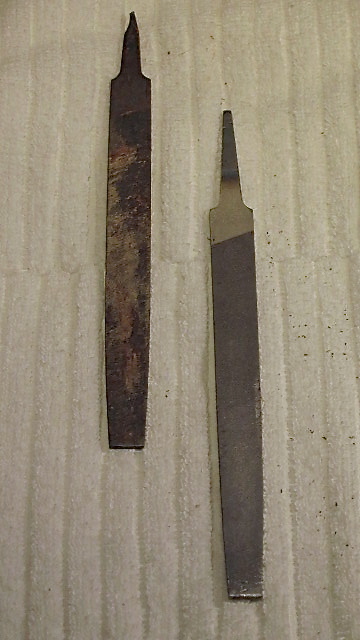
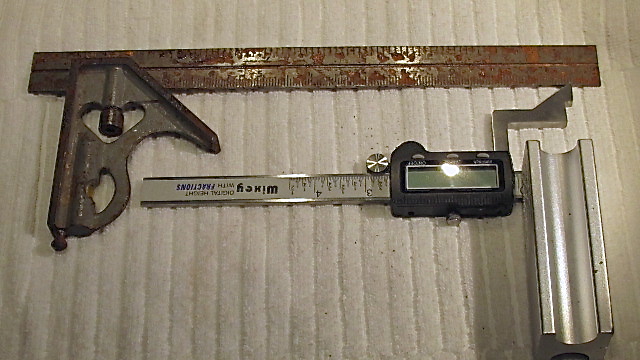
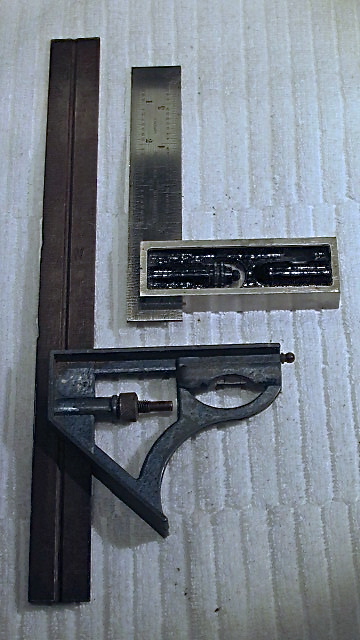
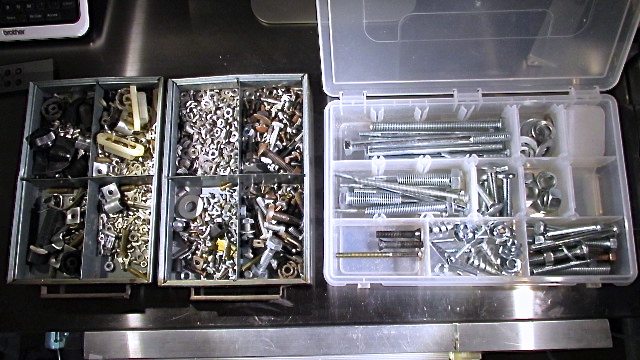
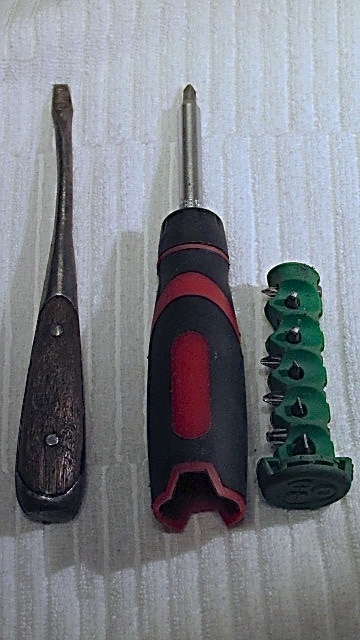
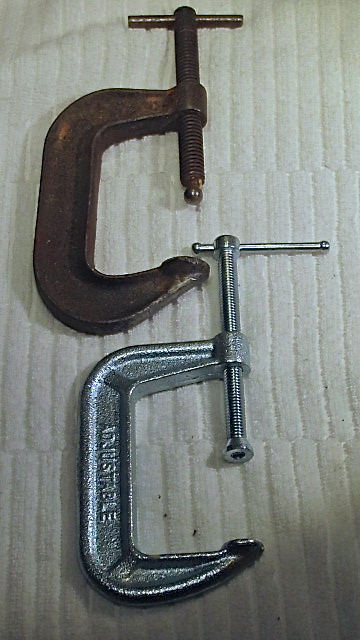
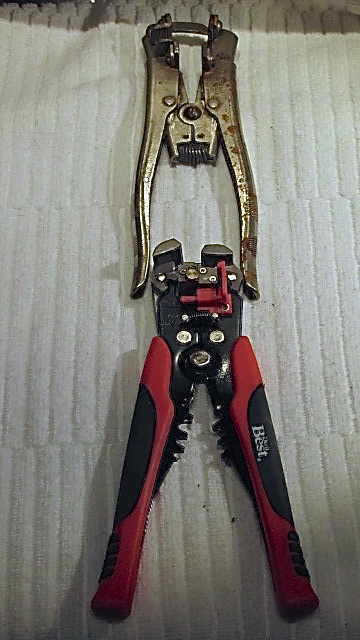
Except, there was one trail which we’d never bothered to follow: a couple of phenomenally heavy boxes which contained an enormous array of hand tools, parts, components, knobs, fuses, and rust.  These boxes had been buried in my brother’s basement for years, neither he nor I had any practical use for them.  In fact, they reminded both of us of particularly painful memories when both of us declined our dad’s invitation to study drafting in high school (and therefore follow his life’s path) and turned our attentions to the performing arts.  That was when I could feel my father’s pride drain from him as though he’d just been gutted.  But fifty years later, after I endured a break down and was determined to entertain my curiosities and creativity I spotted the art of wood working.  And I read a passage: “A Woodworker works wood with hand tools, he doesn’t machine wood with power tools.”  And so began my acquisition of various tools, all with specific purposes, and some which looked distantly familiar, as though I’d stumbled across them long ago but didn’t know what, if any, use they’d have.  What I didn’t understand then, I clearly understand now: Context was missing; meaning was missing; purpose and use and technique and discipline and understanding were all missing the first time, as an adolescent, I had found them.  But today, as I work wood with my hand tools I finally understand my father’s native language.  A language of tools and imagination and creativity.  A language of applied science.  A language which died the same day he did.

But it’s been rediscovered and is as important to me as the discovery of the Dead Sea Scrolls.  I finally understand the language he’d been speaking, how he saw his world, what he’d use to solve problems, and why he was so devastated when my brother and I impolitely snubbed his advice about drafting class and joined glee club instead.  And while I’m overjoyed to finally uncover a common thread uniting me to my dad, it’s also bittersweet: It’s a reminder that he’s gone and a wish that I’d give anything if he and I could, for just one day, sit together in my work space and “talk shop.”

The attached pictures show my dad’s tool at the top or the left and my tool underneath or to the right of his.