The (Un)expected Outcome(s)

Fear stops me like a two by four to the back of the head.  Real fear.  Not anxiety, not nervousness, not hesitation.  The kind of fear that rushes to a moment of quiet like children playing musical chairs.  Real Fear.  Life or Death Fear.  My fear has been the writers-block-in-residence for the past fourteen days.  My fear was a distraction; then my fear developed into an annoyance; then fear and I were bedfellows, fear being the last thing at night and first thing upon waking that knocked on my mind’s front door.  What is my fear?  I’m afraid I’m dying.

As you know, in November, 2008 I was classified as bipolar.  This determination included established and biased reasoning for my life on a seesaw: I was predisposed to life as a yo-yo by genetic roulette.  This milestone was marked by a simple psychiatric ah-ha.  Their specialty professes its ideological conjecture as formative and their ignorance evidenced by the devastating news that they can’t offer a cure, or even a likely protocol.  Instead they offer an indifferent forecast of pharmaceutical trials often resulting in failure and cautioned of a likely future weathering mania-driven misjudgments followed by the doomed deciension into a grey melancholia exacerbated by the digestion of manic destruction and attempted repair.  And then there’s that overcast statistic regarding effectual suicides: 40%.

Fear immediately hit the brakes and sent my entire life crashing headlong into the windshield. Fear sat immobilized by truths: I’ll only be free of madness if I’m one of four out of ten.  Fear’s rationale was logical and pragmatic; why endure decades of depression and delirium only to draw the same conclusion?  I’d decided to ignore Fear’s advice and try, one day at a time, to continue my membership in the sixty percent club.

But two months ago despite my determined effort to avoid that 40%, a wholly separate yet equally incurable physical condition reappeared. Its symptoms are aggravated and impairing; inexplicable weight gain (45 pounds in six weeks); undermining fatigue; breathlessness following exertion; intentional harboring of fluid forced from arteries and causes swelling and immobility.  But just like the Rambler my father owned in the early sixties, no one could determine the cause of the knocking.  That is, until the 1959 V-8 wagon blew a cylinder and sent my father’s first love to every car’s destiny: an auto scrap yard seen from the interstate.  Will my erosion be similar?  An unidentifiable murmur like a whispered yet repeated rumor one day erupts and immediately my initial litany of enigmatic symptoms is sensible, albeit much too late for prevention and most likely too late for intervention.

I’ve been blindsided by these illnesses and worse, hobbled by their improbable cures.  This simply was not my life’s expected outcome.  Or so I believed until very recently when I remembered what a mentor once suggested as a remedy to writer’s block:

“Writer’s block excuses lazy writers; Write about what’s preventing you from writing; Suddenly you’re mindlessly writing and only when you pause do you remember what was prohibiting your expression, but you can’t remember why.  When you can’t write, you must write.  The living face death every day — and then go about living!”

Dog Days of Summer

The eastern sky was more black than blue by the time I took Jenni for her last walk of the day.  There happened to be just enough wind to cause unzipped jackets to billow and flap like fitted sheets pinned to clothes lines.  As our days shorten I switch on the flashing red bicycle light which I’ve affixed to her collar alerting motorists and pedestrians alike that a very purposeful Wheaton Terrier was strutting like Travolta in “Saturday Night Fever” so make way!  I too, had a beacon; an LED flashlight was tethered to my cane, its purpose was purely selfish.  It bathed the path with a subtle pale blue glow providing me with some degree of vision when we passed beneath the thick canopies of mature trees which flank both sides of the road.

It’s very generous of Jenni, allowing me to tag along on her thrice daily adventures!  Apparently she discovers artifacts and remnants left behind by ancestors perhaps, or, most likely the Dabner’s dachshund’s deliberate defection of its defecation which made me wonder if there’s a big difference between what dog’s leave behind and what smoker’s leave behind.

Overall the evening’s constitutional was deemed a success!  Jenni met a few new behinds to the neighborhood.  I met their owners and we made small-talk while our pets introduced themselves.  When my mood is heavy the mere chime of Jenni’s dog tags are like herald trumpets announcing a great adventure is about to begin.  When I see her so happy about a walk, it’s actually infectious, and I too suddenly become part of her circumnavigation of our block just like Magellan.

Some people think dogs smile.  I think dogs live their lives anew each day.  I’d smile if every new day was, in fact, a new day.

Wouldn’t you? 

I Had a Car Like Me Once

QUESTION:
If you were a car, what kind of car would you be?

An old classic?
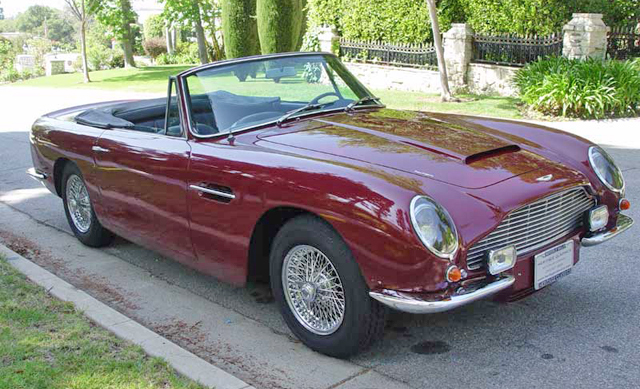
Something like the 1967 Aston Martin convertible?

Maybe the 1968 Mustang GT Fastback?

The car most resembling how I’ve been feeling recently happened to be our third car, the car like me.  We’d bought it used from some co-worker whose face (much less his name) has breached my mind’s curved horizon.  Used is a benevolent description: a couple of common idioms would aptly depict its constitution: . . .On its last legs or has one foot in the grave.  Desperation left little choice: I needed any car that worked to travel the 40 miles daily to a necessary yet useless and under paying job that freed me from beneath the spiked heel of a former employer who was a notoriously brutal, hateful, and infamously outspoken attorney that beguiled jurists to award her clients the largest financial settlements in state history.  Charm was never wasted on me, though.  Neither was persuasion.  She wasn’t the boss, she was the owner: I wasn’t her assistant, I was her indentured servant.  It was I who felt the eviscerating pressure from the pointy toe of her blah-blah collection of blah-blah-blah’s high-heeled shoe.  So I grabbed at the first job even though they’d lowball me and I’d need to buy any car.

The car, a foster child of sorts, had been purchased then passed on, then sold and sold and sold until the gravely agitated owner whispered the auto’s immediate availability for cash only.  And so I became the hastily orphaned auto’s benefactor.  Until that one day arrived (the last bead threaded onto the string), when, as no surprise, another function failed and the pertinent idioms came to mind like eerie messages in the Magic Eight Ball: Are you throwing good money after bad or Are you pouring money down the drain?  It all boiled down to a decision which I couldn’t face, so just like I did in the sixth grade when I was up to bat and had to face the gawky southpaw with a screaming heater which always caught the inside corner, or the lower back of a cowering batter, I fainted on my way to the plate.  I was removed from the game and poor Gerry Schmidt took a fastball in the kidneys. Procrastination is a conundrum best dealt with tomorrow.

But while I’m not a car, I’m spending more time in the shop and starting to string beads.  Unimaginable maladies have begun to appear (besides hum-drum mental illnesses): Edema of the lower extremities; rare forms of heart failure; pulmonary compromise; and rare to boot!  My conditions occur in less than one percent of patients!  Rare is a good thing, right?  Not in medicine.  Rare means few, few means no research, no research means no remedy.

I’ve been feeling lately like a mid-year 1983 Buick which runs, starts in the coldest Chicago winters, and does what a car should do.  Yet recently I’ve heard more pings, louder knocks, noticed oil spots on the garage floor, and the lighter no longer glows orange.  That’s why I’ve been posting less frequently: I’m fatigued, terribly sad witnessing this decline, and frightened.

But to end on a bright note, here’s the car I’d be: a 1965 Cadillac Eldorado! 


“Go Ahead,” they urged, “See If It Fits.”

According to results recently delivered to scientists at an annual meeting of the Categorize, Classify, and Typify Society that more than 92% of the American workforce can be identified as bearing the common traits associated with one of only two populations: unaffectedly round or affectedly round.  Of the 92% of American workers, 97.639% fall into the unaffectedly round while the remaining 2.361% not only self-identify with the characteristics associated with affectedly roundism, but maintain those characteristics no matter the consequence or makeover.  But the most surprising statistic was satisfaction: Nearly 100% of both populations felt little job satisfaction.  And as an addendum, most professionals believe that the hole which they currently occupy doesn’t accurately represent them,

It had been six months since the crash and like so many accidents turned a normal life into a new normal life; I’m not saying that the normal was better than the new normal; I’m simply using pre-crash as a point of reference of which to compare. My normal life had all the normal things: A life partner of 23 years named Nick, a beautiful Victorian home, a cute little MINI convertible, lovely gardens, custom clothing, Rolex watch, retirement accounts, money in the bank; all the trappings. But as the old adage goes “nothing in life is free” and I never knew the cost of having all the normal things until June 28, 2008 when I was not one of the normal things; as a matter of fact, I was one of those new normalists substituting for the normal team.

How many of us continue to force a round peg into a square hole only to find it frustrating, angering and eventually impossible? Some of us can manage to get a corner in, some of us trim the excess by dummying down or taking jobs beneath of us, some of us simply place the round peg atop of the square hole hoping one day one of them will change enough to fit.

On June 28, 2008 I finally realized that I would never fit into one of their holes. My roundness wouldn’t even fit into their round hole because much like metric versus english, a wrench which looks like a close fit isn’t a fit at all and simply won’t work.

Do I Look Like A Pigeon?

There’s a basic tenet of parental behavior to which many ascribe:  Whatever you don’t like, don’t understand, or frightens you about your child, you’ll try to ignore it, or threaten it, or eliminate it under the guise of childhood protection.

If you had known me as a child you would never describe me as: bashful, shy, inhibited, reserved, demure, or innocent.  Especially innocent!  I blame my lack of innocence on a creative incarceration complete with shackles, pillory, and thumbscrews (metaphorically speaking) as the adult-authority’s recommended protocol for youngsters that emigrate to the shores of their imaginations.  My crime?  Being entertained by my imagination’s liberty to dream of things or experiences which landed far beyond the limits of our lower-middle-class capabilities, and of which I insisted were possible despite our depressed economic status.  Not that I asked for things that we couldn’t afford.  I asked for things which required creativity or compromise or cunning.  I only asked for things which were possible but perplexing; things which, if I were taller or older or motorized I could procure.  But I was a short, plump, uncoordinated child that wrestled with an unbridled imagination and raw creativity which everyone described as teetering between adaptation (the positive, yet painful struggle of change: unyielding animosity between divorced parents, recent move to the south side) and abdication (an attempt to cope by disengaging himself from his misery by displacing reality with imagination).  I had just begun implementing a plan which might conquer both my hells (before/after move).  Using creativity and imagination I might be able to map my way free of their self-centered, ego-inflamed romantic ideals and out from under the shitty and selfish mess the adults-in-charge created, then forced down my gullet like corn down the throat of the holiday goose.

So authority figures convened to develop a strategy designed to lower the volume of my imagination and increase interest in my new-world order.  By discouraging escape and encouraging capitulation they hypothesized that I would slowly build a positive (and comfortable) reality without careening into fantasy, imagination, or creativity.  In other words, we’ve tested him and he ain’t no Einstein, scored dead-center 50th percentile, and, thank God, kind, dull, unambitious, and docile: he’s simply avoiding change by daydreaming.  So the adults broke their huddle and walked to the line of scrimmage; a defense full of adulthood, authority, corporal punishment, and varying degrees of coercion designed to obliterate the supply bridge between me and my creativity and imagination.  But I was on the offensive and understood that in a matter of seconds my pulverization would commence; I mustered some resistance, usually a subtle mockery of mumbled affirmations.

Their boundless resources, their freshly recruited therapists (secretly screened in the convent) hammered my resistance and during a nighttime raid caused a debilitating breach, a nightmare, which cast doubt on imaginations allegiance.  Creativity wasn’t strong enough to deflect their incessant whittling away at my corners, sanding down my resolve in order to spit me out at eighth grade graduation: a shining example of what to do with a square peg when the world offers only round holes.  The nuns, lay-people, and counselors believed that by distracting my distractions, by motivating and redirecting and sympathetic yet tyrannical concern and instruction, they could successfully extinguish what, at the time, was thought to be simple imagination.  And I would take my place among my fellow eighth grade graduates poised for the adventure of public middle-school, then high school, and finally be added to the third-shift at some manufacturing or assembly plant as one more blue-collar-assembly-line-lifer with low expectations and very little hope.  

Tragically, these nuns and educators were in pursuit of an example, a trophy, proof that plucking me from a sea of personal trauma and forcing me to face the reality to which I was born.

How nearsighted they were to think they eliminated my problem.  It was much worse than that.  They confirmed, even back then, that it was real and I wasn’t just imagining things.