Tomorrow, and Tomorrow, and Tomorrow. . .

“Seize the day, and put the least possible trust in tomorrow.”  – Horace

When the cease-fire had been successfully negotiated between my bombarded sanity and the merciless encroachment by mania across my poorly fortified borders, I had some time to exit the bunker of my psychiatrists office and assess the destruction caused by my determination to stave off lunacy.  The bipolar assault started with quiet discussions between my moral compass and my livelihood; I deplored my employment and the sanctions forced upon me; I despised their leadership; I spoke out against unfair wage practices.  But surrender wasn’t discussed as I was shouldering the burden of lifestyle and there was a tremendous expectation to avoid austerity measures at all costs.

“No one can confidently say that he will be living tomorrow.”  – Euripides

But as negotiations between sanity and lunacy stalled, my need for stability extinguished every extraneous characteristic strategically in order to sustain a devoted and appeased veneer.  My daily performances of a stable and sanguine employee collapsed the moment I closed my office door.  Obviously, I used to say to myself, you built your house on stilts on a steep slope overlooking a rain forest.  It’s already started to happen, the slipping, the subtle shifting of supports witnessed by numerous cracks, and one day the view will swallow your self-inflated invincibility.  I knew it was on the march, my insight gained by a nightly ritual of alcohol, opiates, and barbiturates; stilts if you will; I tried to shore them up by ingesting higher dosages knowing that an overdose was more likely than a possibility.  But then, at least, the conflict would end, not by a victor, but by a dual annihilation.

“You cannot escape the responsibility of tomorrow by evading it today.”  – Abraham Lincoln

It took less than a month before all negotiations broke down; compromise was impossible; mania demanded that sanity unconditionally surrender immediately.  If sanity stonewalled mania would easily breach the helpless border of sanity and annihilate any vestige of reality.  Mania would speedily dispatch all disenfranchised defiance and finally overthrow sanity’s ruling party.  The occupation by an uncontrolled mania took its toll; defy authority; recent stronghold of relationships humiliated then abandoned in an irreconcilable ruin; mania marched through memory, abducting the defenseless past and drained its meaning as a form of promiscuous entertainment.  Mania’s presence transfigured my identity into a mutation; my anatomy remained intact; it was my mental state which sustained permanent damage.

“The crisis of yesterday is the joke of tomorrow.”  – H.G. Wells

Eventually mania’s corruption, lawlessness, and influential overlords devolved into civil war, fracturing mania’s resistance to the significant bombardment of sanity’s allies.  Continued sorties by way of medications, therapy, and education combined with mania’s faltering infrastructure caused their retreat.  Sanity returned and started the intense clean-up, but some things were destroyed beyond repair; some relationships were so disfigured that it was impossible to identify the missing parties; the financial sector had been sacked, sucked bone dry, leaving sanity buried under a mountain of unsecured debt which was nearly impossible to pay.  But the most significant consequence of mania’s occupation was the destruction of sanity’s history; it’s legends, it’s memories, it’s priceless, irreplaceable moments of time’s memory known as the past.  And tomorrow simply vanished along with hope, their whereabouts unknown, disassociated fragments remain, but I’ve decided that tomorrow and hope were victims of mania’s collateral damage.

“What is not started today is never finished tomorrow.”  – Goethe

It’s been four years since the siege.  I’m hardly the vibrant, entertaining, and social personality I was before the conflict.  I’m anxious at the slightest hint of crowds; I can’t tolerate aggression or hurtful behaviors (from people, dogs, television) and must remove myself immediately; my pharmaceutical therapy is a misnomer and leaves me as focused as a puppy on his first day of obedience training.  And I’ve had to forget that today will become yesterday because for me there is no yesterday; in an abstract sense, yes, I understand that there is yesterday but it and most of what it contained is lost to me.  So I practice forgetting that yesterday holds any value.  And tomorrow?  For me there is no tomorrow.  Again in an abstract sense, yes, I understand, but now I’m driven to finish everything today because I can’t think about tomorrow.

Living in the present is a spiritual lesson and if practiced can lead to enlightenment.  But that only applies to those fortunate enough to enjoy the freedom of choice.

My living in the present is just one more day absent of the bookends of time. Every day is always today.

“Tomorrow is always fresh with no mistakes in it.”  – Lucy Maud Montgomery


After 50 Years, I Can Speak My Father’s Language

I became Harold’s (my father’s name) youngest son when he was forty-nine years old.  Forty-nine today isn’t what it was in 1958, especially when you lived life full bore.  By the time I became conscious of his presence (three years old) he’d already begun his initial descent.  He had the looks of Walter Cronkite, the physique of Jackie Gleason, the temper of John McEnroe, the contempt for women of August Strindberg (Swedish Playwright and infamous misogynist 1849-1912), the alcoholism of Johnny Cash, and a creative and innovative mind in the areas of electrical and mechanical engineering.

There were just two of us (me and my older (2 years) brother.  That is, until 1972 (I was 14 years old), when the dirty laundry was aired: Our father had a previous marriage which produced two daughters and a son.  As I recall I was excited by the prospect (kind of like the “Brady Bunch“) and my brother was apprehensive and quite angry.  The confession of a first marriage only occurred because the eldest daughter had the strong desire to discover what happened to her “real daddy.”  The first wife’s precept that no one was to try to find their father until she had passed was strictly enforced and subsequently honored by all.  She passed in the early 70’s after which the eldest daughter’s search began.  As to why our mother or father kept this secret and never disclosed anything about it is anyone’s guess.

The marriage bond between my father and mother was broadsided by the wrecking ball in 1963 when the County Sheriff appeared at our front door to serve our dad his notice to vacate immediately which, we learned later, was a bitterly contested condition of their divorce. From that day on and until the day he died he expressed a cruel, ruthless and chronic acrimony and rancor toward our mother which he publicly and conspicuously displayed, especially when we visited on Sunday afternoons.  I don’t know if his brutish and vengeful behavior during our visits was aimed at my brother and I, or if he thought we’d run back to headquarters and repeat verbatim his vitriolic euphemisms such as “that god-damned pollock” (those were the only words he ever used to reference her).  I think his ruthless contention began after his first wife deserted him in the middle of the night with the children and his business partner and their business’s assets liquidated to cash.  The few things he treasured had fled in the night leaving him alone and penniless.

But he was not the victim; he was the perpetrator.

As I was to learn later in life, my father lived fast!  It took me a number of years before I could admit that my dad had already been someone else’s dad before he was mine.  What’s more, he was dad to three kids and husband to some lady some place and neighbors and club members and tavern buddies and business partners and customers all of whom I would never meet, but of whom meant very much or very little to him, and this whole other life never ever in a million years, not even for a split second ever imagined that somewhere some day in the universe there’d be Harold’s youngest child telling you their life story.  Well, until the age of fourteen I thought Harold being my dad was a one-act play; I was shocked to discover that there had been an earlier play, a one-man production entitled The First Dad is the Real Dad penned by his first family, which unbeknownst to me, devolved my one-act into a superfluous epilogue found in ancient Greek dramas.

Yet there were earlier chapters, when he was practically barbaric; young and handsome and strong and libertine.  Chapters in which he had pockets stuffed full of youthful immortality and adventurous hunger. Chapters which bore great resemblance to the stories of Hemingway or Faulkner or Steinbeck.  Chapters of male bonding and passage: acquiring the finesse of fly fishing; developing the patience of a deer hunter; learning how to set up camp.  Chapters about acquiring mechanical and electrical skills when combined with his creativity conjured up devices which awed his employers.  It’s these chapters that are out-of-print, those few siblings able to remember have long passed, names of friends or places or dates abandoned.  It would seem that my understanding of who and what my father really was would be conjecture, similar to explanations of figures in portraits painted by famous artists.

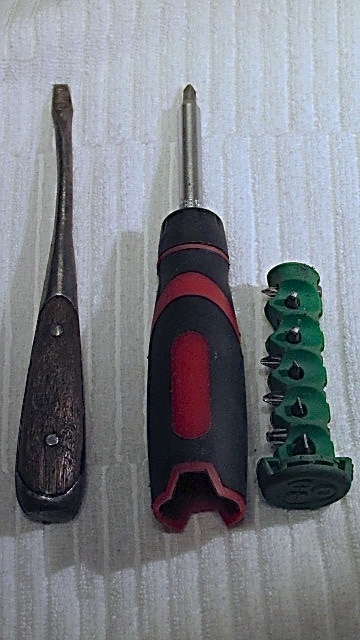
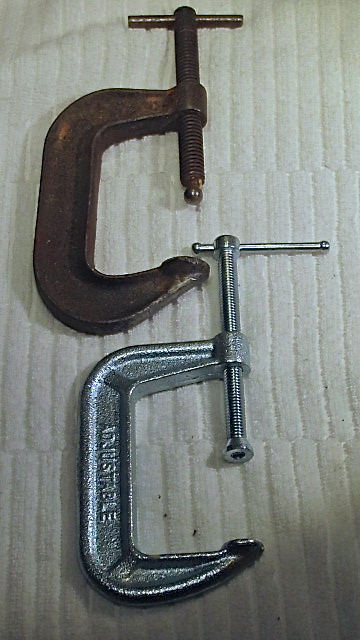
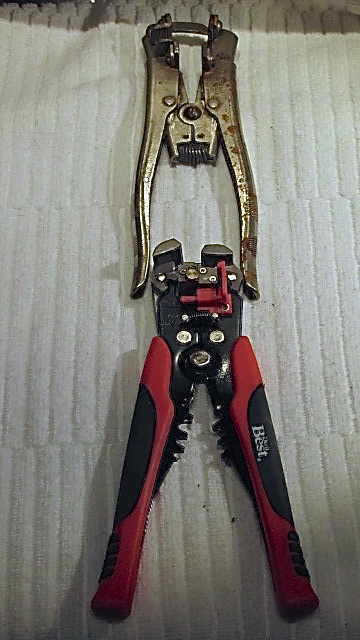
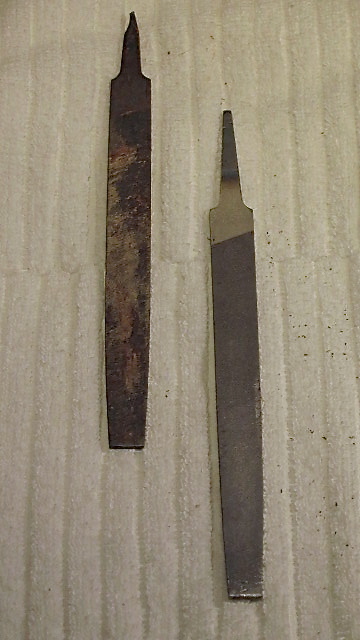
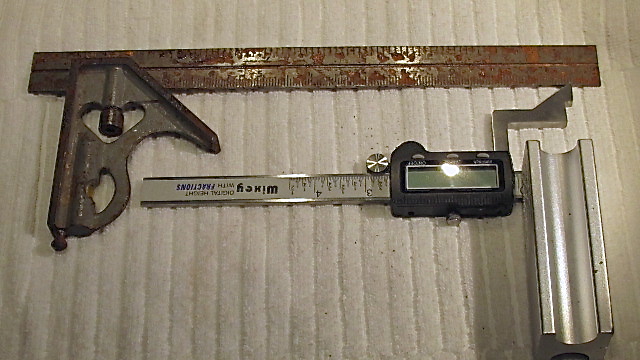
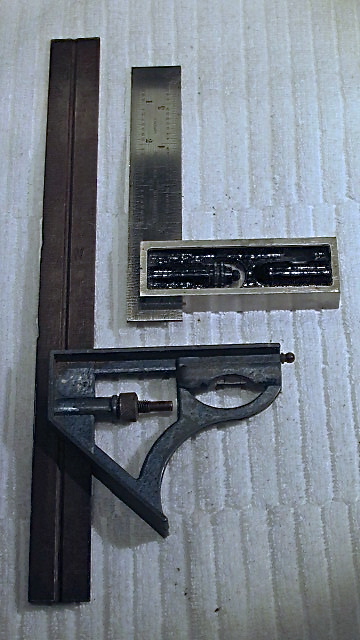
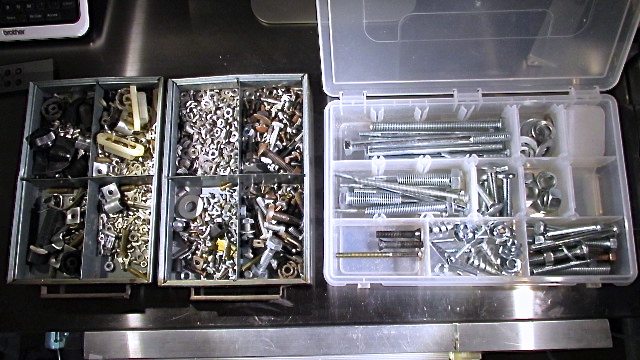
Except, there was one trail which we’d never bothered to follow: a couple of phenomenally heavy boxes which contained an enormous array of hand tools, parts, components, knobs, fuses, and rust.  These boxes had been buried in my brother’s basement for years, neither he nor I had any practical use for them.  In fact, they reminded both of us of particularly painful memories when both of us declined our dad’s invitation to study drafting in high school (and therefore follow his life’s path) and turned our attentions to the performing arts.  That was when I could feel my father’s pride drain from him as though he’d just been gutted.  But fifty years later, after I endured a break down and was determined to entertain my curiosities and creativity I spotted the art of wood working.  And I read a passage: “A Woodworker works wood with hand tools, he doesn’t machine wood with power tools.”  And so began my acquisition of various tools, all with specific purposes, and some which looked distantly familiar, as though I’d stumbled across them long ago but didn’t know what, if any, use they’d have.  What I didn’t understand then, I clearly understand now: Context was missing; meaning was missing; purpose and use and technique and discipline and understanding were all missing the first time, as an adolescent, I had found them.  But today, as I work wood with my hand tools I finally understand my father’s native language.  A language of tools and imagination and creativity.  A language of applied science.  A language which died the same day he did.

But it’s been rediscovered and is as important to me as the discovery of the Dead Sea Scrolls.  I finally understand the language he’d been speaking, how he saw his world, what he’d use to solve problems, and why he was so devastated when my brother and I impolitely snubbed his advice about drafting class and joined glee club instead.  And while I’m overjoyed to finally uncover a common thread uniting me to my dad, it’s also bittersweet: It’s a reminder that he’s gone and a wish that I’d give anything if he and I could, for just one day, sit together in my work space and “talk shop.”

The attached pictures show my dad’s tool at the top or the left and my tool underneath or to the right of his.

The (Un)expected Outcome(s)

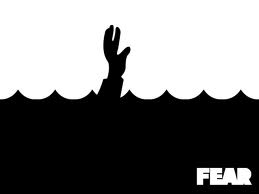
Fear stops me like a two by four to the back of the head.  Real fear.  Not anxiety, not nervousness, not hesitation.  The kind of fear that rushes to a moment of quiet like children playing musical chairs.  Real Fear.  Life or Death Fear.  My fear has been the writers-block-in-residence for the past fourteen days.  My fear was a distraction; then my fear developed into an annoyance; then fear and I were bedfellows, fear being the last thing at night and first thing upon waking that knocked on my mind’s front door.  What is my fear?  I’m afraid I’m dying.

As you know, in November, 2008 I was classified as bipolar.  This determination included established and biased reasoning for my life on a seesaw: I was predisposed to life as a yo-yo by genetic roulette.  This milestone was marked by a simple psychiatric ah-ha.  Their specialty professes its ideological conjecture as formative and their ignorance evidenced by the devastating news that they can’t offer a cure, or even a likely protocol.  Instead they offer an indifferent forecast of pharmaceutical trials often resulting in failure and cautioned of a likely future weathering mania-driven misjudgments followed by the doomed deciension into a grey melancholia exacerbated by the digestion of manic destruction and attempted repair.  And then there’s that overcast statistic regarding effectual suicides: 40%.

Fear immediately hit the brakes and sent my entire life crashing headlong into the windshield. Fear sat immobilized by truths: I’ll only be free of madness if I’m one of four out of ten.  Fear’s rationale was logical and pragmatic; why endure decades of depression and delirium only to draw the same conclusion?  I’d decided to ignore Fear’s advice and try, one day at a time, to continue my membership in the sixty percent club.

But two months ago despite my determined effort to avoid that 40%, a wholly separate yet equally incurable physical condition reappeared. Its symptoms are aggravated and impairing; inexplicable weight gain (45 pounds in six weeks); undermining fatigue; breathlessness following exertion; intentional harboring of fluid forced from arteries and causes swelling and immobility.  But just like the Rambler my father owned in the early sixties, no one could determine the cause of the knocking.  That is, until the 1959 V-8 wagon blew a cylinder and sent my father’s first love to every car’s destiny: an auto scrap yard seen from the interstate.  Will my erosion be similar?  An unidentifiable murmur like a whispered yet repeated rumor one day erupts and immediately my initial litany of enigmatic symptoms is sensible, albeit much too late for prevention and most likely too late for intervention.

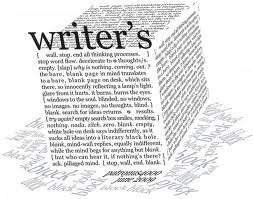
I’ve been blindsided by these illnesses and worse, hobbled by their improbable cures.  This simply was not my life’s expected outcome.  Or so I believed until very recently when I remembered what a mentor once suggested as a remedy to writer’s block:

“Writer’s block excuses lazy writers; Write about what’s preventing you from writing; Suddenly you’re mindlessly writing and only when you pause do you remember what was prohibiting your expression, but you can’t remember why.  When you can’t write, you must write.  The living face death every day — and then go about living!”

The American Lexicon Is Fundamentally Evolutionary

We make all kinds of decisions every day.  I’d assert that a tenet of life is decision.

Decisions are based on a fundamental understanding of options.  These options are often presented through language.  Our language has mirrored our intellectual expansion during the past twenty years (since the commercialization of the internet), but it’s also exponentially increased the likelihood of poor decisions versus good decisions.  And not for the reason you’re probably thinking about right now.

It’s not that our decision-making ability has declined, it’s that our American English lexicon has been stripped of standards and replaced by Idiolects which are varieties of a specific language unique to an individual. In other words, how an individual (all individuals) use parts of speech specific to the language they’re speaking.  Huh?  Are you suggesting that we’re using vocabulary generally accepted but individually defined?

Yes, for example: I’ve had a great evening; would you like to come up for a night cap?  Twenty years ago you had a pretty good idea that the night cap meant some form of refreshment and m-a-y-b-e. . .But today a night cap most likely is prone to interpretation, and depending on the interpreter, the night cap might be the evening’s last tango which spins and dips and clutches its way to dawn, or the night cap might be the gut-wrenching sound of starboard iron scraping along larboard iron in a dense fog on a moonless night in the frigid north sea.  Both invitations were accepted but only one, the former, seemed to coalesce.  The latter was respectfully disharmonious and most likely eliminated any tandem future.  Okay, so what?  What’s this got to do with me?

We’re all assuming that what we say and what they hear are synonymous.  But in this day and age of individuality, identity, and me-me-meism which is reinforced constantly through internet-based social networks and the hardboiled, pragmatic, and mundane personal updates which someone somewhere will proclaim as unique (dismissing our language’s standard usages) and applaud their meism misuse (interpretation) of vocabulary, and whammo!  A word or phrase which held a generalized meaning now has a bastard son.  This phenomenon is known as Language Evolution Based on the Idiolectic Intersection of Individual Adoption.

So what’ve you been blathering on about?

Simply put: What you know you’re saying (standardized use) is being heard as something different (Idiolectic use).  Perhaps if communication was bipartisan (the talkers and listeners understand that their communication is reshaping the English lexicon) then we might lessen misunderstandings and agree to use a mutually standardized language in order to foster a sense of unity.

Posting Sans "Going Postal"

Dear Meta:

Just a brief post via email sending my sincerest appreciation for your recent comment on my blog re: the feature story about me and my living with bipolar II disorder showing up in the on-line version of the Melbourne (Australia) newspaper! Since it’s been two weeks since its initial publishing in the Sunday Chicago Tribune (September 8, 2012), I can only surmise that the story made its way to Australia by way of Cape Hope, South Africa aboard a determined, yet slow freighter bound for New Zealand. Odd, how the most notorious scandals spread across the internet like licentious brush fires, but a story about mental illness, its anonymity, and far-reach takes weeks to reach across the globe.

Please check out her blog: “Buried Words and Bushwa” at http://www.picsandstuff.wordpress.com.

Cheers,

T.M. Mulligan
Author & Blogger
(773) 922-6499 (U.S. Residence)
t.m.@tmmulligan.com (U.S. Email)
t.m.@tmmulligan.co.uk (U.K. Email)

BLOGS:
http://www.becomingnotbecame.org (Mature)
http://www.humphreytales.com (Youngsters)