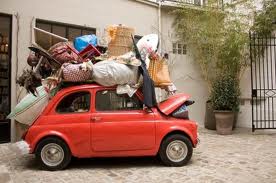
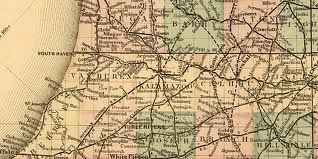
 Last weekend we packed practically half of our possessions (well, it sure felt that way) and went out-of-town for a two-day furlough from life’s daily grind. We travelled south from Chicago and around the tail end of Lake Michigan to the eastern shore and small, polka-dot-like towns of Southwest Michigan known as Harbor Country. These bucolic villages sprung to life during the mid-eighteen hundreds as either orchard or timber towns. After Chicago (due west across Lake Michigan) was destroyed by fire, it was petitioning timber companies from Wisconsin, Indiana, and Michigan to deliver as much timber as fast as they could to rebuild Chicago. A number of towns from this region answered the call.
(On a side note: Much of what is today Chicago’s Grant Park (to the south of our world-class Millennium Park (completed 4 years late (2004) and (hoo-boy) $325 million over-budget)) is built on debris from the fire. Local officials opted to dump the relatively small amount of rubble into convenient Lake Michigan).
Southwestern Michigan saw Stevensville and Benton Harbor being settled as orchard towns and still retain prominence for their peaches, blueberries, and wine-grapes; Union Pier and Three Oaks hit their stride as major  logging centers for Chicago’s restoration. However, once the forests were dismembered Union Pier relied on a small but consistent tourist industry for Chicago residents while Three Oaks turned to agriculture (mainly fruit orchards). Other small whistle-stops took hold along miles of unobstructed beaches and sand dunes as summer retreats. Union Pier was affectionately known as the Catskills of the Midwest and, like many of its nearby towns enjoyed an annual easterly migration of Chicagoans desperately seeking the serenity of rural retreats less than ninety minutes from the city.
That is until the 1950’s when tourism began to wane as Chicagoans discovered their northerly neighbor, Wisconsin was flecked by inland lakes upon which one could raise simple three-season cottages, retirement  retreats, even mansions. And a mere seven-hour drive from Chicago is Wisconsin’s famous peninsula known as Door County. Comprised of small towns and hamlets dotting both the eastern shore abutting Lake Michigan and the western shore adjoining Green Bay, it compares easily to Delaware’s Rehoboth Beach, Boston’s Martha’s Vineyard, and New York’s Fire Island.
For thirty years visual artists slowly discovered Southwestern Michigan’s slow pace, abundant properties, and speedy access to Chicago. Over the years the area has become an established center of professional artists and independently owned road-side galleries offering a variegated degree of original art. But then, in the mid-eighties, gentrification began its blight on these drowsy little towns as over-stressed and over-worked professionals sought a destination closer to home than Wisconsin’s offerings; a location with an aging and troubled economy; a place where you could buy a house, some land, and a night sky chock-full of stars for a fraction of what you’d pay in Illinois or Wisconsin. And what made these Harbor Country towns so appealing? Poor economic conditions: They looked and felt pretty much the way they did in the fifties when they’d been abandoned by Chicagoans the first time.
And so they came, prosperous couples with new families gobbled up properties like Romans marching across Europe. The lakefront corridor was by far most desirable, especially the west (lake) side where modest stone bungalows with beach rights might fetch as much as seven figures. The march continued both north toward Benton Harbor and west, leap-frogging the Red Arrow Highway, and slowing its pace at the eastern most fringe of Three Oaks. By 2000 the narrow lanes, over-built lots, and idyllic, provincial, and simple character of these sleepy hometowns were scuttled by the import of urbanized behaviors and expectations. Rather than fleeing the unyielding stress of city life for a long-weekend of birdsong, hammock-naps, and tall tales around a blazing fire, these transplants smuggled stress, brash voices, and booming stereos across state lines, and piled their city lives one-on-top-the-other, until their retreat disappeared, and their urban maladies doubled because now, not only were they experiencing the exact situations from which they fled, they were stuck in a tiny, Hicksville town, that oh m’god! couldn’t draw a shot of espresso, much less support a Starbuck’s!
Except for Frank’s. Our longtime friend found a small, modest home built of cinder block overlooking a field of corn and backed-up against a steep ravine hidden by a dense thicket and impassable brambles. It had  been home to a family of four until the kids left and, luckily for Frank, so did the parents. The small and unassuming house and garage was overcast by Hemlock and Juniper pines which splayed out in all directions like the bloom of a peacock’s tail. Frank has an uncanny creative quirk: he can look at a common object and by deconstructing it in his mind, he imagines its parts which he then assembles into a completely new object. In this bashful home which dutifully sheltered a self-effacing and
  respectable generation Frank saw a discreet refuge, and a distanced and disconnected property a few inland miles due west of the shore communities whose infrastructure narrowly supports the torrent of weekenders and the subsequent bottlenecks (roads, shops, restaurants). Frank prudently purchased the property and created a master plan which included landscaping: pruning the pines, planting native fruit trees, installing a 2,500 gallon koi pond and waterfall, indigenous gardens, fire pit, and outdoor sculpture; upgrading the utilities in the house; and the most innovative change: repurposing the two-car garage into a modern three-bedroom guest house complete with a full kitchen, fireplace, vaulted ceilings and scores of windows which flood the rooms with sunlight and the achievement of privacy, serenity, and timelessness; the very qualities desperately sought by other Chicagoans who impulsively bought homes in
  the favored townships on the popular lanes only to discover that their little resort town had overdeveloped into the Lilliputian version of Chicago.
Sans, oh m’god! A half-caf double-foam skinny extra hot latte with three pumps of caramel! Which, by-the-way, Frank concocts (simply espresso, sugar cube, and twist of lemon) using an original, aluminum-bodied, Bialetti stove-top espresso maker.
That Frank, he’s simply an innovator and an inspiration to everyone who’s ever really gotten out of the city and into the real Harbor Country, his retreat in the middle of nowhere, which is precisely where we urbanites yearn to be.
Thanks, Frank.
0.000000
0.000000
 Over the course of my lifetime I’ve learned a thing or two about loving men.
 someone is stoking the fire. What happens before the brush fire is struck by the tortuous lightening of longing? And what happens after? I think that sensuality precedes sexuality and intimacy outlasts it. I especially love loving men when their desire has cooled and what remains are the warm, calm embers of strong hands entwined around the others’s like a fleshy creeping ivy. The dampness of eyebrows which now produce the small dots of gooseflesh which erupt on the naked torsos which peek from beneath the coiled sheets. I love the whispers which quietly replace the gnawing and growling of congenital passion.
 dreadfully antagonistic and well-rehearsed sequence of deplorable behavior: Vanish, spot, affirm, invite, tempt, yield, pity, agony, masquerade, endure, discredit, and pluck. And each incarnation ripped yet another piece of moral character from me until sometime in the early nineties I concluded that we were no more to each other than a dealer and an addict, and he was always, always willing to deal, not out of compassion for me, but to satisfy some dark hunger, a craving, maybe a need.
 other. I finding love and partnership and success in Chicago. He and his art landed in New York. It wasn’t his drawings they placed atop acrylic pedestals. For dollar bills he ignored their probing fingers; for five’s he forgot their foraging. We never discussed the activities associated with higher denominations but he emphasized they were few and far between (“even for someone that looks like me!”), a thinly veiled plea for adoration of which I ignored and which subsequently produced a stifling silence as though the bridge between us had been washed away by indifference.
 hands down the most lucrative (and dangerous). His last trip to Chicago was a bona fide performance, secretly cast by the Chicago Vice Squad who raided the place and arrested the lot and charged them with indecency (the cheek dividing string of his g-string was 0.25″ too narrow to entirely cover his anus). I was called and took clothes and cash and bailed him out of jail. As the sun started to peek above Lake Michigan we were driving north on Lake Shore Drive when he said, “You know, I think it’s time to hang up the g-string.”