PLEASE NOTE: BnB has 190 posts. I doubt you’re going to rummage around in the basement of my blog, so I’ve decided to bring a handful of posts forward and mention why these are some of my favorites. Like: My Penned Invention of the Pen Invention (because I had fun writing it); or, The Start starring Wile E. Coyote (because this was my first post and of which has received 138 comments); or this one I Reckon, It Was My Reckoning (an early attempt to illustrate a dire consequence when you barter your character for wealth, fame, power and career). I hope you enjoy it and, as always, I invite you to leave comments.
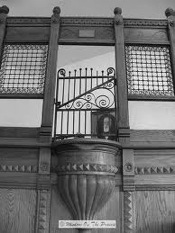
It was now, right now, right now as you read this, exactly four years ago, that I stood in front of an old, caged teller’s window and watched The Principle Clerk place the Scales of Character atop an antiquated green-marbled counter. His craggy index finger moved slowly down a ledger, then stopped; picking up the ledger he walked to the back where small drawers were stacked thirty feet high. Looking near the bottom he opened a drawer, plucked out a box, then returned it, plucked another, returned it, and after five attempts in four different drawers he removed a box, closed the drawer, snapped shut the ledger and returned to the front.
“That drawer was really packed,” I said to relieve my tension.
“That drawer is all you,” he said, “You in different lives; there’s quite a bit of you; more is better than less; you didn’t squander character; admirable.” From the
From the box, he lifted a small parcel and placed it on the counter beneath his barred window. Looking at me above his spectacles he said, “You’ve got to open it and verify that everything’s there; that there’s nothing missing, and that it meets with your satisfaction; once you’re finished, close it, tie the string, and then pass it back to me under the barred window.” Then leaning in, within whispering distance, he looked left and then right to check if anyone was within earshot and whispered, “Almost everyone expects more; don’t be surprised; a bit is withdrawn each time you barter truth to self,” then he turned and went about his busy work.
Hands shaking, I untied the bow, peeled back the paper and gazed upon five brilliant, transparent, and twinkling jewels. Immediately I felt absorbed or better, renewed; I felt capricious and peculiar; I looked eagerly for paper and pencil so I could describe it; I felt shy and naked; every ploy and deceit and means were displayed. I folded the paper atop the jewels, tied a knot in the string and called for the clerk. “Everything in order, sir?” he asked.
“I assume so,” I replied absolutely uncertain as to the truth of my answer.
“Excellent,” he said, “Now, let’s take a look at where you stand,” as he carried my box back to the Scales of Character.
“On the left,” he started to explain, “we place your parcel, that is, what remains of your character,” he says as he delicately places my parcel on the brass tray. “On the right,” he continued, “we place the whole of your Lifetimes represented by these incremental weights. The target for which we aim is that the left side, You, outweighs the right side, Lifetime. The objective is that one’s Character can outlast one’s Existence.”
“And what does it mean if the right outweighs the left?” I asked hesitantly.
“Many things,” he said after taking a deep breath, “and one which you must choose. But before we talk about that, let’s see where you stand,” has said quietly, turning back to the scale. I tried to peer through the closeness of the bars of his window and watched as he carefully selected the right-side weights and placed them delicately in the elevated tray. With each weights placement, he paused momentarily, allowing the scale to stop moving before he proceeded. When he placed the second to last weight on the tray the right side sunk significantly but remained higher than the left. “Not too bad, not too bad at all,” he said over his shoulder, “that weight is what does so many, so so many people in.”
“One weight left. . .” my comment exposing my nervousness.
“Yes,” the Clerk said, “but it represents the last decade,” he said as he placed it on the scale causing the left side to rise above the lowered right side.
“Out of balance,” I mumbled, defeated.
Turning, he walked to the counter and studied me before speaking. In a voice resembling that of my conscience, he began to explain, “There are people that stand where you’re standing and their left side hit bottom long before I stacked the weight. They knew what it meant before I started my explanation. And for those people, there are no options: There’s just one thing to do. But it’s not the thing that’s hard to believe, it’s knowing that they won’t know when. That by overdrawing their Character account they lost the privilege of forethought. Now they spend their time oblivious to all the choices of life, they’re left behind; indecisiveness caused missed chances, lost opportunities, and the upstarts, the less deserving were handed promotions. And they continued to fall further and further down their chosen ladder. And on his way down all of the trappings associated with bartered success fell too like leaves or thin branches: their wives and children and grandchildren. Here we call that damnation.” He checked his watch and placed a sign directing people to other windows, walked back to a coat tree, grabbed his hat and coat and stood next to me.
“You stopped by at a good time. You didn’t wait thinking the ship would right itself. You abandoned the inclination to compromise. Compromise depletes Character quicker than any other life choice; compromise also happens to be the easiest and most benign. And yet Character is the most coveted virtue by people besieged by empty character overdrafts and find themselves pleading for, but being denied protection. This persona non grata will happily promise anyone anything to convince the unwitting to give it up; let it go; who cares; nobody will see and who cares if they do; everyone else does it; it’s just for a while; come on we’re friends. And before the new initiates know it, their high-rolling days are over; they’re marginalized; they’re alone at any bar on any street and in that part of town; no wingmen; no gaggles and gaggles of girls gathering and giggling; no brunette with Azurite eyes. Those seeking devotees have already begun to feel that Life is no longer a Miracle but a rubric to be endured for all time. Not celebrated or explored or shared or even predicted. The damned chides those with Character but those with Character cannot hear their heckles. You see, it’s not that those with Character won’t listen. They have listened. It’s the damned that didn’t listen and sadly they’ll be the only ones that will listen.
“But here’s what’s going to happen to you: You saw that you’re a wee bit short on Character to last your Lifetime. Maybe you traded it, sold it, or gave it away. So you’re going off-line for a few years; to recharge; to reenergize; to rediscover curiosity and creativity; to stop, take root, sprout and expand; to see not simply look; to listen and understand not just hear and obey; to get back to the business of your life; to be you to the end. Expect people to identify you as crazy, loony, out-of-your-head and off your noggin, a victim of mental illness; they may even identify you as a kind of nut case; a specific type of lunatic; because, they’ll say, if Crayola can have five different reds and blues and greens, then why can’t the mentally ill be as colorful! Let it be, let it wash ashore like the tide; you’ll survive. That pinch of Character you might need to navigate life will be available and parsed out. Now, once that door opens and you cross that threshold your entire life will fall apart. You won’t know why you won’t remember here or me. That is until one day some years from now when it’s time for your turn at the window you’ll recall a sort of Déjà vu clerking behind the window. And being one of Generous Character you may even tell this story using your own voice which mysteriously fell silent twenty years ago just like mine did twenty years ago. And maybe the middle-aged man standing in front of your window will have more Character than Life remaining. And then both of you can walk out that door over there.”
“What’s it say?” I asked, careening my neck in order to see.
“There’s no need knowing now,” he said as one strong hand went to my back and the other hand to the lock. “Besides,” he said turning the knob, “Time just eats you up,” as he nudged me, waited, then with considerably more strength he nudged me again with more purpose, and then he barked loudly and snarled like a teased-to-mean junkyard dog waving that craggy finger at me, “Now, get out!” he snarled, “Twenty more years until I can go through that door marked “To Trains.” Then with great conviction, he pushed me into the street followed by doors slamming and deadbolts being thrown. When I turned back I saw an empty, fenced-in lot among pitiless faces deep within a strange city when my eyes shot open early this morning.
0.000000
0.000000
 Recently I’ve been intrigued with the ideas of creativity and greatness. What most of us think of as creativity is limited to the arts like writing, painting, dancing, acting, and sculpting. What people don’t consider is athletics. But think of the greats like Michael Jordan, Johnny Orr, Alex Rodriguez, Mario Andretti, Richard Petty, Joe Montana, Brett Favre, Jean-Claude Killy, Apollo Ono, Evgeni Plushenko, and Michelle Kwan.
 he’d practised hundreds of times before; creating the hole requires a pulling guard to double team the defensive tackle and the center to move the nose guard to the right causing a gap in the defensive line and subsequent hole; theoretically, in the gap normally covered by the middle linebacker reading a run, but who now reads a pass from the secondary, yelling “pass pass!” The safety bumps and runs with the wide receivers as the tight end drops back to move the defensive right tackle to protect the quarterbacks blind side, while the fullback picks up a nimble cornerback blitzing wide, but the fullback buries him in the backfield; the the handoff finally happens just as the hole appears like an apparition in a dense fog; a hole, first imagined by a coach on a sheet of paper, placed in a playbook as “off-tackle left on two”; practised hundreds of times but
 never recognized by the RB; but now, the hole has opened and he’s about to step through the paradigm and into a new future; what’s on the other side of the hole, what does the future hold; this is creativity at its rawest form; this is the result of imagination and practice; it’s a coach’s hypotheses, an offensive lines determination, and an RB’s commitment to his future; yet, he hesitates until he hears his conscience telling to run through the hole; then he runs headlong through the gap while realizing that the
 hole isn’t the future, it’s simply a doorway, his future lies on the other side of the threshold.
 imperceptible henna to tangerine to apricot. They knew it was coming, this night.
 Tonight I’m staring right into an abyss whose depth is wholly uncertain.




 prom date, recipient of the first kiss, Girl Scout, Teddy Roosevelt (yes, really), Girl Scout Leader, Sinéad O’Conner, full back, Metta World Peace ,
 offensive line coach, movie star, Burgess Meredith, Opera Star, Ronald Braunstein, famous orchestra conductor, infamous commuter train conductor or any one of the other 25% of our world’s population. How about the other 75% of the world’s population loosen the reins of their prejudice.

